








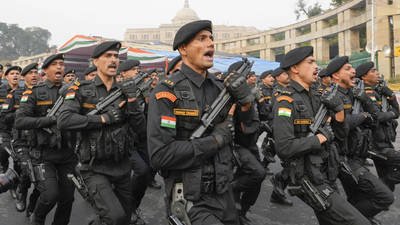
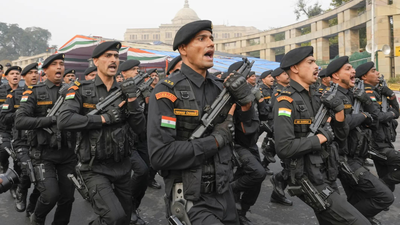
NEW DELHI: The Union ministry of home affairs on Monday released India’s first comprehensive anti-terror policy, naming it “PRAHAAR”, and flagged threats ranging from cross-border terrorism and cyber-attacks to the misuse of drones and emerging technologies.The policy emphasizes that apart from terror sponsored from across the border, “criminal hackers and nation states continue to target India through cyber-attacks.” It notes that India faces terrorist threats across water, land and air, and states that capacities have been developed to secure critical sectors of the economy, including power, railways, aviation, ports, defence, space and atomic energy, against state and non-state actors. The strategy document, uploaded on the MHA’s website, states that “India does not link terrorism to any specific religion, ethnicity, nationality or civilisation.” It adds that the country has long been affected by “sponsored terrorism” from across the border, with “Jihadi terror outfits as well as their frontal organisations” continuing to plan and execute attacks.The policy names global terror groups such as Al-Qaeda and Islamic State of Iraq and Syria (ISIS), stating that they have sought to incite violence in India through sleeper cells, while violent extremists operating from foreign countries have hatched conspiracies to promote terrorism.It further highlights the use of advanced technologies by handlers across the border, including drones, particularly in Punjab and Jammu and Kashmir. Terror groups are increasingly engaging organised criminal networks for logistics and recruitment, the policy says.On the digital front, the document points to the use of social media platforms, instant messaging applications, encryption tools, the dark web and crypto wallets for propaganda, funding and operational guidance, enabling anonymous activity.“Disrupting/Intercepting terrorist efforts to access and use CBRNED (Chemical, Biological, Radiological, Nuclear, Explosive, Digital) material remains a challenge for Counter Terrorism (CT) agencies. The threat of state and non-state actors misusing drones and robotics for lethal purposes remains another area of concern,” the policy states.As part of its roadmap, the MHA has suggested associating legal experts at every stage of investigation, from the registration of FIRs to prosecution, to strengthen cases against perpetrators.The policy emphasises that national measures must be complemented by international and regional cooperation to address transnational terrorism. It also notes that foreign-based groups increasingly rely on local infrastructure, logistics and terrain knowledge to carry out attacks.On radicalisation, the MHA said terror groups continue attempts to recruit Indian youth. Once identified, such individuals undergo a graded police response, and “Legal action is initiated against the individual based on their level of radicalisation.”The policy also underlines the role of community and religious leaders, stating that moderate preachers and NGOs are engaged to spread awareness about the consequences of radicalisation and extremist violence. It also calls for constructive youth engagement and steps within prisons to prevent radicalisation of vulnerable inmates, alongside de-radicalisation programmes.The document positions PRAHAAR as a framework to address evolving security threats through coordinated legal, technological and community-based responses.