








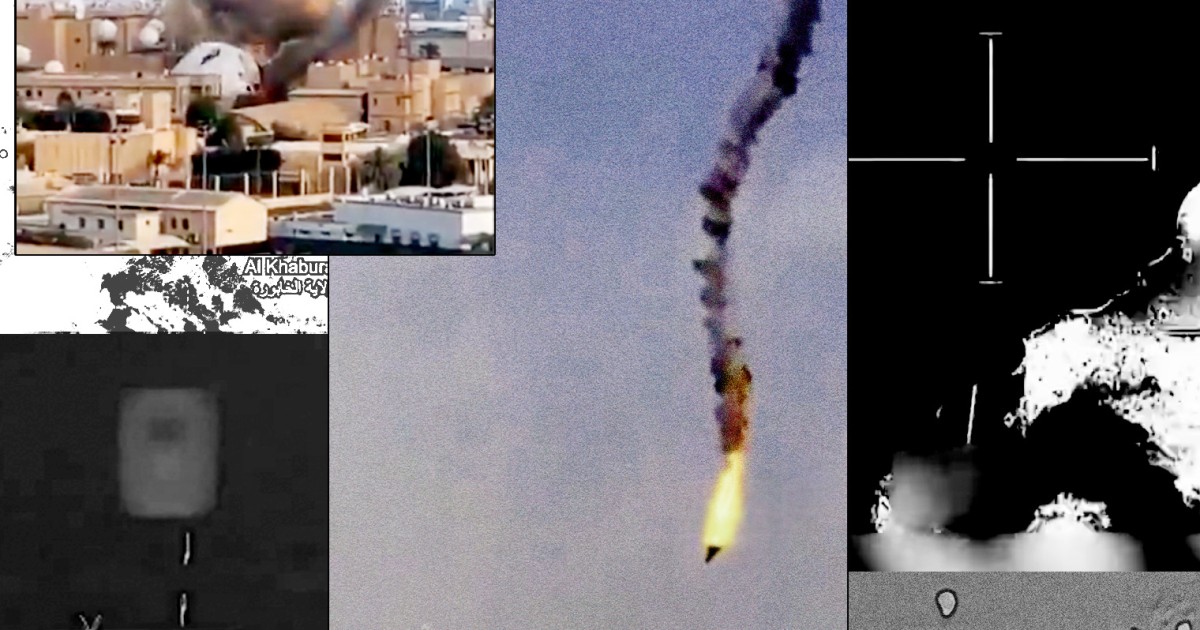
The buzz came before the explosion. An aerial vehicle dove from the cloudless sky toward its target at Camp Buehring, a U.S. military base in Kuwait. It struck near a running track with a fiery plume of black smoke.
“Oh s—t,” a man recording from the base said. “Oh my God. Oh, that was right here. They’re f—ing getting… They’re starting to dial into our building.”
The video ends as the smoke billows in the desert outpost.
The footage of this attack, posted online on March 1 but possibly filmed earlier, is one of over 30 open-source videos and satellite images verified by NBC News showing Iranian drone strikes and interceptions by the U.S. and its allies across seven countries. Apparent targets include military bases, transportation hubs, energy infrastructure and diplomatic centers. In 21 of 26 videos, drones appear to reach their targets.

The videos, posted on various online platforms, reveal a pattern of inadequate protection for strategic locations targeted by the drones from the outset of the war. As the U.S. and Israel bombard Iran with the stated goal of crippling its nuclear, ballistic and drone capabilities, Iran retaliates by utilizing its arsenal of missiles and cheap exploding drones.
The drones are a novel challenge for the U.S., its allies and the countries caught in the crossfire. Adversaries will be watching America’s response closely.
The weapon’s versatility may allow Iran to prolong the war by straining enemy resources, a tactic attractive for cash-strapped states, experts say. Iran is a pioneer of the technology, which it sold to Russia following its full-scale invasion of Ukraine in 2022. It has challenged the economics of warfare. While the U.S. remains firm in its air dominance, Iran’s drone campaign has forced the targeted countries to use expensive munitions for interceptions.
“It’s kind of like the ultimate symbol of asymmetric warfare,” said Joe Dyke, director of programmes for Airwars, a nonprofit that tracks civilian harm in conflict zones.
While the drones can be shot down with a range of weapons including heavy machine guns, fighter jets and advanced interceptors, they can overwhelm air defenses and even one such aircraft can inflict deadly damage.
A drone strike killed six U.S. servicemembers at the civilian Port of Shuaiba in Kuwait. Video verified by NBC News shows that others have bombarded oil infrastructure and logistics hubs. Some drones have struck U.S. consulates and embassies across the Gulf states as passersby gasped and filmed the nosedives. An oil storage facility in Oman was hit twice: Once last week and again this week, underscoring the ongoing vulnerability of crucial targets.
The U.S. does not release data on the munitions it intercepts or faces. Data from the United Arab Emirates, which has been heavily impacted by Iranian strikes, says that 1,475 unmanned aerial vehicles (UAVs) were fired at the country as of March 10 and 1,385 were intercepted.
The UAE, one of the hardest hit Gulf countries, has reported six killed and 122 wounded resulting from the conflict as of March 11. Israel has reported 13 dead. In Iran, more than 1,200 people have been killed by U.S.-Israeli strikes, according to the Iranian Red Crescent Society.
The drone most frequently deployed by Iran is the Shahed-136, according to the weapons tracking project Open Source Munitions Portal (OSMP). With a wingspan of 11.5 feet, it is capable of flying some 1,200 miles and carrying up to 110-pound warheads guided by a satellite navigation system, OSMP says. The drones are pre-programmed to fly to a specific target and operate with no pilot.
In the opening days of the war, Gen. Dan Caine, the chairman of the Joint Chiefs of Staff, said, “The threat from one-way attack UAVs has remained persistent.”
Since then, the U.S. has published video of drone interceptions and Defense Secretary Pete Hegseth claimed in a briefing Friday that the number of drone attacks has dropped.
“CENTCOM continues to attack ballistic missile and drone capabilities so that they are no longer a threat to us, our forces, our bases or our partners,” said Caine in the same briefing.
The U.S. is one of over 10 countries formally requesting help from Ukraine, according to Ukrainian President Volodymyr Zelenskyy, who said in a post on social media that Ukraine has dispatched three teams to the Middle East.
The Trump administration’s official ask came six days after the beginning of the U.S.-Israeli war on Iran, according to a post from Zelenskyy on social media at the time, despite Ukraine offering it months earlier. Ukraine has nearly four years of experience dealing with the weapon, earned at the expense of infrastructure destroyed and civilian lives lost as it pleaded for air defense.
“Ukraine can contribute to stabilization,” said Zelenskyy on Friday at a news conference in France.
Iran’s Foreign Minister Abbas Araghchi has apologized for some of the attacks. In an interview with Al Jazeera, he implied that some of the strikes were not coming directly from the country’s top command.
“Our military units are now, in fact, independent and somewhat isolated, and they are acting based on general instructions given to them in advance,” he said.
In other interviews, Araghchi said Iran has been preparing for this war and a possible ground invasion by U.S. troops.
The first Shahed sighting was in 2019, according to OSMP. It gained popularity when Russia bought the technology from Iran in November 2022 and has since improved on the Shahed-136 model.
An NBC News analysis of online video of Shahed-type attacks shows that the majority of them have hit along the Persian Gulf coastline. Depending on detection radar placement in the Gulf, the drones may be more difficult to locate as they approach the coastline, said Kelly Grieco, a senior fellow at the Stimson Center, a Washington think tank. It could also hint at Iran’s larger plan.
“This second week now, the target set is very similar, and they’re re-attacking things,” said Grieco. “There’s real coherence to their strategy.”
In one video, a drone follows its pre-programmed path to an oil storage tank in Oman, the second such attack on the facility.

A Dubai beachgoer filmed another video showing a buzzing drone flying inland as a warplane boomed after it, releasing an interception missile moments later.

The drones have reached Azerbaijan, verified videos show, bombarding the airport in Nakhchivan. Azerbaijan is not a party to the conflict and demanded an apology from Iran, which has denied responsibility.

The attacks by primitive drones and more sophisticated ballistic missiles have crippled both air and sea traffic in the crucial oil-rich region. The strategically critical Strait of Hormuz is effectively closed to traffic. Air travel in the Persian Gulf region has been heavily affected, according to data from Flight Radar 24, a global tracking service. Kuwait and Bahrain airports are completely closed to commercial flights while other regions face heavy restrictions.
The size of Iran’s drone arsenal and production capabilities is unclear. Interception numbers released by the UAE suggest attacks have dwindled, but that could be an indication of regrouping and stockpiling before the next attack rather than a diminishing supply, said Grieco of the Stimson Center. Russia, the only other country using these types of weapons regularly, frequently breaks between major bombardments to amass more drones to release in one attack.