








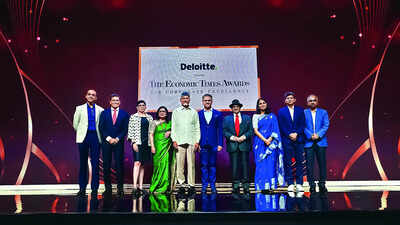
Mumbai: As global supply chains brace for the ripple effects of the ongoing West Asia conflict, India’s top policymakers and corporate titans are looking inward to fortify the country’s economic defences.At the 26th Economic Times Awards for Corporate Excellence, a unified vision emerged: India’s vast domestic market, coupled with strategic self-reliance and a demographic dividend, is its ultimate shield against international disruption. Rather than merely weathering the storm, the country’s leadership is framing this geopolitical volatility as an urgent catalyst to accelerate domestic manufacturing, transition to green energy, and realise the untapped potential of the Indian workforce.For finance minister Nirmala Sitharaman, the primary bulwark against external shocks lies in the sheer scale of the Indian consumer base and the untapped potential for import substitution.She identified the internal market as India’s greatest defence, noting, “The Indian population and its consumption, essentially your domestic consumption, is what is giving you that shock-absorbing capacity. As long as we are not failing in keeping our consumption boosted and well supported, we can be sure to weather the storm. That I would think is the biggest support we have for our economy.”To truly exploit this, she challenged the Indian industry to step up and capture the domestic demand currently met by foreign markets. “Businesses are importing a lot of goods which are intermediary, so there is some more agility which I expect from the Indian industry.”Saturday evening brought together a power-packed mix of industry leaders spanning new-age startups and centuries-old businesses, alongside financiers and policymakers, at one of the country’s oldest business awards-instituted in 1998-with N Chandrababu Naidu among the rare early winners to repeat his achievement this year.Naidu, once again the chief minister of Andhra Pradesh, emphasised that reducing dependence on volatile regions like West Asia requires a massive, cost-effective pivot to renewables. Connecting energy independence to national prosperity, he stated, “Ultimately we need energy to run anything, be it factory or vehicle or lighting. Now that is where I am working. Cost-effective energy sector… Our Prime Minister has announced 500 GW green energy by 2030. In that Andhra Pradesh is going to contribute 160 GW… The future is totally green energy.”Echoing this urgency for energy sovereignty, Sajjan Jindal, chairman and MD of the JSW Group, warned that a nation of India’s size cannot afford to leave its economic engine at the mercy of disrupted international trade routes. He championed a radical shift in daily energy consumption to create a resilient domestic buffer, arguing,“I have a different perspective on this war. Today the world is not the same… we, as a large country like India, cannot depend on, oh, the ship has left, and my dinner will be cooked or restaurants will be running because LPG is coming. So what we need to do very quickly is rely on our own energy sources. We have solar, wind, coal, and nuclear. These are the four real energy sources that we have. So we must, as a country, make ourselves truly ‘atmanirbhar’ by using our own energy sources.“Beyond consumption and energy, India’s human capital remains a critical domestic asset capable of overcoming global technological and economic shifts. Arundhati Bhattacharya, president and CEO of Salesforce South Asia, pointed out that exploiting domestic opportunities requires an aggressively upskilled workforce ready to take on the new roles created by disruption.She highlighted this intrinsic advantage, noting, “India basically is blessed in the fact that it has a very deep pool of young professionals who are very easy to train and very quick to learn. And the other good thing that I see in our workforce is the hunger, the hunger to really excel… it’s a question of ensuring that you are up to date with your skills.”While leaders look to long-term structural buffers, they are also tactically managing the immediate fallout of global conflicts. Anish Shah, group CEO and MD of Mahindra Group, provided a pragmatic view from the front lines of global manufacturing, confirming that while the West Asia crisis demands agility, India’s robust demand and diversified sourcing are holding strong.“The challenges today are essentially to do with supply chains. And what we’ve seen is so far it’s good,” he explained, adding, “From a supply chain standpoint, what worries us most is about helium impacting semiconductors that will impact multiple industries, not just for India, but across the world. For most other things, we’ve had the ability to source from various different places. So I would just say it’s caused a lot of scrambling for our teams, but from a net impact standpoint, very minimal. We’re not seeing an impact on demand either at this point. So the Indian economy is on a strong footing.”Winners at the ET Awards collectively framed their achievements as a reflection of India’s structural rise, powered by policy support, digital infrastructure, and a growing emphasis on self-reliance. Chandrababu Naidu struck an optimistic note on India’s trajectory, asserting that “India will be number one” and calling for a shift from ease to the “speed of business.”
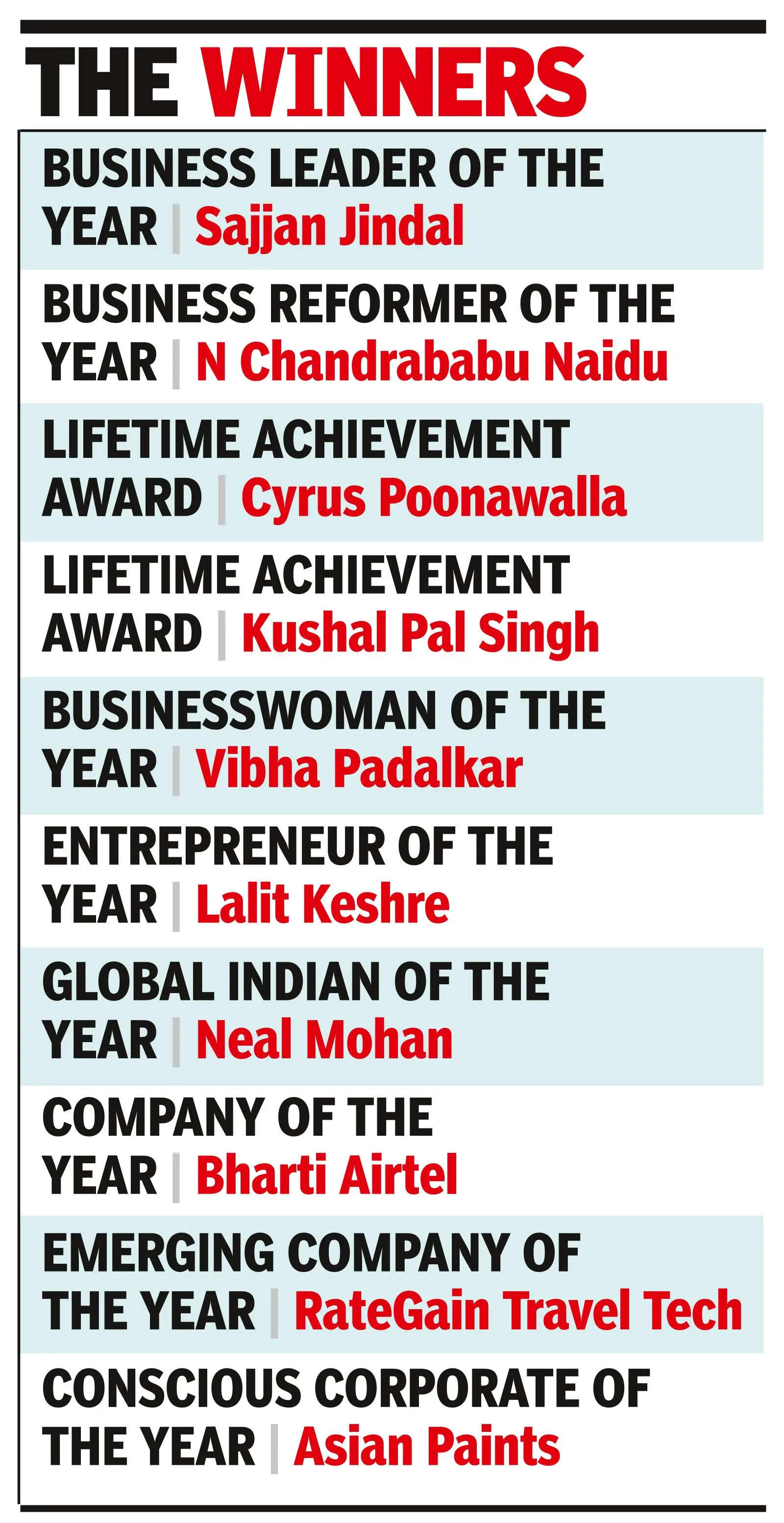
The winners
Industry veterans and global leaders placed India’s growth within a broader nation-building and global context. Sajjan Jindal, chairman and MD, JSW Group, said, “It has never felt like business to me. It has always felt like participation in India’s story,” while KP Singh, chairman emeritus, DLF, argued that India needs a “quantum leap” in urbanisation to become the third-largest economy.Cyrus Poonawalla, chairman, Serum Institute, traced his journey from making “industrial India self-sufficient” to positioning the country as the pharmacy of the world.Emerging entrepreneur Bhanu Chopra, founder of RateGain Travel Technologies, highlighted the global footprint of Indian innovation, noting his platform is “made in India,” while YouTube CEO Neil Mohan said India has moved from keeping pace with the world to “setting the current,” becoming a global “creator nation” exporting culture worldwide. Shashwat Sharma of Bharti Airtel described the company’s journey as one rooted in doing right by “our customers and our people,” helping build a seamlessly connected nation.Lalit Keshre, co-founder and CEO of Groww, credited “progressive regulations and digital public infrastructure” for enabling scale, while Vibha Padalkar, MD, HDFC Life, linked India’s development ambitions to financial security, saying, “we cannot become Viksit Bharat without having strong foundation of insurance for all by 2047.”Ultimately, the consensus is that surviving global turbulence requires an offensive, not just defensive, posture. Romal Shetty, CEO of Deloitte South Asia, captured this sentiment perfectly.“India has navigated a world that has moved from one crisis to another. From the COVID pandemic to the Russia-Ukraine conflict to Gaza and now Iran. Through each phase, India has shown resilience, anchored in a strong macroeconomic foundation and an increasingly anti-fragile structure,” he observed.Summarising the collective mission to build a fortified, self-reliant economy, he concluded, “The question is not whether disruption comes, it’s how fast you respond… India did not just get lucky. The world got complicated. We were ready… As we move towards Viksit Bharat 2047, we must understand that the journey is not a govt promise. It is a private sector assignment.”