
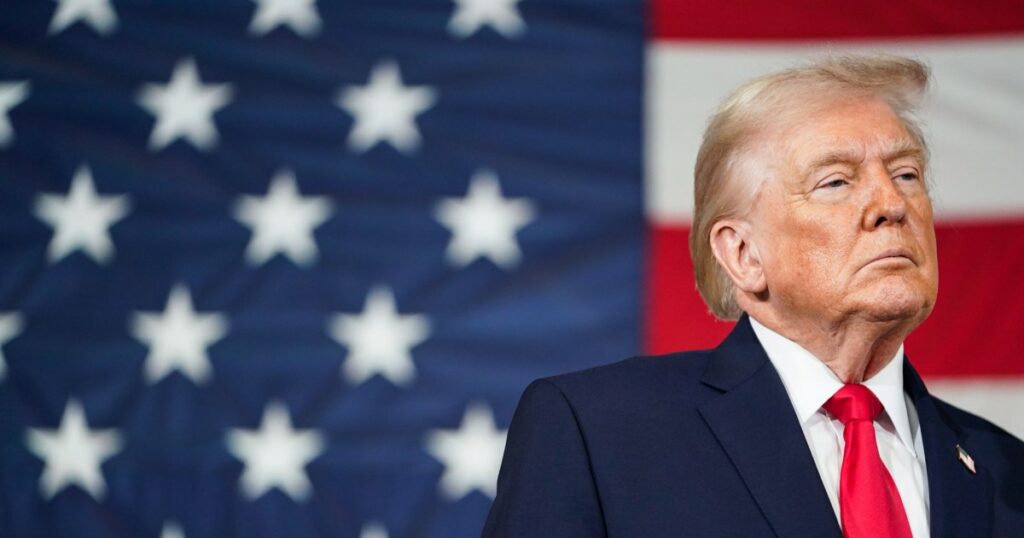
As a Republican push to pass the SAVE America Act has stalled in Congress, even amid escalating pressure from President Donald Trump, efforts are underway at the state level to fill in the gaps.
Lawmakers in a dozen states have advanced legislation this year that would require residents to prove their U.S. citizenship to register to vote or bring photo ID to the polls, according to the Voting Rights Lab, a nonpartisan group that tracks election legislation. Those proposals are two of the central planks of the SAVE America Act at the national level.
The latest example comes in Florida, where the Republican-led Legislature passed a bill this week to require election officials to confirm the citizenship of voters through government databases when they register to vote or update their registration, as well as during list maintenance. If a voter’s eligibility is in question, they would be asked for proof of citizenship.
The legislation, once it reaches GOP Gov. Ron DeSantis’ desk for a signature, would largely go into effect next year, after the midterm elections.
Bills to add a proof-of-citizenship requirements to voter registration have also passed through both legislative chambers in South Dakota and Utah, where they await the signatures from their Republican governors.
Mississippi lawmakers in both chambers of the Legislature have passed bills that would make some voters show proof of citizenship when registering to vote. They will need to reconcile amendments on the legislation before it can go to the Republican governor for a signature.
In Iowa, Republicans in the state Senate passed a bill that would ask some voters for proof of citizenship, sending it to the House. And in Kansas, Republicans in the House passed a similar bill.
Plus, new voter ID restrictions have been approved by at least one legislative chamber in eight states, according to the Voting Rights Lab: Arizona, Idaho, Iowa, Kentucky, New Hampshire, Oklahoma, Utah and West Virginia.
Voter impersonation and noncitizens casting ballots — the problems these bills seek to address — are exceedingly rare and already illegal. But election experts warn these proposals would affect wide swaths of U.S. citizens without ready access to the documentation the bills require of voters.
More than 9% of American citizens of voting age do not have proof of citizenship documents readily available, according to a study commissioned by the Brennan Center of Justice.
The national version of the SAVE America Act has emerged as a particular focus for Trump in recent weeks. After the bill passed the House last month, it has languished in the Senate, where it would need 60 votes to pass — but Republicans only control 53 seats.
Trump has said he would not sign any other pieces of legislation until the SAVE America Act is passed. He has also called on unrelated restrictions on gender-affirming medical care and transgender participation in sports to be added to the bill.
“I’m not doing anything until they get it done,” Trump told NBC News on Monday.

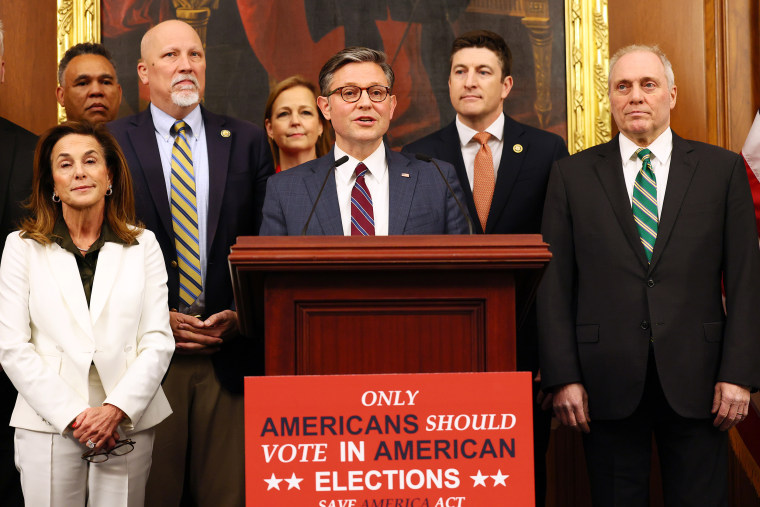
In the meantime, states with Republican-led legislatures have acted on similar measures.
Florida’s bill would add proof-of-citizenship requirements and limit the types of ID that voters can show to cast a ballot. The state has had a voter ID requirement on the books for years, but this bill would bar people from using student IDs, debit or credit cards, public assistance cards and retirement home IDs from proving their identity at the polls.
Democrats and voting rights advocates have pointed out that some voters may not have ready access to other forms of ID. They also warn that many voters may not have a certified birth certificate or official paperwork detailing name changes that would be required to prove their citizenship.
“More than a million Florida voters could receive letters from their supervisor of elections informing them that they have 30 days to produce documentary proof of citizenship, or they could be removed in the voter rolls,” said League of Women Voters of Florida President Jessica Lowe-Minor.
Lowe-Minor said her figure comes from applying an estimate that 9% of Americans do not have easy access to the proper documentation to Florida’s voting-age population. The vast majority of Florida driver’s licenses are already REAL-ID compliant, which means that millions of voters’ citizenship is already on file. It’s unclear how many voters don’t have driver’s licenses in the state.
Lowe-Minor said a league member had been unable to help their retired mother obtain a state ID because she had been married three times in another state and no longer had the decades-old paperwork documenting her name changes. Democratic state Rep. Ashley Gantt told a story on the House floor about her aunt, who was born at home during the Jim Crow era and did not have a birth certificate.
“The right to vote should not depend on whether someone can afford to track down costly documents from decades ago,” Democratic state Sen. LaVon Bracy Davis said during a debate on the Florida Senate floor.
But the bill’s sponsor in the Senate, GOP state Sen. Erin Grall, pushed back against efforts to expand the acceptable IDs for voting, arguing that people might print fake IDs and impersonate others to vote.
“We have seen technology change over the years, almost anyone can print an ID card in their house,” she said during the debate. “They might be the one in charge of printing them for their homeowner association.”
GOP state Rep. Jenna Persons-Mulicka, who sponsored the bill in the House, said the proposed list of IDs was designed to align the Florida bill with the national SAVE America Act.
“When you show up at the polls for election integrity purposes, we want to make sure that you are who you are, and that somebody hasn’t stolen your identity,” she said. “So our list would match what Congress is currently considering in the SAVE America Act.”
Outside of Florida, the bills vary. Legislation in South Dakota and Utah would require voters to have or show proof of citizenship to keep voting in state elections. Both would adopt a bifurcated election system like the one in Arizona, where courts ruled the state couldn’t stop voters without proof of citizenship from registering and voting in federal elections.
Ten states currently have strict photo ID requirements for voters at the polls, though nearly all do not go as far as the ones laid out in the SAVE America Act. Dozens of states — including Florida — have a less strict ID requirement at the polls, and many of the bills lawmakers are considering this year aim to further tighten up those rules.
In New Hampshire, lawmakers want to eliminate student IDs from being used at the polls, while bills in Arizona and Missouri would add new ID requirements for mail voters.