
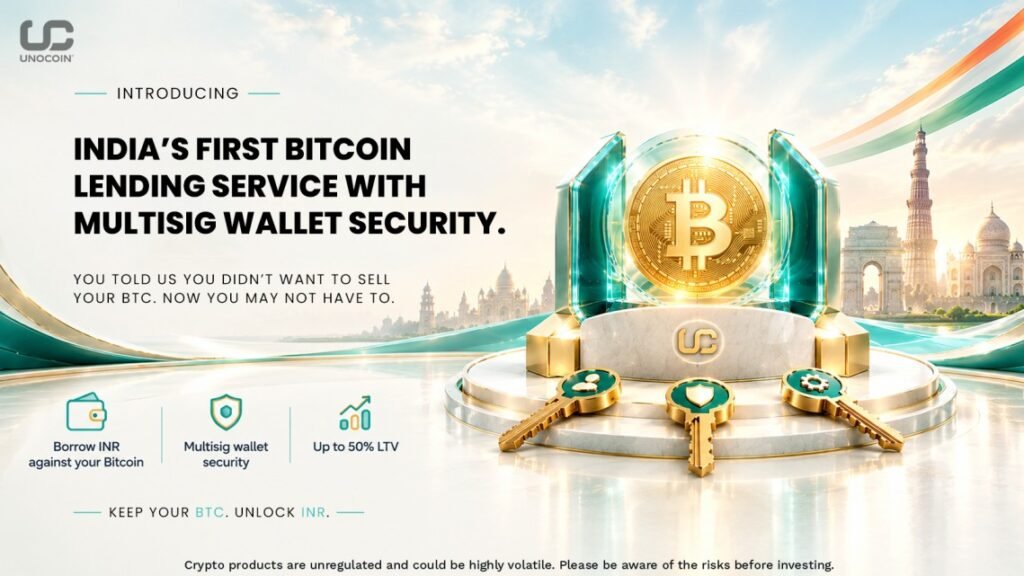
Need INR but Hold Bitcoin?
Bitcoin holders may face a familiar situation: they need Indian rupees for an expense but also want to retain their Bitcoin holdings.
Selling Bitcoin is not the only option. Now users may also explore borrowing against Bitcoin through a lending arrangement, subject to the lender’s eligibility criteria, terms and approval.
Introducing UnocoinXPledg, a journey for exploring Bitcoin-backed INR Loan through Pledg Wallet, featuring a multi-signature (multisig) wallet mechanism.
The idea is simple: instead of selling your Bitcoin outright, you can explore whether pledging eligible BTC as collateral for an INR loan suits your needs.
What Is Bitcoin-Backed INR Loan?
Bitcoin-backed Loan is a borrowing arrangement in which eligible Bitcoin is used as collateral for a loan.
Instead of selling BTC to receive INR, a borrower may pledge Bitcoin under the lender’s terms. If the application is approved, the lending institution provides the loan according to the agreed conditions.
The Bitcoin serves as collateral for the borrowing arrangement. Bitcoin-backed Loan is not the same as selling Bitcoin, and it does not eliminate financial risk.
Before choosing this route, users should understand:
- The interest rate and how it is calculated.
- Applicable fees and the total borrowing cost.
- The loan-to-value (LTV) ratio.
- Repayment obligations and timelines.
- What happens if Bitcoin’s market value falls.
- The conditions for collateral release or liquidation.
Let’s break it down below!
What Does a Multisig Wallet Mean?
A multisig wallet uses multiple keys to authorize a specified wallet operation instead of relying on a single key alone.
For example, in a two-of-three arrangement:
- Three key holders each hold a separate key.
- Any two of the three keys are required for the specified wallet operation.
- The arrangement defines how authorization is shared between the key holders.
This is the multisig mechanism associated with the UnocoinXPledg journey.
The exact way the mechanism operates—including who holds the keys, which operations require authorization and how recovery works—should be understood from the product’s official documentation.
Multisig is a wallet authorization mechanism, not a guarantee that the lending arrangement is risk-free. Users should still review the security procedures, collateral terms and responsibilities applicable to the service.
How Does the UnocoinXPledg Journey Work?
The journey involves moving from Unocoin to Pledg Wallet and completing the required lending steps.
Step 1: Start from Unocoin
Access the approved UnocoinXPledg entry point through Unocoin.
OR
Step 2: Sign up with Pledg Wallet
Sign up with Pledg.in & continue the process.
Step 3: Complete the Required On-boarding
New users must complete the required registration and verification steps. Existing Unocoin users may be able to use previously verified KYC information, subject to applicable consent, verification and compliance requirements.
Step 4: Follow the BTC Pledging Instructions
Eligible users who choose to proceed must follow the instructions provided for pledging BTC and transferring it to the designated wallet address.
Always verify the wallet address and the applicable instructions before initiating a transfer.
Step 5: The Lending Institution Assesses the Application
The lending institution evaluates the application according to its eligibility criteria, collateral valuation and other applicable requirements.
Step 6: INR Is Disbursed if Approved
If the application is approved, the lending institution provides the INR loan according to the agreed terms. Approval and disbursal are not guaranteed.
Before proceeding, users should carefully review the loan agreement, interest calculation, fees, repayment schedule and collateral conditions.
Borrowing Against Bitcoin vs Selling Bitcoin
Both selling Bitcoin and borrowing against it have different implications. The right choice depends on an individual’s financial needs, repayment capacity and view of the associated risks.
| Consideration | Selling Bitcoin | Borrowing Against Bitcoin |
| How INR is obtained | By selling BTC | Through a loan secured by eligible BTC |
| Bitcoin ownership | The BTC sold is no longer held by the seller | BTC is used as collateral under the applicable agreement |
| Repayment | No loan repayment for the sale itself | Repayment obligations apply |
| Costs | Trading fees and applicable taxes may apply | Interest, fees and other loan costs may apply |
| Market risk | The seller no longer bears future price changes on the BTC sold | BTC price changes can affect the collateral position |
| Important consideration | Sale proceeds and tax treatment | Repayment capacity, collateral conditions and possible liquidation |
Borrowing against Bitcoin does not guarantee that a user will benefit from future BTC price movements. If Bitcoin’s value falls or the borrower cannot meet the required terms, the collateral may be at risk under the lending agreement.
Users should compare the total cost of borrowing with the implications of selling BTC before making a decision.
Understanding the Loan-to-Value Ratio
The loan-to-value ratio, or LTV, compares the loan amount with the value of the collateral accepted by the lender.
For example, if eligible BTC collateral is valued at ₹2,00,000 and a lender offers a 50% LTV, the corresponding loan amount would be ₹1,00,000.
This is an illustrative calculation, not a loan offer or guarantee. Actual loan eligibility and the amount available depend on the lender’s valuation method, limits, eligibility requirements and terms.
Before applying, confirm how the collateral is valued, whether the LTV can change, and what happens if the value of BTC falls during the loan period.
Understand the Interest Rate and Total Borrowing Cost
The interest rate is an important part of any borrowing decision, but it is not the only cost to consider.
Before accepting a Bitcoin-backed loan, users should verify:
- Whether the quoted interest rate is annual and whether it is calculated on a flat or reducing balance.
- How interest accrues and when payments are due.
- Whether processing fees, taxes or other charges apply.
- The total amount payable over the loan period.
- Whether early repayment or other conditions affect the total cost.
Review the official loan terms to understand the actual borrowing cost before proceeding.
What Happens If Bitcoin’s Price Falls?
Bitcoin prices can change significantly. A decline in the market value of pledged BTC may affect the collateral position under the lending agreement.
Depending on the lender’s terms, the borrower may face additional collateral requirements or other consequences. If the borrower fails to meet the applicable requirements or repayment obligations, the pledged BTC may be liquidated in accordance with the agreement.
Before pledging BTC, understand the circumstances that can trigger liquidation, how the lender communicates such requirements and whether there is a process for addressing a shortfall.
Never pledge Bitcoin without understanding the potential consequences of a price decline and your ability to repay the loan.
Now Instead of selling BTC outright, you can pledge Bitcoin as collateral,and get INR instantly
CTA: Explore UnocoinXPledg
Frequently Asked Questions
- Do I have to sell my Bitcoin to explore an INR loan?
Not necessarily. Bitcoin-backed lending allows eligible users to explore borrowing against BTC collateral instead of selling it outright. Approval, collateral requirements and loan terms depend on the NBFC.
- What is a multisig wallet?
A multi-signature wallet uses multiple keys to authorize specified wallet operations. In a two-of-three arrangement, two of three keys are required for the operation covered by that arrangement.
- Is a Bitcoin-backed loan guaranteed?
No. The NBFC assesses each application based on its eligibility criteria, collateral valuation and other terms. Loan approval and disbursal are not guaranteed.
- What happens if Bitcoin’s value falls after I pledge it?
A price decline may affect the collateral position. Depending on the loan agreement, additional requirements or liquidation may apply. However, a Top-Up option is available.
- Can existing Unocoin users use their KYC information?
Previously verified KYC information may simplify on-boarding, subject to applicable consent, verification and compliance requirements. Users should follow the instructions provided during the application process.
- What should I check before accepting a Bitcoin-backed loan?
Review the interest calculation, applicable fees, LTV, repayment schedule, collateral custody and liquidation terms. Make sure you understand the total cost and can meet the repayment obligations.