







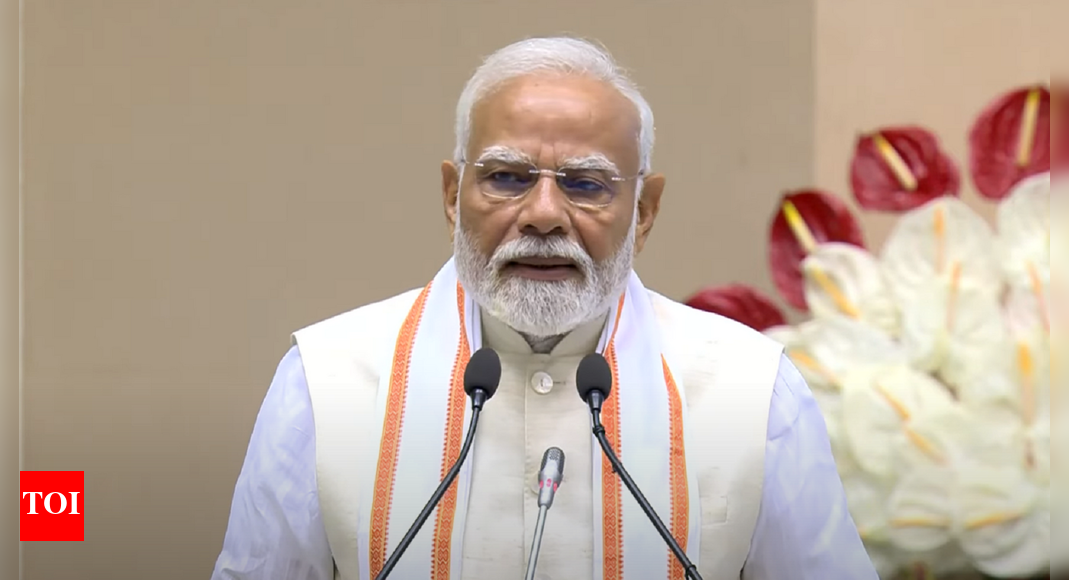
NEW DELHI: Prime Minister Narendra Modi on Saturday said India is poised to play a defining role in shaping the global economy, with experts projecting its contribution to reach 20% in the coming years. He was speaking at the ET World Leaders Forum 2025 in New Delhi. Highlighting the foundation of India’s growth story, the Prime Minister credited the country’s macroeconomic stability over the past decade. “The macroeconomic stability of the last ten years is behind today’s growth and resilience,” he said. PM Modi underlined that despite the shocks of the Covid-19 pandemic, India has managed to maintain strong fundamentals. “Our fiscal deficit is predicted to come down to 4.4%, that too after the setbacks of Covid,” he said, adding that the economy has shown remarkable recovery. The Prime Minister pointed to strengthened banking systems, low inflation, reduced interest rates, and a current account deficit under control as signs of resilience and confidence in India’s economic trajectory.Here are his key quotes from the address:On reforms and growth
- “Last week, from Red Fort, I spoke of next-gen reforms. Now, this forum is working as the multiplier of these incoming reforms.”
- “Today, India is the fastest growing major economy in the world. Soon, we will become the third-largest economy of the world. We will be the world’s third-largest economy.”
- “Experts say, India’s contribution to global growth will account for 20%.”
- “We are moving ahead with the goal of a quantum jump, not just incremental change.”
On macroeconomic stability
- “The growth and resilience that we see in the Indian economy today is due to macro stability.”
- “Our fiscal deficit is predicted to come down to 4.4%, that too after we suffered due to Covid.”
- “Our banks are stronger than before, inflation is low, interest rates are less, the current account deficit is under control, and forex reserves are strong.”
- “Every month, several domestic investors are investing heavily through SIPs.”
- “When economic fundamentals are strong, the foundation is strong, the impact is also strong.”
- “In the past one week, everything that has happened is a befitting testament to India’s growth story.”
On technology and semiconductors
- “Semiconductor-related factories have started coming up in India. By the end of this year, the first Made in India chip will come in the market.”
- “We are working rapidly on Made in India 6G.”
On space ambitions
- “We’ve opened India’s space sector to private companies.”
- “In the years to come, several space missions are scheduled to be launched.”
- “Today, India is home to more than 300 space startups, up from 1 such startup in 2014.”
- “The day is not far when we will have our own space station. Soon, India will have its own space station.”
- “You will be happy to know that in the last 11 years, more than 60 space missions have been completed. There are many missions lined up. This year, we have also achieved the capability of space docking. This is a big achievement for our future missions.”
On Gaganyaan mission
- “Now India is preparing to send its astronauts to space through the Gaganyaan mission, and in this, we are going to get a lot of help from the experience of Group Captain Shubhanshu Shukla.”
On Tax and GST reforms
- “We’ve brought reforms in the Income Tax bill after 60 years. This has been prepared in simple language for India’s common man.”
- “By this Diwali, GST reforms will be completed. This will make the GST simple.”
On economy, industry and jobs
- “Manufacturing will rise, demand will increase, ease of living and doing business will improve.”
- “This will energise the industry, ease of doing business will improve and new employments will be generated.”
On Vision for 2047
- “The basis of 2047 Viksit Bharat dream is Aatmanirbhar Bharat.”
- “India is ready for Aatmanirbharta as a Viksit Bharat.”
On defence production
- “Between 1979 and 2014, India produced only 42 missiles in 35 years, while in the past 11 years it has produced 60 missiles.”
On reforms impact
- “The new generation reforms will help lower prices, boost market demand, create jobs, and improve both ease of living and ease of doing business.”
Ahead of the Prime Minister’s address, Union minister Piyush Goyal underscored India’s economic strength, calling it “the world’s fastest-growing economy, full of possibilities and resilience.” He stressed that India negotiates trade deals with a “clear vision to protect national interests” while working on the basis of mutual respect with global partners, including the EU.On the global front, former US secretary of state John Kerry described the current era as “dangerous but also momentous,” while praising India’s role in navigating its development trajectory. “We need to recognise and honour the impact of Indians in the US,” he said, adding that the world still lacks clear rules on the use of artificial intelligence.Congress MP Shashi Tharoor also warned against being “oblivious about China,” citing Beijing’s deliberate economic decisions, while External Affairs Minister Jaishankar reminded that “the overall trend [in India’s global ties] has been net positive,” even as challenges with major powers persist.Defence minister Rajnath Singh meanwhile reiterated India’s focus on strengthening its domestic defence industry, stating that 75% of the defence budget has been earmarked for procurement from domestic companies.The forum has also seen insights from business leaders and state heads. Andhra Pradesh chief minister Chandrababu Naidu said “the power of India cannot be stopped,” while Vishal Sikka, founder of Vianai Systems, highlighted AI’s transformative potential for businesses.