
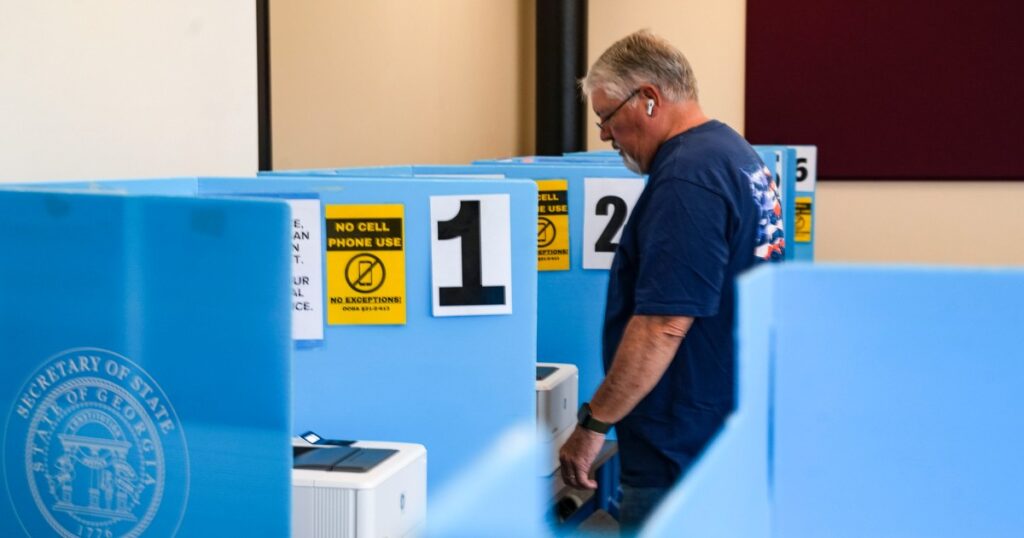
Georgia lawmakers did not delay the required implementation of a new elections system by July before their legislative session ended Friday, raising urgent questions about how votes in the battleground state will be cast and counted in the November midterm elections.
Subscribe to read this story ad-free
Get unlimited access to ad-free articles and exclusive content.


Fueled by conspiracy theories about Georgia’s election system, state lawmakers voted two years ago to stop using touch-screen voting machines, which generate a QR code that is used to tally votes.
That change is set to go into effect after Georgia’s primary elections, but the lawmakers haven’t allocated funds for a new or modified system and the state hasn’t procured one. State officials said in 2024 that changes to the current system could cost tens of millions of dollars, while a total replacement could run as much as $300 million.
Even if the state could find the money elsewhere, experts warn against changing voting systems in the middle of an election year.
The state House passed a bill Thursday to push the July 1 deadline back to 2028, but the state Senate did not approve the fix before adjourning for the year.
The absence of a legislative fix sets the state up for likely litigation over how the November elections are run and could fuel further doubts about the integrity of the election system.
Georgia’s voting system, which cost $107 million dollars, was used for the first time in 2020. The use of QR codes during a close presidential contest have kept the system at the heart of many election conspiracy theories, though no evidence of widespread voter fraud has been found. President Donald Trump tried to overturn his 2020 loss to Joe Biden and has continually made false claims about the election, both in Georgia and nationally, being stolen from him.
Georgia’s current system asks voters to make their choices on a touch-screen computer; the computer then prints out a ballot listing their choices next to a QR code, which the tabulators use to count. Critics argue this system is vulnerable to hacking, because voters can’t read the QR code. The state conducts audits of the results by reviewing the written summary of the voter’s choices, ensuring they match the tabulator count tallied with the QR codes.
Still, a yearslong federal lawsuit challenged the integrity of the election system, arguing it was so fundamentally vulnerable to hacking and errors that it violated voters’ constitutional rights.
During the trial, a cybersecurity expert dramatically hacked one of the systems in open court. The state argued that the system was not hackable under real-world conditions, and a federal judge eventually sided with them, dismissing the case.
Gabriel Sterling, the chief operating officer in the Georgia secretary of state’s office, testified in the case’s 2024 trial that overhauling an election system in an election year would be “nightmarish.”
Georgia will once again be a closely watched state in this year’s midterm elections. Democratic Sen. Jon Ossoff’s seat is a top target for Republicans, while both parties are vying to replace outgoing GOP Gov. Brian Kemp.