
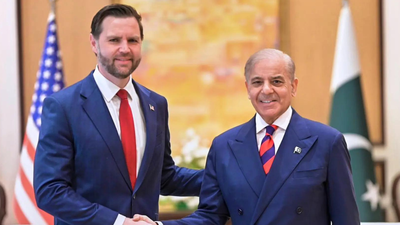
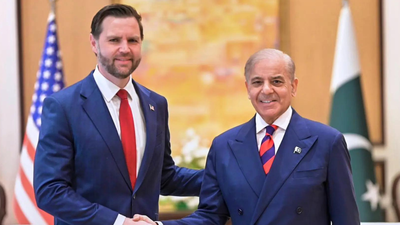
A US delegation led by vice president JD Vance and an Iranian delegation headed by parliament speaker Mohammad Bagher Qalibaf reached Pakistan on Saturday for talks aimed at reinforcing a fragile ceasefire and exploring a path toward a permanent end to the conflict. The two delegations met Pakistan PM Shehbaz Sharif separately as direct talks between the two remain uncertain.The ceasefire, however, continues to face significant challenges, with Israel and Hezbollah still exchanging fire along the southern Lebanon border and Iran setting conditions before formal negotiations can proceed.“We’ll find out what’s going on. They’re militarily defeated,” US president Donald Trump said hours before the meeting.Iran’s red lines in the ongoing negotiations include control over the Strait of Hormuz, payment of war reparations, the release of Iran’s blocked assets, and a ceasefire across the region, according to an Iran state TV reporter.The following are the key issues expected to be discussed, as Tehran maintains that formal talks can begin only after Washington commits to a ceasefire in Lebanon and the lifting of sanctions on Iran.
Lebanon
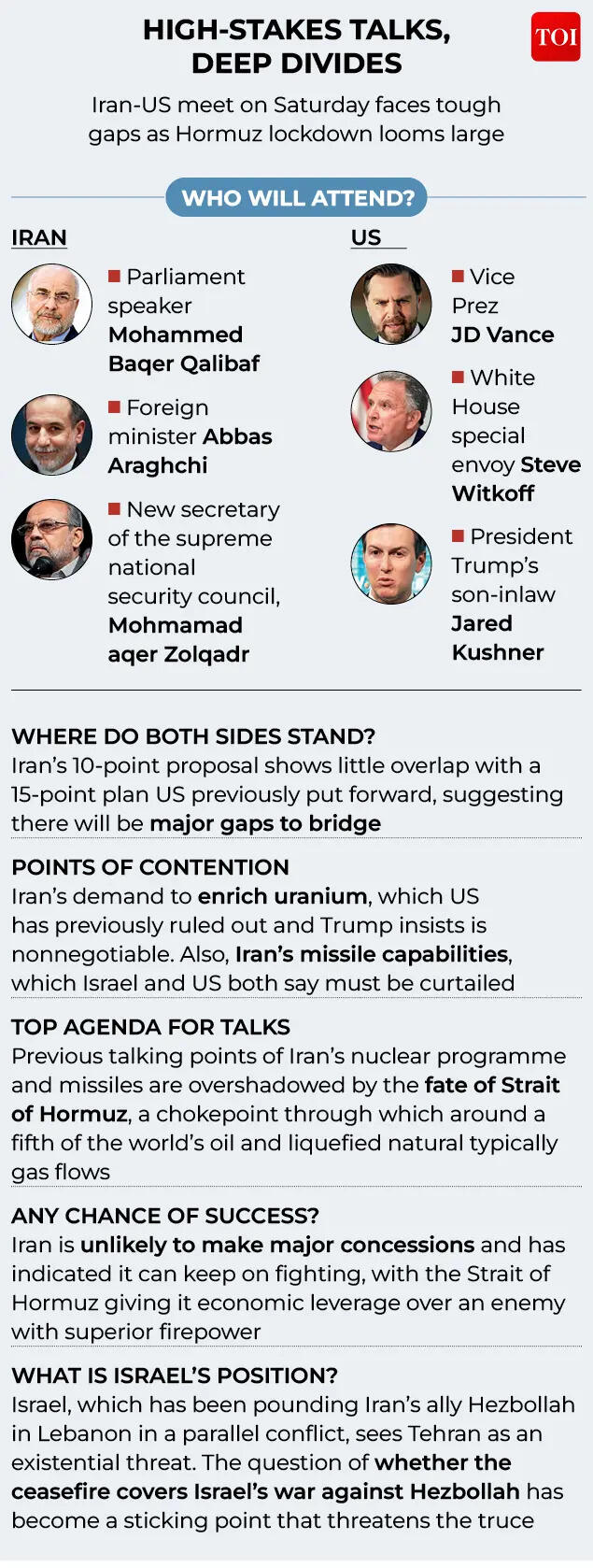
Iran is calling for a ceasefire in Lebanon, where Israeli strikes on Iran-backed Hezbollah militants have killed nearly 2,000 people since the fighting began in March, as cited by Reuters. Israel and the United States say the Lebanon campaign is separate from the Iran–US ceasefire, but Tehran insists it is directly linked.Israeli prime minister Benjamin Netanyahu has said there is “no ceasefire” when it comes to Hezbollah. However, Israel’s repeated warnings urging residents of Beirut’s southern suburbs to evacuate have not yet been followed by further military action.

.
US president Donald Trump said Israel’s operations in Lebanon will now be “a little more low key,” while the US State Department said direct talks between Israel and Lebanon are scheduled to take place in Washington next week.Israel’s ongoing military campaign against Hezbollah, Iran’s Lebanese ally, risks undermining the talks even before they formally begin.“The continuation of these actions will render negotiations meaningless,” Iran’s president Masoud Pezeshkian wrote on X.“Our fingers remain on the trigger. Iran will never abandon its Lebanese sisters and brothers.”
Strait of Hormuz
Another key issue that could complicate the talks from the outset is the Strait of Hormuz, a vital global oil shipping route.Iran is seeking acknowledgment of its authority over the strait, where it aims to collect transit fees and control access, a move that would mark a major shift in regional power. The United States, however, insists the waterway must remain open to oil tankers and other vessels without restrictions, including tolls.Trump said Iran is “doing a very poor job” of allowing ships to pass through the strait, despite earlier assurances that traffic would continue.“This is not the agreement we have!” he wrote in a post on Truth Social, accusing Iran of being “dishonourable”.Currently, very few vessels are passing through the waterway, with hundreds of ships and an estimated 20,000 seafarers still stranded inside the Gulf.On Thursday, Iran announced the creation of new transit routes north of the two existing traffic separation channels.In a statement that appeared to deliberately play on concerns among shipping companies, it said the new routes were necessary “to avoid the presence of various types of anti-ship mines in the main traffic zone.”
Nuclear capacity
One of the most contentious and long-standing issues in the talks is Iran’s nuclear programme. Iran is seeking permission to continue enriching uranium, a demand Washington has ruled out, with US President Donald Trump insisting it is non-negotiable.Trump said he launched Operation Epic Fury in part to ensure Iran “can never have a nuclear weapon.”Asked about the issue earlier this week, US Defence Secretary Pete Hegseth said Iran would “never had a nuclear weapon or the capability to get a path to one.”Another major point of dispute is Iran’s missile programme. Israel and the United States want Iran’s missile capabilities to be significantly curtailed, but Tehran says its arsenal is non-negotiable.
Iran’s sanctions demand
Iran is demanding that the United States unfreeze its assets and lift sanctions that have strained its economy for years. Washington has indicated it may consider significant sanctions relief, but only in exchange for concessions from Tehran on its nuclear and missile programmes.The White House on Saturday dismissed a report that the United States had agreed to release Iran’s frozen assets held in foreign banks. A Reuters report, citing a senior Iranian source, had earlier claimed that Washington had agreed to release Iran’s frozen assets held in Qatar and other foreign banks. The source also said the proposed unfreezing of assets was “directly linked to ensuring safe passage through the Strait of Hormuz.”The funds in question are estimated to amount to about $6 billion.
Troop withdrawal
Iran is demanding the withdrawal of US combat forces from the region, an end to hostilities on all fronts, and a commitment to non-aggression as part of any broader peace agreement.Trump, however, has vowed to keep American military assets in the Middle East until a final peace deal is secured and warned of a major escalation in fighting if Iran fails to comply.