

How does Bitcoin work? Bitcoin uses a combination of blockchain technology, cryptography, a distributed network of computers, and Proof of Work mining to process and record transactions — without a central bank or payment company. When you send Bitcoin, your wallet signs the transaction, nodes verify it, miners add it to a block, and the blockchain records it permanently.
Bitcoin is often described as digital money, but what actually happens when you send Bitcoin to someone? Unlike a bank transfer, there is no central bank or payment company processing the transaction. Instead, Bitcoin uses a combination of blockchain technology, cryptography, a distributed network of computers, and Proof of Work mining to process and record transactions.
In simple terms, Bitcoin works by allowing users to send value directly to one another while the network independently verifies those transactions and records them on a public blockchain.
How Does Bitcoin Work in Simple Terms?
Bitcoin works through a decentralised network of computers that all follow the same set of rules. Here is the straightforward version of how a Bitcoin transaction happens:
Create Transaction
→
Broadcast
→
Verify
→
Select for Block
→
Mine
→
Add to Blockchain
→
Confirm
That is the basic answer to the question “How does Bitcoin work?” — but each step involves an important piece of technology that is worth understanding in detail.
The 5 Main Components That Make Bitcoin Work
Bitcoin doesn’t depend on a single technology. Several components work together to keep the network operating securely and without a central authority.
1
The Bitcoin Network
The Bitcoin network is a peer-to-peer network made up of computers connected to one another around the world. There is no central Bitcoin server that controls the entire system. Instead, participants communicate directly with one another and independently follow the Bitcoin protocol. This distributed structure means Bitcoin does not depend on one company or institution to maintain a single database.
2
Bitcoin Wallets and Cryptographic Keys
A Bitcoin wallet allows you to manage your Bitcoin and create transactions. Technically, Bitcoin itself is not stored inside a wallet — ownership is represented through information recorded on the blockchain, while your wallet manages the cryptographic keys needed to access and spend those funds.
Public Address
The information you share when you want someone to send you Bitcoin. Think of it like your bank account number — safe to share.
Private Key
A secret cryptographic key used to authorise transactions. It should never be shared — whoever holds it controls the Bitcoin.
3
Bitcoin Transactions
A Bitcoin transaction records the movement of Bitcoin from one set of addresses to another. When you initiate a transaction, your wallet creates the transaction details and signs them using your private key. The transaction is then broadcast to the Bitcoin network, where it is checked and eventually becomes part of the blockchain.
4
Bitcoin Nodes
Nodes are computers that participate in the Bitcoin network. They receive transactions and blocks, verify them against Bitcoin’s rules and share valid information with other nodes. Some nodes maintain a complete copy of the blockchain and independently verify the network’s entire history. Nodes are important because they help prevent any single party from deciding which transactions are valid.
5
Bitcoin Miners
Bitcoin miners are specialised participants that compete to add new blocks to the blockchain. They collect valid transactions and attempt to solve a computational challenge as part of Bitcoin’s Proof of Work system. The miner that successfully produces a valid block receives the block reward and transaction fees. After the April 2024 Bitcoin halving, the block subsidy is 3.125 BTC per block, designed to decrease over time through Bitcoin’s halving schedule.
How Does a Bitcoin Transaction Work? — 8 Steps

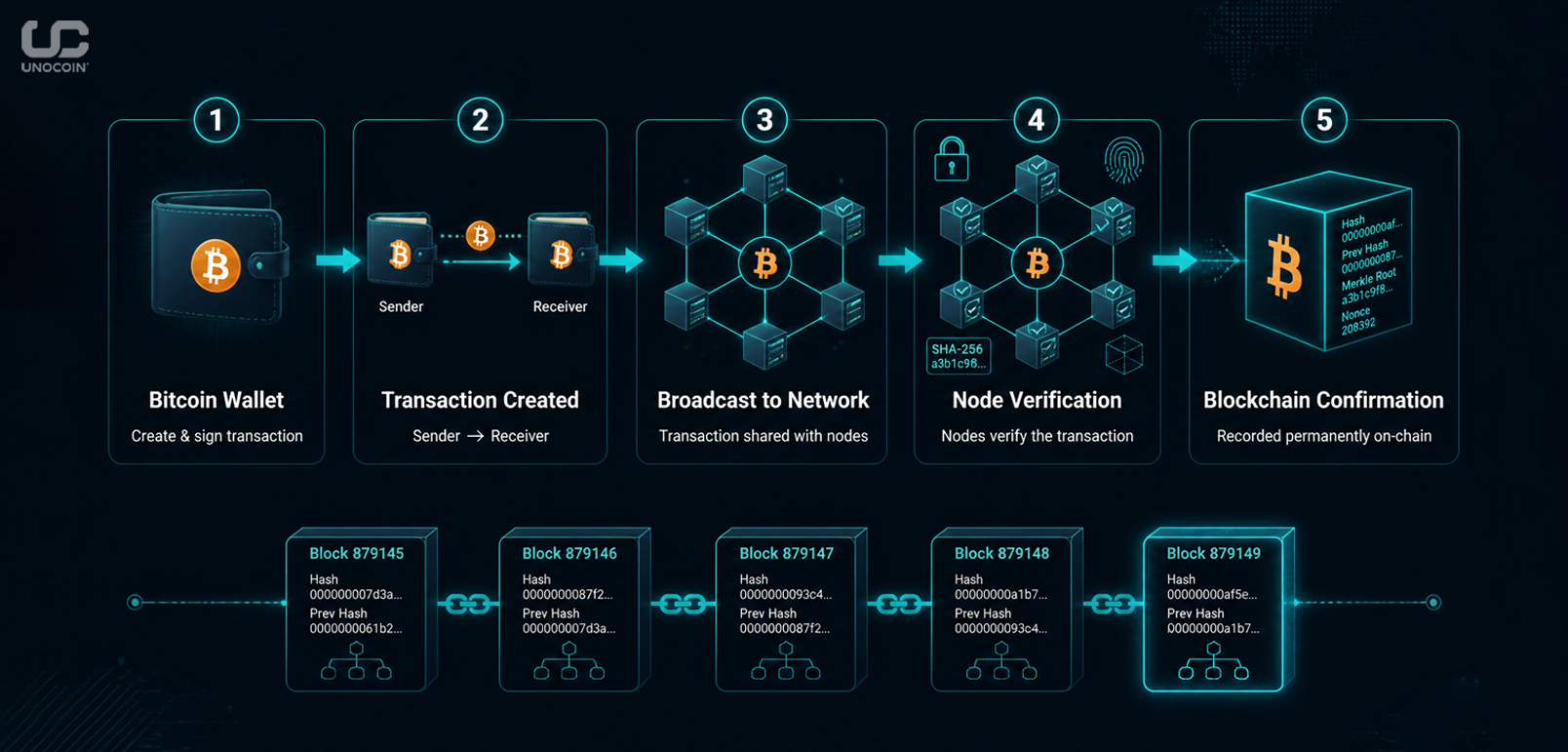
Let’s follow exactly what happens when you send Bitcoin to another person — step by step.
1
You Create a Transaction In your Bitcoin wallet
Suppose you want to send 0.01 BTC to another Bitcoin address. You enter the recipient’s address and the amount in your wallet. Your wallet creates a transaction that specifies which Bitcoin outputs are being spent and where the resulting Bitcoin should go.
2
Your Wallet Signs the Transaction Using your private key
Your wallet uses your private key to digitally sign the transaction. This signature allows the network to verify that the person attempting to spend the Bitcoin has the authority to do so. Crucially, your private key itself is never sent to the Bitcoin network — only the digital signature is.
3
The Transaction Is Broadcast To the peer-to-peer network
Once signed, the transaction is broadcast to Bitcoin’s peer-to-peer network. Other nodes receive the transaction and begin checking whether it follows the rules of the Bitcoin protocol.
4
Nodes Verify the Transaction Against Bitcoin’s consensus rules
Nodes check several things before accepting the transaction. For example, they verify that:
✓The transaction is correctly formatted
✓The digital signature is valid
✓The Bitcoin being spent is available
✓The same Bitcoin has not already been spent (double-spend check)
✓The transaction follows Bitcoin’s consensus rules
5
The Transaction Waits in the Mempool
The unconfirmed transaction waiting area
Valid transactions that have not yet been included in a block wait in a temporary pool commonly called the mempool. Think of the mempool as a waiting area for transactions before they are packaged into a block. The transaction is not yet permanently recorded on the blockchain at this stage.
6
Miners Select Transactions Building a candidate block
Bitcoin miners select transactions from the available pool and assemble them into a candidate block. Transactions generally include fees, and miners have an incentive to include transactions that offer attractive fees relative to the space they consume in a block. The miner then attempts to produce a valid Proof of Work for that block.
7
The Block Is Added to the Blockchain
First confirmation — transaction recorded
When a miner finds a valid block, it is broadcast to the network. Other nodes independently verify the block. If the block follows Bitcoin’s rules, nodes accept it and add it to their copy of the blockchain. Your transaction now has its first confirmation and is permanently recorded.
8
Additional Confirmations Increase Confidence
Each new block adds another confirmation
Once included in a block, the transaction receives one confirmation. Each subsequent block added after it adds another confirmation.
1Block containing your transaction = 1 confirmation
2One additional block after = 2 confirmations
6+Most recipients consider 6 confirmations highly settled
The more blocks built on top of the transaction’s block, the more computational work would be required to reorganize that part of the blockchain. For larger transactions, users may wait for multiple confirmations.
What Is the Bitcoin Mempool??
The Bitcoin mempool, short for “memory pool,” is a temporary waiting area for valid Bitcoin transactions that have been broadcast to the network but have not yet been included in a block.
When you send Bitcoin, your transaction does not immediately become part of the blockchain. After the transaction is broadcast, Bitcoin nodes verify it against the network’s rules. If it is valid, it can be accepted into a node’s mempool and relayed to other nodes.
You can think of the mempool like a waiting room:
Bitcoin transaction → Node verification → Mempool → Miner → Block → Blockchain
The mempool is not one single global database. Each Bitcoin node can maintain its own local mempool, so the transactions and their order can differ between nodes.
What Happens to a Bitcoin Transaction in the Mempool?
Once a valid transaction is in the mempool, it waits to be included in a future block.
Miners select transactions from the transactions available to them and assemble them into candidate blocks. Transaction fees are one factor miners consider when deciding which transactions to include, particularly when block space is limited.
Once a miner successfully produces a valid block containing the transaction and the network accepts that block, the transaction moves from being unconfirmed to having its first blockchain confirmation.
Does the Mempool Store Bitcoin?
No. The mempool does not store Bitcoin.
It temporarily stores information about unconfirmed transactions waiting to be included in a block.
Bitcoin ownership and transaction history are recorded on the blockchain. The mempool is simply part of the process through which transactions move from being created to becoming confirmed blockchain records.
How Long Does a Bitcoin Transaction Stay in the Mempool?
There is no fixed amount of time.
A transaction could be included in a block relatively quickly, while another may remain unconfirmed for longer depending on factors such as network activity, available block space, transaction fee rates and miner selection.
If a transaction remains unconfirmed for too long, its treatment can also depend on individual node policies and wallet or service behaviour.
Once the transaction is included in an accepted block, it is no longer considered merely an unconfirmed mempool transaction.
Mempool vs Blockchain: What’s the Difference?
The simplest way to remember the difference is:
Mempool = transactions waiting to be confirmed
Blockchain = confirmed transaction history
The mempool is temporary and can vary from one node to another. The blockchain is the shared, persistent record that forms Bitcoin’s transaction history.
This distinction is important because seeing a transaction in a wallet or on a blockchain explorer does not necessarily mean that it has already received a blockchain confirmation.
What Is the Bitcoin Blockchain?
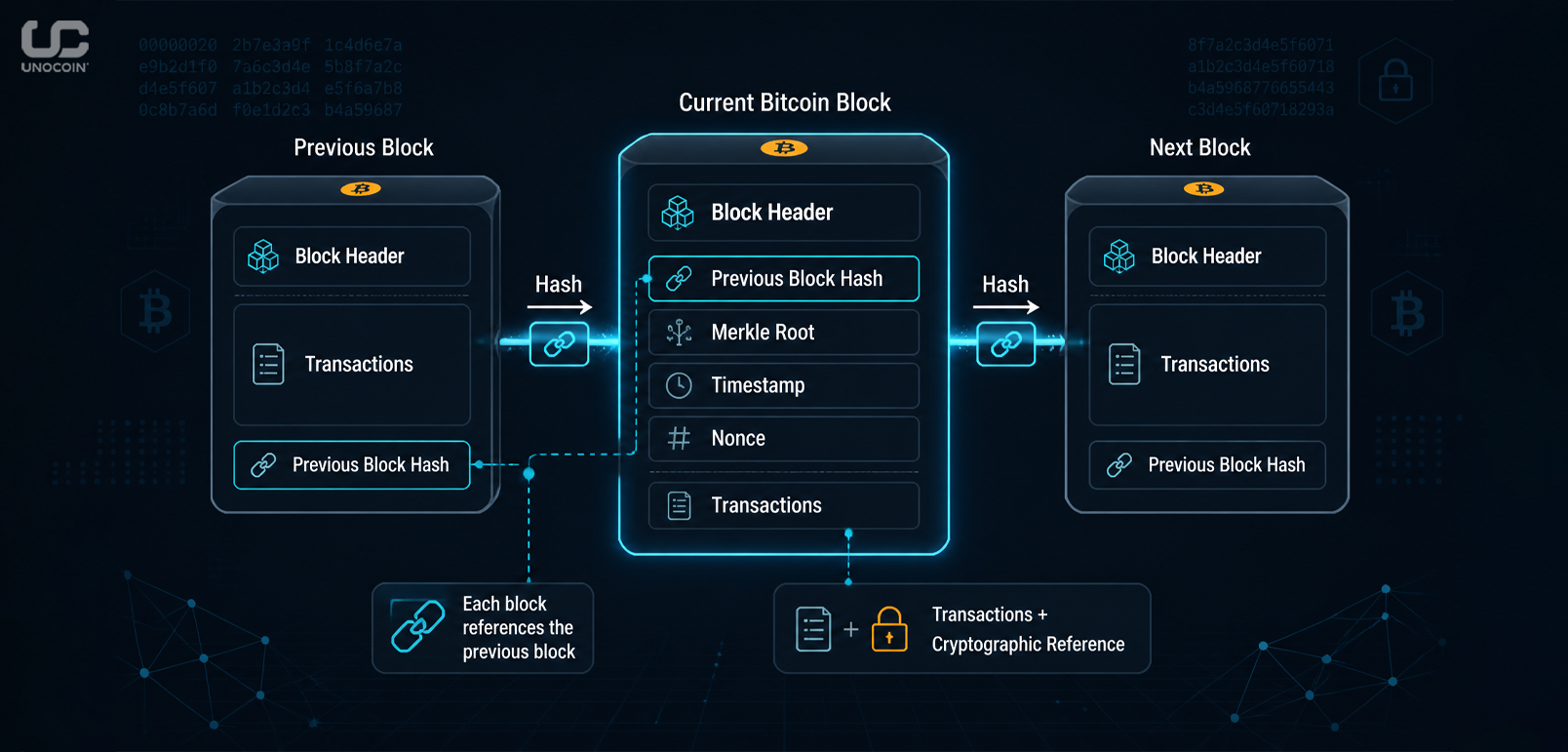
The Bitcoin blockchain is a public, chronological record of Bitcoin transactions. It consists of a sequence of blocks, with each block containing transaction data and cryptographic information that connects it to the previous block.
You can think of it like a continuously growing chain of digital records. Each new block points back to the previous block through cryptographic data, making it extremely difficult to change historical information without also affecting all subsequent blocks.
What Is a Bitcoin Block?
A Bitcoin block is a collection of transactions that has been accepted into the blockchain. A block contains:
•Transactions
•A reference to the previous block
•A timestamp
•A cryptographic commitment
•Information used in the Proof of Work process
Blocks are added to the Bitcoin blockchain approximately every 10 minutes on average — though the actual time between individual blocks can vary based on network conditions and the number of miners actively competing.
Why Is the Blockchain Difficult to Change?
Bitcoin does not make historical transactions impossible to alter through a simple “lock” on the database. Instead, its security comes from the combination of cryptographic linking, network consensus and Proof of Work.
Changing an old transaction would require an attacker to reproduce the necessary Proof of Work for that block and catch up with the honest chain while competing against the rest of the network simultaneously. This is one of the reasons Bitcoin’s blockchain becomes increasingly difficult to rewrite as more blocks are added.
How Does Bitcoin Mining Work?
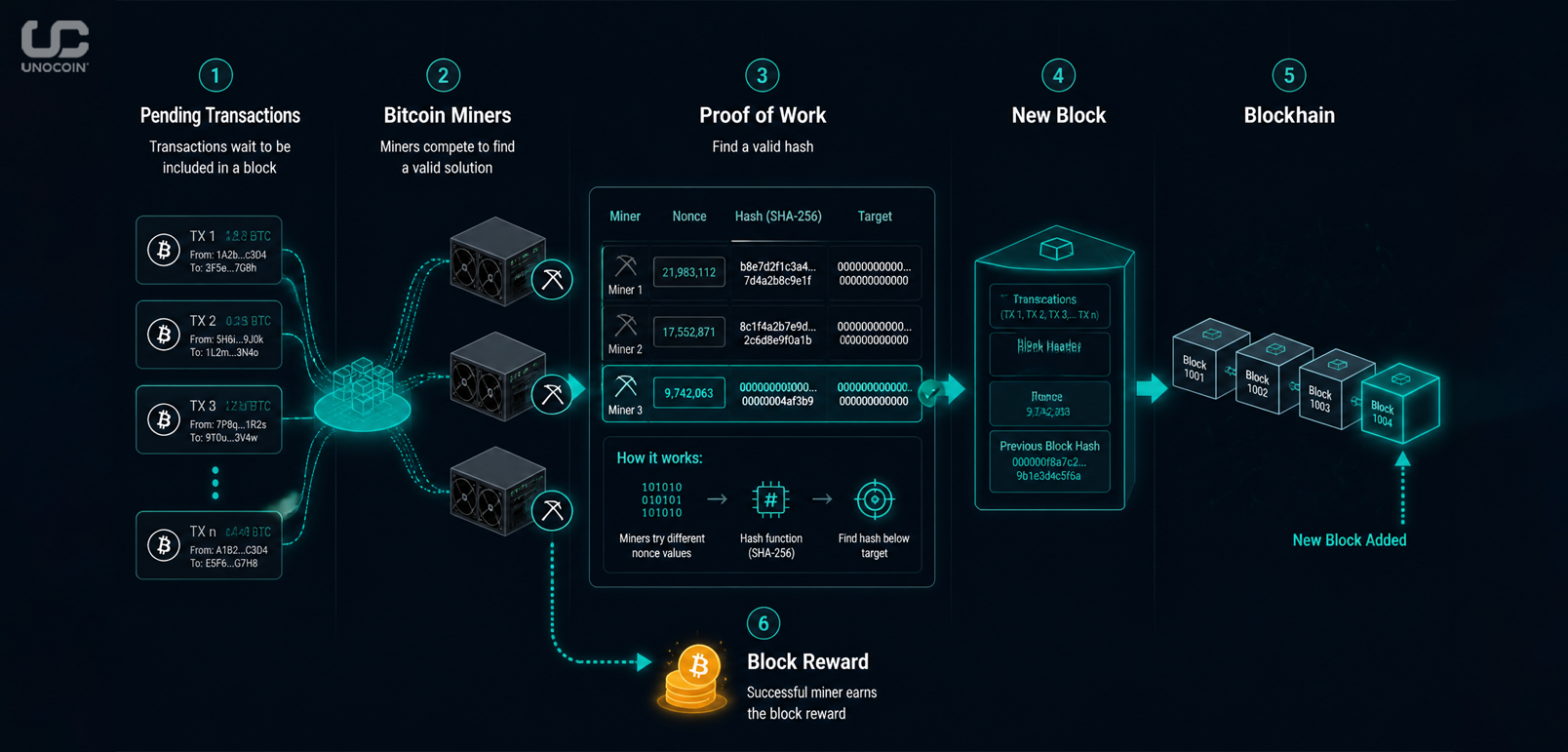
Bitcoin mining is the process used to add new blocks to the blockchain through Proof of Work. Despite the name, Bitcoin mining does not involve finding physical Bitcoin. Instead, miners use specialised computers to compete in a computational process.
What Do Bitcoin Miners Actually Do?
The Bitcoin Miner’s Process
1Collect valid transactions from the mempool
2Build a candidate block from those transactions
3Construct the required block header information
4Search for a valid Proof of Work — the computationally expensive step
5Broadcast the block if a valid solution is found
6Receive the block reward and eligible transaction fees if the block is accepted
What Is Proof of Work?
Proof of Work is Bitcoin’s consensus mechanism. Miners repeatedly change a value in the block header and calculate cryptographic hashes until they find a result that satisfies the network’s current difficulty requirement. There is no shortcut — a miner cannot simply calculate the answer directly.
The Key Asymmetry of Proof of Work
FINDING a valid Proof of Work
⛏️
Computationally expensive
Billions of attempts required
VERIFYING a valid Proof of Work
✅
Comparatively easy
Any node can check instantly
How Do Bitcoin Miners Earn Bitcoin?
Block Subsidy
Newly issued Bitcoin included in the block reward. Currently 3.125 BTC per block after the April 2024 halving. Decreases over time through Bitcoin’s halving schedule.
Transaction Fees
Fees paid by users whose transactions are included in the block. Will eventually become miners’ primary compensation once the block subsidy reaches zero.
What Are Bitcoin Nodes?
A Bitcoin node is a computer that participates in the Bitcoin network and helps enforce the rules of the protocol. Nodes independently verify transactions and blocks. This is an important distinction:
Miners
Propose blocks they perform Proof of Work and attempt to add new blocks to the chain.
Nodes
Verify blocks they check whether proposed blocks follow Bitcoin’s consensus rules and can reject invalid ones.
A miner cannot simply create an invalid transaction and force the Bitcoin network to accept it. If a proposed block violates Bitcoin’s consensus rules, nodes reject it. This separation between mining and validation is a fundamental part of Bitcoin’s decentralised design.
How Does Bitcoin Prevent Double Spending?
One of the biggest challenges in creating digital money is preventing someone from spending the same unit twice. With physical cash, handing a ₹500 note to someone means you no longer have that physical note. Digital information can normally be copied — so how does Bitcoin solve this?
Bitcoin’s Double-Spend Solution
1When a transaction is broadcast, nodes check whether the Bitcoin being spent is available and has not already been spent in an accepted transaction
2The blockchain provides a shared transaction history that the entire network can use to determine which spending is valid
3Once a transaction is confirmed in a block, the network consensus makes it extremely difficult to invalidate it and attempt the same spend again
How Long Does a Bitcoin Transaction Take?
Bitcoin blocks are targeted to arrive approximately every 10 minutes on average. However, that does not mean every Bitcoin transaction takes exactly 10 minutes. The actual time depends on several factors:
→Network conditions and congestion at the time of sending
→Transaction fee — higher fees are typically prioritized by miners
→When the transaction is selected by a miner for the next block
→How many confirmations the recipient requires before releasing goods or services
A transaction may be visible on the network almost immediately — but it is not permanently settled until it receives its first block confirmation. For smaller everyday transactions, many exchanges and wallets consider 1–3 confirmations sufficient. For larger transactions, 6+ confirmations is a common standard.
What Happens When You Send or Receive Bitcoin?
Here is the entire Bitcoin transaction process in one clear view — from the moment you send to the moment it is permanently confirmed:
Complete Bitcoin Transaction Flow — Sender to Blockchain
STEP 1You enter the recipient’s Bitcoin address and amount in your wallet
STEP 2Your wallet creates the transaction
STEP 3Your private key digitally signs the transaction (without revealing the key)
STEP 4The transaction is broadcast to the Bitcoin peer-to-peer network
STEP 5Nodes verify the transaction against Bitcoin’s consensus rules
STEP 6Valid transaction waits in the mempool (unconfirmed transactions pool)
STEP 7A miner selects the transaction and includes it in a candidate block
STEP 8Miner completes Proof of Work and broadcasts the new block
STEP 9Nodes independently verify the block and accept it
STEP 10The block is added to the blockchain — transaction receives its first confirmation ✓
STEP 11Each additional block added after it provides another confirmation — increasing settlement finality ✓✓✓
Is Bitcoin Really Decentralised?
Bitcoin is designed so that no single organization needs to control the network. Different participants perform different roles — and no one role controls all the others.
Users
Create and receive transactions
Wallets
Manage keys and create signed transactions
Nodes
Verify transactions and blocks against consensus rules
Miners
Compete to add new blocks using Proof of Work
Important distinction: Decentralization is not the same thing as saying Bitcoin has no rules. Bitcoin operates according to a set of protocol rules that participating nodes independently verify — the rules are decentralised, not absent.
Bitcoin Explained With a Simple Example
Rahul Sends 0.01 BTC to Priya
①Rahul opens his Bitcoin wallet and enters Priya’s Bitcoin address
②His wallet creates the transaction and signs it using Rahul’s private key
③The transaction is broadcast across the Bitcoin network
④Nodes verify Rahul has the Bitcoin available and the transaction is valid
⑤The transaction enters the mempool — waiting for a miner
⑥A miner includes it in a candidate block and finds a valid Proof of Work
⑦Nodes verify and accept the block — it is added to the blockchain
⑧Priya’s transaction now has its first confirmation — no bank approval required at any step
That is the basic mechanism that allows Bitcoin to operate as a peer-to-peer digital payment network — without any bank, payment processor or central authority involved at any stage.
Bitcoin vs Traditional Bank Transfers
The easiest way to understand Bitcoin’s architecture is to compare it with the system most people already know — a traditional bank transfer. See our detailed Bitcoin vs Ethereum guide for a comparison of the two largest cryptocurrencies.
| Feature | Bitcoin | Traditional Bank |
|---|---|---|
| Transaction record | Public blockchain | Bank’s private ledger |
| Central authority | None required | Bank / payment system |
| Validation | Distributed network participants | Bank / payment provider |
| Transaction availability | 24/7 — always open | Depends on banking hours |
| New monetary units | Protocol-defined issuance — fixed max 21M BTC | Central bank controlled |
| Security model | Cryptography + consensus + Proof of Work | Institutional controls + banking infrastructure |
Bitcoin replaces the need for a central ledger operator with a distributed network that independently verifies transactions according to predefined, transparent rules.
What Makes Bitcoin Secure?
Bitcoin’s security comes from several mechanisms working together — not from a single technology. It is this combination that makes the system robust:
Cryptography
Digital signatures prove that a transaction was authorised by the holder of the relevant private key — without revealing that key to anyone.
Decentralization
Many independent participants verify and relay transactions globally — there is no single point of failure that can be targeted or shut down.
Proof of Work
Mining makes adding blocks computationally expensive — making it extremely costly to attack or rewrite the blockchain’s history.
Blockchain Structure
Blocks are cryptographically linked — changing any historical block would require recalculating all subsequent blocks while outpacing the rest of the network.
Consensus Rules
Nodes independently verify whether transactions and blocks follow Bitcoin’s rules — ensuring no single miner or group can change what is valid.
Key Takeaway: How Does Bitcoin Work?
Your wallet creates and signs the transaction
Nodes verify the transaction against consensus rules
Miners add verified transactions to blocks using Proof of Work
The blockchain permanently records the transaction — visible to anyone
The next time you send Bitcoin, you’re not simply moving a digital coin from one app to another. You’re creating a cryptographically signed transaction that travels through a global network, gets verified, is included in a block and becomes part of Bitcoin’s permanent shared transaction history.
Frequently Asked Questions About How Bitcoin Works
QHow does Bitcoin work for beginners?
Bitcoin allows people to transfer digital value through a decentralised network — without a bank or payment company. Transactions are digitally signed using private keys, verified by nodes, added to blocks by miners through Proof of Work, and permanently recorded on the public blockchain.
QHow does a Bitcoin transaction work?
A Bitcoin transaction is created by the sender’s wallet, digitally signed using their private key, broadcast to the network, verified by nodes, selected by a miner, included in a block through Proof of Work, and then accepted by the network — at which point it receives its first confirmation on the blockchain.
QHow does Bitcoin mining work?
Bitcoin mining uses Proof of Work. Miners use specialised computers to repeatedly calculate cryptographic hashes until they find a valid result for a new block. The successful miner receives the block subsidy (currently 3.125 BTC) and transaction fees if the block is accepted by the network.
QWhat is the Bitcoin blockchain?
The Bitcoin blockchain is a public, chronological record of Bitcoin transactions organised into blocks. Each block is cryptographically linked to the one before it and secured by network consensus and Proof of Work — making historical records extremely difficult to alter.
QWhat are Bitcoin nodes?
Bitcoin nodes are computers that participate in the Bitcoin network and independently verify transactions and blocks against Bitcoin’s protocol rules. They are distinct from miners — miners propose blocks, while nodes verify whether those blocks follow the rules and can reject invalid ones.
QHow long does a Bitcoin transaction take?
Bitcoin targets an average block interval of approximately 10 minutes, but a transaction may take longer depending on network congestion, the fee attached, and when it is included in a block. Additional confirmations take additional blocks — most exchanges consider 3–6 confirmations sufficient for standard transactions.
QWhat is Proof of Work in Bitcoin?
Proof of Work is Bitcoin’s consensus mechanism. It requires miners to perform extensive computational work to produce valid blocks — making it costly to attack or rewrite the blockchain. Finding a valid Proof of Work is difficult; verifying one is comparatively easy. This asymmetry is fundamental to Bitcoin’s security.
QCan Bitcoin transactions be reversed?
Confirmed Bitcoin transactions generally cannot simply be reversed like a bank transfer. Once a transaction has been confirmed on the blockchain, recovering Bitcoin sent to the wrong address generally depends on the recipient choosing to return it — there is no central authority that can reverse the transaction.
QWhere is Bitcoin stored?
Bitcoin itself is recorded on the Bitcoin blockchain — not inside a wallet. A wallet manages the cryptographic private keys that allow you to control and spend Bitcoin associated with your addresses. If you lose your private keys, you lose access to the associated Bitcoin.
QWhat happens when all Bitcoin is mined?
Bitcoin’s block subsidy is designed to decrease through periodic halvings — approximately every four years. Once the subsidy eventually reaches zero (estimated around the year 2140), miners will rely entirely on transaction fees for compensation. The network is designed to continue operating through fee incentives alone.
Final Thoughts
Understanding how Bitcoin works makes it easier to see why it is fundamentally different from traditional money and payment systems. Bitcoin doesn’t rely on one central database or institution to process every transaction. Instead, wallets, nodes, miners, cryptography and the blockchain work together according to a shared set of transparent rules.
For a broader introduction to Bitcoin — including what Bitcoin is, why it was created, how its supply works and why people assign value to it — read our complete cornerstone guide:
Disclaimer
This article is for informational and educational purposes only and does not constitute financial or investment advice. Cryptocurrency investments involve significant risk. Always conduct your own research before making investment decisions. Crypto products are unregulated as of this date in India. Please DYOR (Do Your Own Research).
Related Guides on the Unocoin Blog