

Key Takeaways — Crypto Trading in India
✔Cryptocurrency trading in India is fully legal — buy, sell, and trade on FIU-registered exchanges like Unocoin.
✔Crypto markets are open 24/7 — unlike stock markets, you can trade any time including weekends.
✔Beginners should start with spot trading using Market Orders before exploring advanced strategies.
✔All crypto trading profits are taxed at a flat 30% in India — plus 1% TDS on qualifying transactions.
✔Bitcoin and Ethereum are the most recommended cryptocurrencies for first-time traders in India.
✔Not ready to actively trade? Unocoin’s SBP (Systematic Buying Plan) lets you invest automatically from ₹100/week.
Cryptocurrency trading in India is legal, accessible, and available 24/7 through regulated exchanges like Unocoin. Beginners can start trading Bitcoin, Ethereum, Solana, XRP, and 150+ other cryptocurrencies with as little as ₹100 — using simple Market Orders or price-targeted Limit Orders.
Cryptocurrency trading has gained significant popularity in India as more people explore digital assets like Bitcoin, Ethereum, Solana, and XRP. While some investors buy cryptocurrencies for long-term wealth creation, others actively trade them to take advantage of short-term price movements.
If you are new to crypto, trading may seem complicated at first. Terms like market orders, limit orders, candlestick charts, and stop-losses can feel overwhelming. However, once you understand the basics, trading becomes much easier to follow.
Unlike traditional stock markets that operate only during business hours, cryptocurrency markets are open 24 hours a day, 7 days a week. This allows traders to react to market movements whenever opportunities arise. At the same time, crypto prices can be highly volatile — making it important to trade with a clear strategy and proper risk management.
What Is Cryptocurrency Trading?

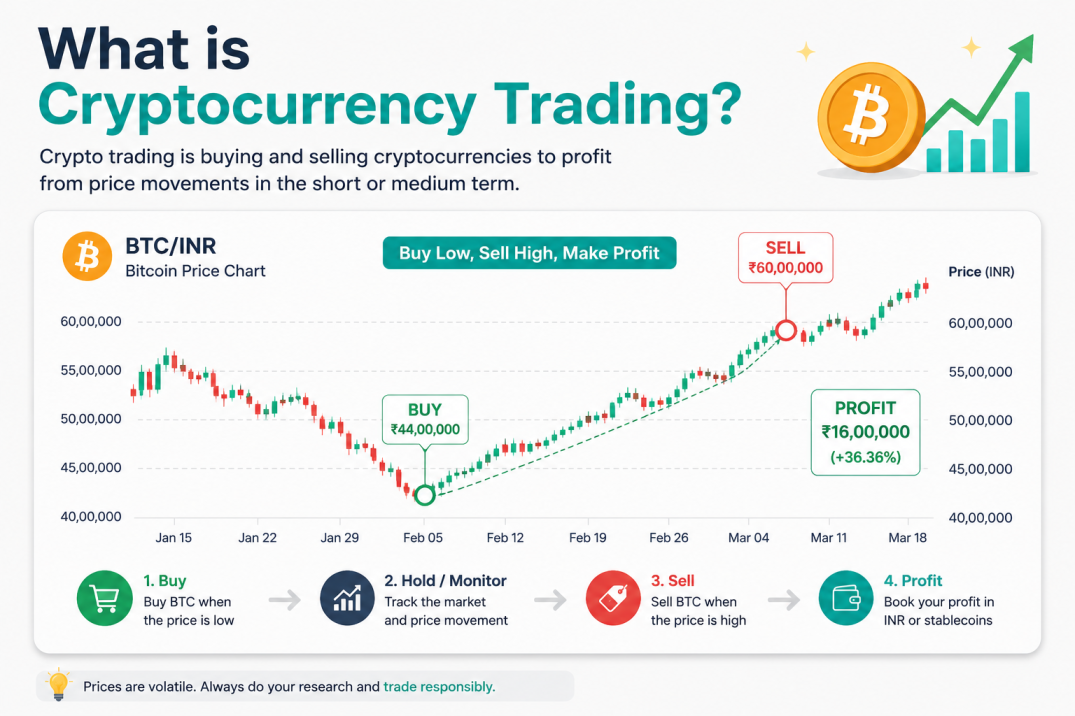
Cryptocurrency trading is the process of buying and selling digital currencies with the goal of benefiting from changes in their market prices. Instead of holding an asset for several years, traders typically look for opportunities to buy at one price and sell at another based on market conditions.
Simple Trading Example
①You buy Bitcoin (BTC) when it is trading at ₹60 lakh
②A few days later, Bitcoin rises to ₹65 lakh
③If you sell at the higher price, the difference (after applicable fees and taxes) becomes your potential profit
The same concept applies to other cryptocurrencies such as Ethereum (ETH), Solana (SOL), XRP, and many others listed on cryptocurrency exchanges. Unlike stock markets, crypto markets operate 24/7 — meaning you can buy or sell at any time, including weekends and public holidays.
Important: Trading also involves risk. Cryptocurrency prices can move rapidly, and there is no guarantee of profit. Successful traders focus on learning the market, following a strategy, and managing risk — not predicting every price movement.
Is Cryptocurrency Trading Legal in India?
Yes — individuals in India can legally buy, sell, and trade cryptocurrencies through compliant cryptocurrency exchanges. However, cryptocurrencies such as Bitcoin are not recognised as legal tender in India. Instead, they are treated as Virtual Digital Assets (VDAs) under India’s tax framework.
Legal Confirmation: Cryptocurrency trading in India is permitted under the current regulatory framework. Unocoin is registered with FIU-IND as a compliant Virtual Asset Service Provider (VASP).
If you are planning to trade cryptocurrency, keep these points in mind:
•Complete the required KYC verification on your chosen exchange
•Use a trusted, FIU-registered platform that follows applicable compliance requirements
•Maintain records of your crypto transactions for tax filing purposes
•Stay informed about regulatory updates, as rules and taxation may evolve over time
Crypto Trading vs. Crypto Investing — What Is the Difference?
Although the terms trading and investing are often used interchangeably, they refer to two fundamentally different approaches. Understanding the distinction is an important first step before deciding which path suits you.
| Feature | Crypto Trading | Crypto Investing |
|---|---|---|
| Goal | Benefit from short-term price movements | Build long-term wealth |
| Holding Period | Minutes, hours, days, or weeks | Months or years |
| Trading Activity | Frequent buying and selling | Buy and hold |
| Time Commitment | High | Low to Moderate |
| Suitable For | Active market participants | Long-term investors |
What About HODLing?
HODLing is a popular strategy where investors continue holding their cryptocurrency despite short-term market fluctuations. It is commonly used by people who believe in the long-term growth potential of assets like Bitcoin — and it does not require active trading skills.
A Beginner-Friendly Alternative: Systematic Buying Plan (SBP)
What is a Systematic Buying Plan (SBP)?
If actively tracking the market every day is not your goal, a Systematic Buying Plan (SBP) offers a disciplined way to build your crypto portfolio. Instead of trying to time the market, you invest a fixed amount at regular intervals — automatically.
This approach — also known as Dollar-Cost Averaging (DCA) — helps reduce the impact of short-term market volatility by spreading your purchases over time.
How to Start Trading Cryptocurrency in India — 6 Steps
Once you understand the basics, the next step is learning how to place your first trade. Whether you are interested in trading Bitcoin, Ethereum, Solana, or XRP, the overall process is straightforward when using a trusted cryptocurrency exchange.
Total Setup Time: Under 30 minutes — from account creation to your first trade on Unocoin.
1
Choose a Trusted Cryptocurrency Exchange
The most important decision
Your trading journey begins by selecting a reliable cryptocurrency exchange that supports INR deposits, follows regulatory requirements, and offers a secure trading experience. When comparing exchanges, consider:
•Security features and account protection (2FA, cold storage)
•Supported cryptocurrencies and trading pairs
•Trading fees and transparent fee structure
•INR deposit and withdrawal options (UPI, NEFT, IMPS)
•Ease of use for beginners
Tip: Unocoin allows users to buy, sell, and trade popular cryptocurrencies through a simple interface designed for both new and experienced users.
2
Complete Your KYC Verification
⏱ ~10 minutes
Most cryptocurrency exchanges in India require KYC verification before accessing trading features. You will typically need to provide:
✓PAN card
✓Aadhaar card
✓Mobile number and email
✓Selfie / liveness check
3
Deposit INR into Your Account
⏱ ~5 minutes
After your account is verified, add funds before placing your first trade. Most Indian crypto exchanges support convenient INR payment methods:
IMPS
NEFT
RTGS
4
Choose the Cryptocurrency You Want to Trade
Match crypto to your goals and risk tolerance
Before placing your first order, decide which cryptocurrency aligns with your trading goals. Here are the most commonly traded cryptos for Indian beginners:
₿ Bitcoin (BTC)
World’s first and largest cryptocurrency — highest liquidity, mature market. Suitable for first-time traders and long-term investors alike.
Ξ Ethereum (ETH)
Powers thousands of decentralised apps and smart contracts. One of the most widely used blockchain networks with strong trading volume.
◎ Solana (SOL)
Known for fast transaction speeds and low network fees. More volatile than Bitcoin — attracts traders looking for high-growth blockchain exposure.
✕ XRP
Designed for fast, low-cost cross-border payments. Remains one of the most actively traded cryptocurrencies in global markets.
Beginner Tip: If you are new to cryptocurrency trading, starting with well-established assets like Bitcoin or Ethereum is generally easier than trading newer or low-liquidity tokens.
5
Place Your First Trade
Market Order or Limit Order
Once you have selected a cryptocurrency, it is time to place your first order. You will typically choose between two order types — covered in detail in the next section below.
6
Monitor Your Portfolio
Ongoing — develop a disciplined approach
Placing a trade is only the beginning. Successful trading also involves tracking your portfolio and reviewing market movements over time. Instead of reacting to every price fluctuation, consider:
•Reviewing your portfolio at regular intervals — not obsessively
•Setting realistic profit and loss expectations before each trade
•Avoiding impulsive decisions based on social media trends
•Staying informed about major market developments via trusted sources
Market Order vs. Limit Order — What Is the Difference?
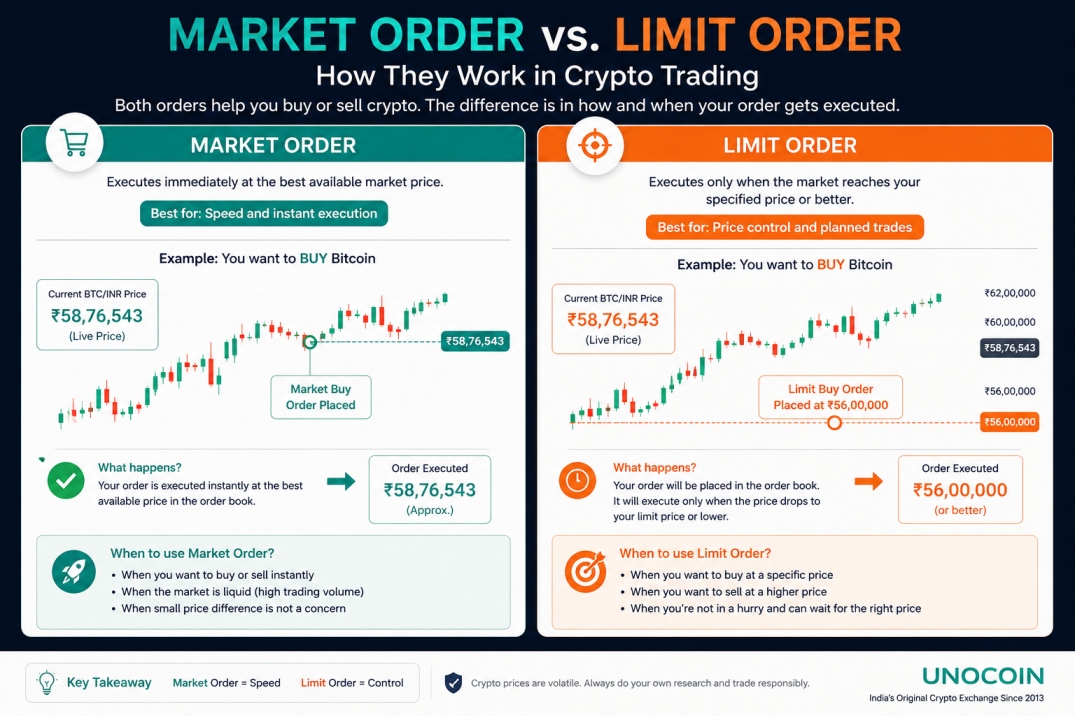
When trading on an exchange, you will typically choose between two common order types. Understanding the difference can help you make more informed trading decisions from your very first trade.
Market Order
A Market Order buys or sells immediately at the best available market price. This is the simplest order type — commonly used by beginners who want their trade to execute as quickly as possible.
EXAMPLE
Bitcoin is at ₹95,00,000. You want to buy immediately. A Market Order executes at the best available price right now.
Best for: beginners, urgent trades, high liquidity assets
Limit Order
A Limit Order lets you specify the exact price at which you want to buy or sell. Your order stays open until the market reaches your chosen price — or you cancel it.
EXAMPLE
Bitcoin is at ₹95,00,000 but you believe it may drop to ₹92,00,000. You place a Limit Buy at ₹92,00,000 — executes only if that price is reached.
Best for: planned entries, target price exits, experienced traders
| Feature | Market Order | Limit Order |
|---|---|---|
| Execution | Immediate | Only at your specified price |
| Speed | Fast | Depends on market conditions |
| Price Control | Lower (may slip in volatile markets) | Higher (you set the price) |
| Best For | Beginners and urgent trades | Planned entries and exits |
For Most Beginners: Start with a Market Order for your first purchase — it is the simplest option and executes immediately. As you gain experience, Limit Orders can help you trade at your preferred price levels.
Understanding Basic Crypto Charts for Beginners
Before making trading decisions, it is helpful to understand how cryptocurrency price charts work. While professional traders use advanced technical indicators, beginners only need to learn three core concepts to get started.

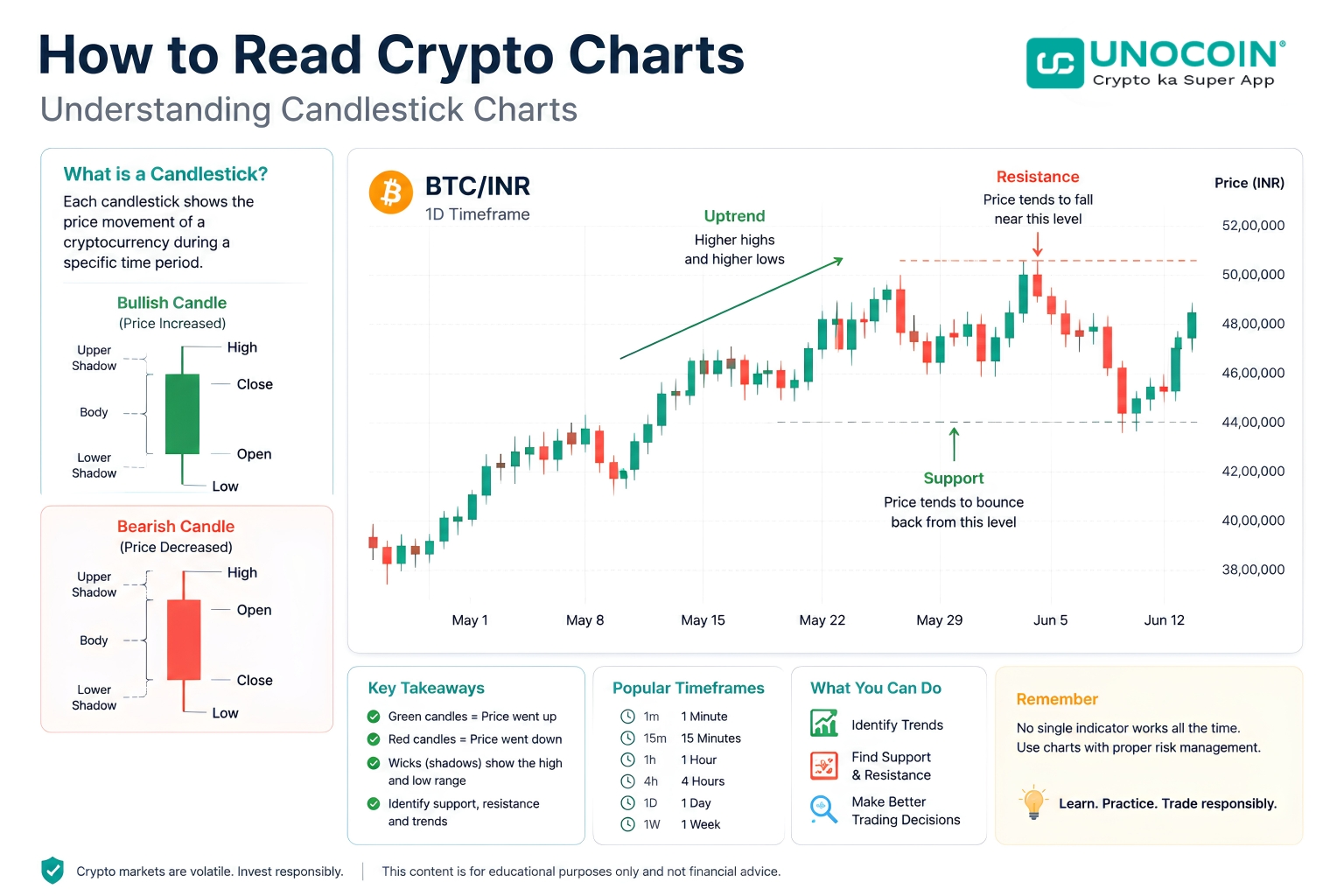
Candlestick Charts
Candlestick charts are the most commonly used way to visualise cryptocurrency price movements. Each candlestick represents price activity during a selected time period and shows four key prices:
Open: Price at start of period
Close: Price at end of period
🟢 Green candle: Closed higher than it opened (price went up)
🔴 Red candle: Closed lower than it opened (price went down)
Trading Volume
Trading volume refers to the total amount of a cryptocurrency bought and sold during a specific period. Higher trading volume often suggests stronger market participation, while lower volume may indicate reduced trading activity. For beginners, volume provides additional context when evaluating price movements.
Support and Resistance
Two basic concepts that many traders use when reading charts:
🟢 Support
A price level where buying interest tends to increase — potentially slowing a decline. Price often “bounces” off support.
🔴 Resistance
A price level where selling pressure tends to increase — potentially limiting further price gains. Price often stalls at resistance.
Note: Support and resistance levels are not guarantees — they are areas where price behaviour may change based on historical patterns.
Types of Cryptocurrency Trading — Which Style Suits You?
Not every crypto trader follows the same approach. Choosing the right trading style depends on your experience, available time, financial goals, and risk tolerance. Here are the four most common types:
SPOT
TRADING
Spot Trading — Simplest & Most Popular
You buy a cryptocurrency at the current market price and own the actual asset. You can hold it or sell it later based on your strategy. This is the most beginner-friendly approach.
Best suited for: Beginners · Long-term investors · Anyone who wants to own crypto
SWING
TRADING
Swing Trading — Short to Medium Term
Swing traders aim to benefit from price movements that occur over several days or weeks. This style requires some understanding of chart patterns and market analysis — but generally involves less screen time than day trading.
Best suited for: Part-time traders · Users with basic market knowledge
DAY
TRADING
Day Trading — High Activity, High Risk
Day trading involves buying and selling cryptocurrencies within the same day. Because crypto markets operate 24/7, day traders often monitor price movements closely and may place several trades throughout the day. This carries higher risk and requires discipline, experience, and a well-defined strategy.
Best suited for: Experienced traders · Active, full-time market participants
POSITION
TRADING
Position Trading — Long-Term Trends
Position traders focus on long-term market trends rather than daily price fluctuations. Trades may remain open for several weeks or months. This approach combines elements of investing and active trading — based on broader market analysis rather than short-term volatility.
Best suited for: Investors with a long-term outlook · Less frequent traders
Not sure which style is right for you? Beginners are generally better off starting with spot trading before exploring more advanced approaches like swing or day trading.
Tips for Trading Cryptocurrency Safely in India
Successful trading is not just about finding the right opportunity — it is also about protecting your capital. Developing good habits early can help reduce unnecessary risks and improve decision-making over the long term.
Start Small
Avoid investing a large amount in your first few trades. Starting small allows you to learn how the market works while limiting potential losses during the learning curve.
Never Invest More Than You Can Afford to Lose
Cryptocurrency prices can fluctuate significantly within short periods. Only use money that fits within your financial goals and risk tolerance — never emergency funds or borrowed money.
Diversify Your Portfolio
Rather than investing all your funds in a single cryptocurrency, consider spreading your investment across multiple assets. Diversification may help reduce the impact of sharp price movements in any one asset.
Avoid Emotional Trading
Many beginners make decisions based on fear or excitement — buying because everyone else is buying (FOMO), or panic-selling during temporary market declines. Successful traders rely on research and planning instead of emotions.
Continue Learning
The cryptocurrency market evolves quickly. Following trusted educational resources, market updates, and industry news can help you make more informed decisions over time. The Unocoin blog is a good place to start.
Common Mistakes Beginners Should Avoid in Crypto Trading
Every trader makes mistakes, especially when starting out. Consequently, understanding common pitfalls in advance can help you avoid costly decisions before they happen.
1
Trading Without a Plan
Buying and selling without a clear strategy leads to inconsistent results. Before placing any trade, decide: why you are entering, your target price, your maximum acceptable loss, and when you will exit.
2
Investing Everything at Once
Putting all your money into a single trade increases your exposure to market volatility. Many experienced investors prefer building positions gradually over time instead of investing a lump sum all at once.
3
Chasing Market Hype
Social media trends and viral posts can influence market sentiment, but they should never be the sole reason to buy a cryptocurrency. Always research a project independently before investing.
4
Ignoring Trading Fees
Trading fees, spreads, network fees, and withdrawal charges can significantly affect your overall returns — especially if you trade frequently. Understanding the full fee structure of your exchange helps you calculate potential profits more accurately.
5
Expecting Quick Profits
Cryptocurrency trading is not a guaranteed way to make money quickly. Consistent success requires patience, education, and disciplined decision-making. Focus on learning rather than trying to profit from every single trade.
Understanding Crypto Trading Fees in India
Every cryptocurrency trade may involve certain costs. Being aware of these fees beforehand helps you understand your total trading expenses and calculate net returns more accurately.
Trading Fees
A fee charged by the exchange when you buy or sell a cryptocurrency. Unocoin charges a flat 0.7% per trade — shown transparently before you confirm.
Spread
The difference between the highest price buyers are willing to pay (bid) and the lowest price sellers will accept (ask). Tighter spreads mean lower implicit trading costs.
Network Fees
When transferring cryptocurrency between wallets, blockchain networks charge a transaction fee (also called gas fees). These are paid to the network — not the exchange — and vary by blockchain and congestion.
Withdrawal Fees
Some exchanges charge a fee when withdrawing cryptocurrencies or INR, depending on the withdrawal method and asset. INR withdrawals on Unocoin are free of charge.
Tip: Before placing your first trade, review the fee structure of your chosen exchange carefully — so you understand the total cost of each transaction and can calculate net returns accurately.
Crypto Trading Taxes in India — What Every Trader Must Know
If you are trading cryptocurrency in India, it is important to understand that all crypto transactions have tax implications. Under India’s tax framework, cryptocurrencies are treated as Virtual Digital Assets (VDAs) — and profits from trading are taxed accordingly.
Crypto Tax Quick Summary — FY 2026-27
30%
Flat tax on all crypto trading profits
1%
TDS on qualifying transactions
❌
No loss offsetting against other income
To make tax reporting easier, follow these habits from day one:
•Keep records of every purchase and sale — date, amount, price, exchange
•Save transaction receipts and downloadable statements from Unocoin
•Track trading fees, network fees, and transfer history separately
•Declare all VDA income in your ITR using Schedule VDA (ITR-2 or ITR-3)
Choosing Your First Cryptocurrency to Trade in India
One of the biggest questions new traders ask is: “Which cryptocurrency should I start with?” While there is no one-size-fits-all answer, many beginners choose established cryptocurrencies because they generally have higher liquidity, stronger market adoption, and broader availability on Indian exchanges.
| Cryptocurrency | Why Beginners Choose It |
|---|---|
| Bitcoin | Largest cryptocurrency by market cap — highest liquidity, most widely available on Indian exchanges, most recognised globally |
| Ethereum | Popular blockchain platform with a large developer and user ecosystem — strong trading volume and wide adoption in India |
| Solana | Known for fast transactions and growing adoption — appeals to traders seeking high-growth blockchain exposure |
| XRP | Frequently used for cross-border payment solutions — actively traded with relatively low price per unit |
| Tether | A stablecoin often used to hold value between trades — avoids price volatility while remaining liquid on exchanges |
Why Choose Unocoin for Cryptocurrency Trading in India?
Choosing the right cryptocurrency exchange is just as important as deciding what to trade. A reliable platform should offer strong security, transparent pricing, an easy-to-use interface, and support throughout your trading journey.
Since 2013, Unocoin has been helping Indians buy, sell, and manage cryptocurrencies through a secure and beginner-friendly platform. Whether you are placing your first Bitcoin trade or building a diversified crypto portfolio, Unocoin provides the tools to help you get started with confidence.
150+ Cryptocurrencies
Trade Bitcoin (BTC), Ethereum (ETH), Solana (SOL), XRP, and many more
Easy INR Support
Deposit and withdraw via UPI, NEFT, IMPS — free INR withdrawals
Beginner-Friendly Interface
Designed for both new and experienced traders — clean, simple layout
Bank-Grade Security
2FA, cold storage, multi-sig wallets — industry-standard security practices
Systematic Buying Plan (SBP)
India’s first crypto SIP — invest automatically from ₹100/week without timing the market
Portfolio Tracking
Monitor all your crypto holdings, transaction history, and tax statements in one place
Ready to begin cryptocurrency trading in India?
Create your Unocoin account, complete KYC verification, and start trading with confidence.
Frequently Asked Questions — Crypto Trading India
QWhat is cryptocurrency trading?
Cryptocurrency trading is the process of buying and selling digital assets such as Bitcoin or Ethereum with the aim of benefiting from price movements. Traders may hold assets for minutes, days, or weeks depending on their strategy.
QIs cryptocurrency trading legal in India?
Yes. Individuals in India can buy, sell, and trade cryptocurrencies through compliant exchanges. Cryptocurrencies are not recognised as legal tender but are treated as Virtual Digital Assets (VDAs) subject to applicable regulations and a 30% flat tax on profits.
QHow much money do I need to start trading crypto?
The minimum investment depends on the exchange you choose. On Unocoin, users can start trading with as little as ₹100 — making crypto trading accessible to virtually every Indian investor.
QWhich cryptocurrency is best for beginners in India?
Bitcoin and Ethereum are often considered the best starting points because of their established market presence, higher liquidity, and widespread adoption on Indian exchanges. Both are available on Unocoin.
QWhat is the difference between a Market Order and a Limit Order?
A Market Order executes immediately at the best available price, while a Limit Order executes only when the market reaches the price you specify. Market Orders are better for speed; Limit Orders give greater price control.
QCan I trade cryptocurrency every day in India?
Yes. Cryptocurrency markets operate 24 hours a day, 7 days a week — including weekends and public holidays. You can trade at any time on Unocoin.
QIs cryptocurrency trading risky?
Yes. Cryptocurrency prices can be highly volatile, and there is no guarantee of profit. It is important to research thoroughly, manage risk carefully, start small, and invest only what you can afford to lose.
QDo I need to learn technical analysis before trading?
Not necessarily. Beginners can start by understanding basic concepts such as candlestick charts, trading volume, and support and resistance levels before exploring more advanced technical analysis tools.
QHow are cryptocurrency trades taxed in India?
All crypto trading profits in India are taxed at a flat 30% rate plus 4% cess under Section 115BBH. A 1% TDS is also deducted on qualifying transactions. Losses cannot be offset against other income.
QCan I invest instead of actively trading?
Yes. Many people prefer long-term investing over active trading. Unocoin’s Systematic Buying Plan (SBP) lets you invest a fixed amount automatically at regular intervals — reducing the impact of short-term market volatility without requiring daily market monitoring.
QWhat are the biggest mistakes new crypto traders make?
Common mistakes include: trading without a clear strategy, investing more than you can afford to lose, following market hype without research, ignoring trading fees, and allowing fear or excitement to drive decisions instead of a plan.
QShould I keep all my money in one cryptocurrency?
Diversification can help reduce portfolio risk. Rather than relying on a single cryptocurrency, many investors spread investments across multiple assets — such as Bitcoin, Ethereum, and USDT — based on their goals and risk tolerance.
Final Thoughts — Getting Started with Crypto Trading in India
Cryptocurrency trading offers exciting opportunities — but it also requires knowledge, discipline, and a clear understanding of risk. While short-term price movements can create trading opportunities, successful traders focus on developing consistent strategies rather than chasing quick profits.
If you are just getting started, take time to understand how cryptocurrency markets work, begin with smaller investments, and continue learning as you gain experience. Building good trading habits — such as managing risk, staying informed, and avoiding emotional decisions — can make a meaningful difference over the long term.
Whether your goal is active trading or long-term investing, using a trusted cryptocurrency exchange can help simplify the process. With features such as easy INR transactions, secure account protection, and a beginner-friendly Systematic Buying Plan (SBP), Unocoin provides a practical and accessible starting point for anyone looking to participate in India’s growing crypto ecosystem.
Disclaimer
Cryptocurrency trading involves significant risk. Always conduct your own research and consult a qualified financial professional before making investment decisions. They could be highly volatile. Please DYOR (Do Your Own Research).
Related Guides on the Unocoin Blog