
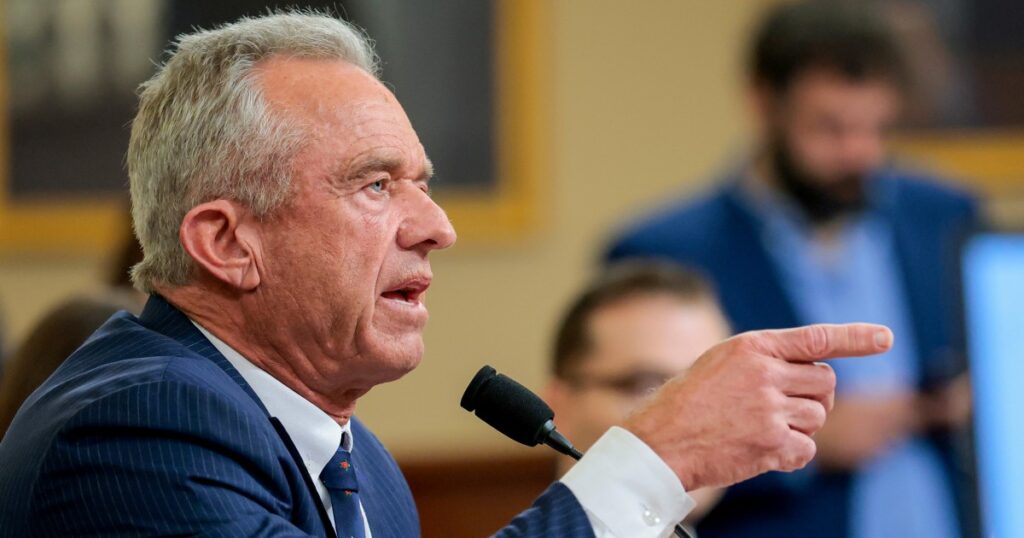
Health Secretary Robert F. Kennedy Jr. faced blistering criticism from Democrats over his vaccine policy and overhaul of federal health agencies at two House committee hearings Thursday.
Subscribe to read this story ad-free
Get unlimited access to ad-free articles and exclusive content.


Both hearings were about the proposed budget for the Department of Health and Human Services next year. The department’s funding request includes a $15.8 billion reduction from this year, for a total of $111.1 billion.
Kennedy has said he intends to consolidate some of the health agencies within HHS and strengthen their focus on disease prevention.
Large parts of the hearings Thursday focused on the sweeping changes Kennedy has made since he assumed the role early last year. Lawmakers commented on Kennedy’s overhaul of the childhood vaccine schedule to include fewer universal recommendations (changes that a judge later blocked), his expressions of doubt about the safety of measles vaccines and his suggestion that Tylenol use in pregnancy could be linked to autism.
The Trump administration also instituted large staffing cuts across federal health agencies, some of which have been reversed. Kennedy stood by the firings when Rep. Steny Hoyer, D-Md., pressed him before a House Appropriations subcommittee.
The terminated staffers “presided over the biggest decline in health in the history of the world,” Kennedy said. “It was their job to protect us, and they did not do it. They failed at their job.”
Kennedy said HHS has 72,000 employees and plans to hire 12,000 more.
“We will have made up all the employees that we lost,” he said. “We’ve replaced them with a better group of people who are actually going to address chronic health.”

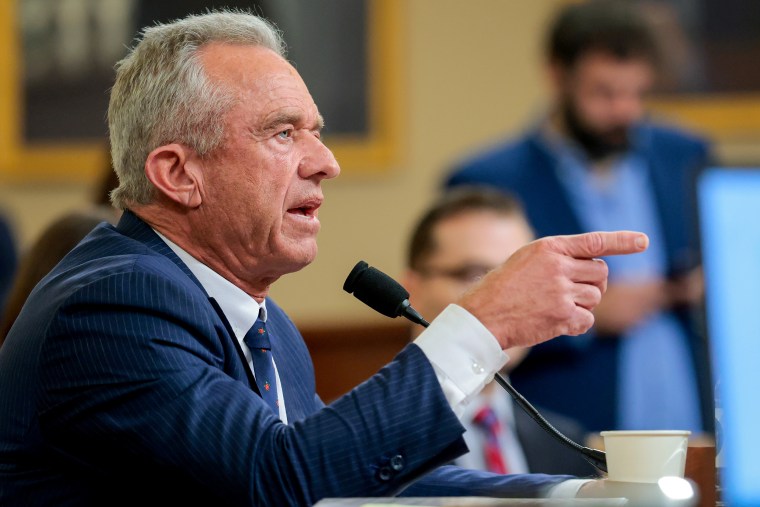
Kennedy also defended his department’s measles response after multiple members of the House Ways and Means Committee criticized his handling of recent outbreaks. The country recorded 2,287 measles cases last year — the most since the disease was first considered eliminated in the U.S. 25 years ago. Another 1,714 cases have already been recorded this year.
Rep. Linda Sánchez, D-Calif., asked Kennedy to clarify his stance on measles vaccines.
“Do you agree with the majority of doctors that the measles vaccine could have saved that child’s life in Texas?” she asked, referring to the first of three measles deaths last year.
“It’s possible, certainly,” Kennedy replied.
He later added that the U.S. has “done better” at preventing measles than any other country. Although some other countries had higher measles case totals than the U.S. last year, many disease experts have said that Kennedy’s de-emphasis of vaccines has nonetheless undermined efforts to control outbreaks.
Rep. Mike Thompson, D-Calif., said, “Mr. Secretary, kids have died because measles is running rampant under your watch.”
In addition to fielding pointed questions, Kennedy announced two major policy changes.
First, he said he is reforming the U.S. Preventive Services Task Force, which makes national screening recommendations for diseases. Insurance companies often follow the recommendations in determining coverage and reimbursements.
“That committee has been lackadaisical and negligent for 20 years,” Kennedy said. “We’re now bringing new members on who have a clear mission. We’re going to have much more frequent meetings. We’re going to have, for the first time, transparency.”
The medical community has long suspected that Kennedy would overhaul the task force, given that its last several meetings were postponed and it has not convened in more than a year. The American Medical Association urged him in a letter last year not to fire the current members.
Kennedy also revealed that on Wednesday, he changed the classifications of 12 peptides from Category 2 substances to Category 1. The change allows compounding pharmacies to produce the peptides — a broad category of amino acids — while the Food and Drug Administration is still evaluating their safety and effectiveness.
Peptide injections have exploded in popularity in the wellness community, whose members say certain formulations can have anti-aging effects or boost athletic performance. For the most part, however, the safety and effectiveness of peptides have not been evaluated in people, except for a small fraction approved by the FDA.
The Biden administration classified 19 peptides as Category 2 substances, meaning they were flagged as having significant safety risks “pending further evaluation.” Kennedy said at the hearing that the decision was “improper” and that “there was no science that indicated a safety concern.” He also said peptides should be regulated as supplements, meaning they would be subject to far less oversight than drugs.
Early in the day of hearings, Kennedy was asked about the lack of permanent leaders at some federal health agencies, including the Centers for Disease Control and Prevention. During his afternoon testimony, President Donald Trump nominated Dr. Erica Schwartz — who was the deputy U.S. surgeon general during Trump’s first term — for CDC director and announced several other nominees for top health roles, as well.
Kennedy asked lawmakers Thursday to confirm Dr. Casey Means as surgeon general, calling her “the most articulate, eloquent and erudite evangelist for the MAHA movement,” or “Make America Healthy Again.”
Means has faced criticism from lawmakers on both sides of the aisle for her controversial stances on vaccines, birth control and pesticides. Her nomination has been in limbo since February. The Senate Health, Education, Labor and Pensions Committee has not decided whether to approve her, and there is still no clear timeline for a committee vote.