
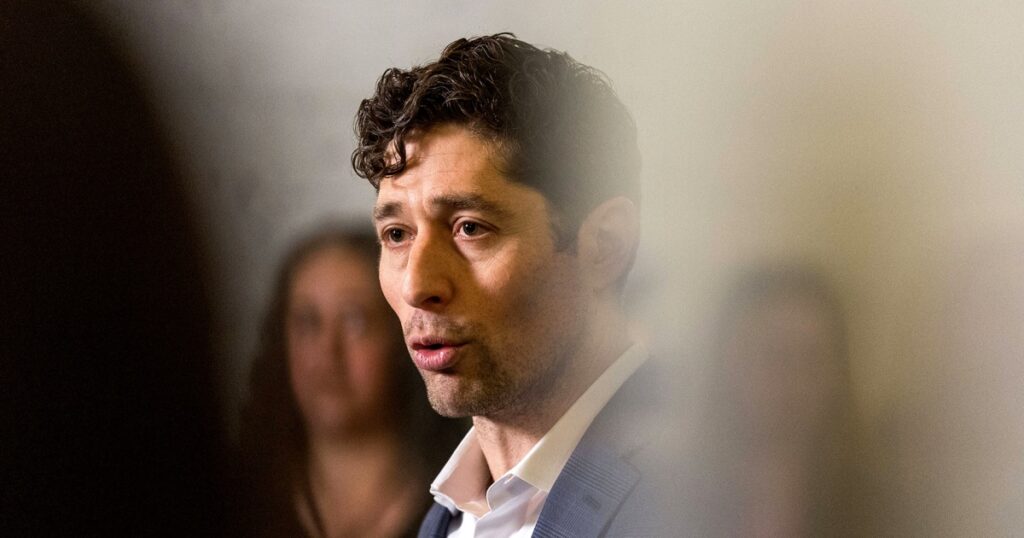
Hours after 37-year-old Renee Nicole Good was fatally shot by an Immigration and Customs Enforcement officer in Minneapolis last week, Mayor Jacob Frey delivered a passionate and expletive-riddled response to the latest tragedy to befall his city.
He accused ICE of “trying to spin this as an action of self-defense,” claiming that its interpretation of the video of the incident “is bulls—.” He said the officer who shot the woman was “recklessly using power that resulted in somebody dying” and demanded that ICE “get the f— out of Minneapolis.”
“We do not want you here,” Frey said. “Long-term Minneapolis residents that have contributed so greatly to our city, to our culture, to our economy, are being terrorized — and now somebody is dead.”
His sharp-edged remarks ricocheted around social media, giving voice to the frustration and anger many around the country were feeling about the violence.

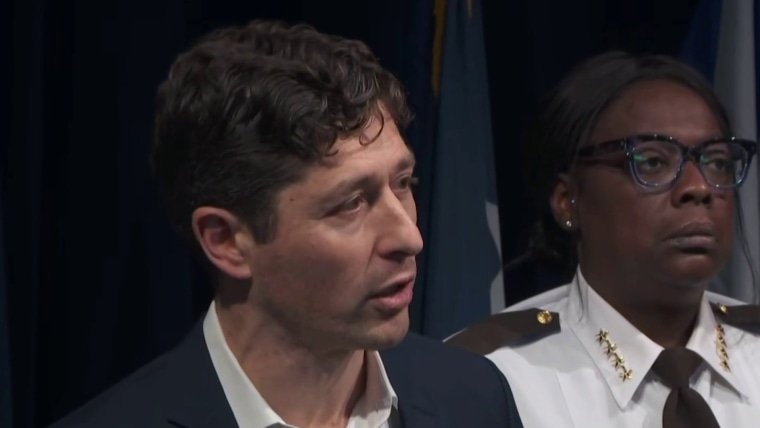
In the days since, Frey, the 44-year-old three-term mayor, has continued to respond frequently, bluntly and often emotionally to the shooting and the Trump administration’s surge of immigration agents to Minnesota through a series of TV interviews, newspaper op-eds and news conferences.
It has thrust him again into the center of a contentious national debate — a position he was in more than five years ago when another Minneapolis resident, George Floyd, died at the hands of law enforcement blocks away from where Good was shot.
Longtime Democratic Minneapolis lawmakers, operatives and community members have lauded Frey’s leadership following the shooting, with many singling out his emotionally charged approach.
“Jacob has really stepped up, and he’s really been a leader of the city. I think he’s been the emotional voice for Minneapolis since this tragedy we’ve needed,” said Corey Day, the former executive director of the Minnesota Democratic–Farmer–Labor Party. “He understands the power of his voice. He understands where the city is and he is vocalizing how we feel.”
“Leadership is not stagnant. It’s forged under pressure, and from my vantage point, I’ve watched Mayor Frey grow in real time during some of the most painful chapters our city has ever faced. He has not been perfect, but I’ve watched his growth, and I’m proud of that growth,” added PJ Hill, a Democratic businessman who owns several buildings near where Floyd was killed in 2020.
Hill, who has worked with Frey on several initiatives, specifically praised him for “having compassion for the movement without endorsing chaos” in the wake of Good’s shooting and “demanding accountability without dehumanizing any of the ICE agents.”
Linea Palmisano, a Minneapolis City Council member, said her initial reaction upon hearing the mayor’s choice of words following the ICE shooting was, “Whoa, I wish he hadn’t said that. … That was pretty forward.”
But Palmisano, a friend of Frey who entered the City Council with him back in 2014, also saw the merit in the approach.
“His way to jump into that moment was to try to leap ahead of it, and by saying something that maybe to some people, seemed outrageous, that was his way to be able to grab a big enough microphone to push back on Donald Trump.”
Frey has faced a series of tragedies that have grabbed national headlines since taking office in 2018. Most prominent among those events was the May 2020 murder of Floyd by Minneapolis police, an event that triggered nationwide protests.
Last summer, there was the assassination of Democratic state lawmaker Melissa Hortman and her husband at their home in Brooklyn Park, a suburb northwest of Minneapolis. Weeks later, two children were killed and 15 others injured, as well as three adult parishioners, in a shooting at Annunciation Catholic School.
The Floyd murder in particular threw Frey into the perils of crisis leadership. Many said he struggled to regain control of Minneapolis as it plunged into chaos and rioting. And he faced criticism from progressives for his refusal to commit to defunding the police.
But this time around, those who’ve closely watched his mayoralty see growth.
“There’s definitely been a maturity of his leadership — unfortunately, forged by fire — that we’ve seen through all these tragedies, with Minneapolis being a focal point of so many of these different incidents over the years,” Day said.
Even some Republicans have begrudgingly given Frey credit for the way he has confronted a lengthy list of challenges.
“I can empathize with an elected leader being in a position of having to react to crisis. People can react in a lot of different ways. He doesn’t seem to have gone crazy or anything. He’s had to deal with these crises. It’s seemingly one after the other, and I don’t envy him for that,” said Minnesota Republican Party Chair Alex Plechash.
Frey, a native of the Washington, D.C., suburbs and a former college and professional runner, moved to Minneapolis to practice law in 2009 after finishing law school in Philadelphia. Four years later, he won a seat on the City Council, serving just one term before being elected the city’s second-youngest mayor.
He’s advocated for affordability measures, reproductive health care and police accountability, while drawing backlash from some on the left for vetoing a number of progressive measures passed by the City Council.
Voters re-elected Frey last November over a crowded field of competitors that included state Sen. Omar Fateh, a democratic socialist. Frey has said he will not run for a fourth term, prompting some speculation that he will seek a higher office in blue-leaning Minnesota in the near future.
But for the time being, he’s a prominent voice in a broader debate over federal-versus-local authority amid Trump’s mass deportation push.
In the immediate aftermath of Good’s death, Frey began demanding that ICE leave the city. After federal authorities quickly froze state and local officials out of the nascent investigation, Frey and other Minnesota Democrats called for the federal government to allow state agencies to help.
In an interview Sunday with NBC News’ “Meet the Press,” Frey cited a “deep mistrust” of federal agencies in Minnesota “because so many of the things that we are hearing are not true.”
The reaction to the shooting has largely fallen along partisan lines. Trump, Vice President JD Vance and other members of the administration say Jonathan Ross, the ICE officer who shot Good, was acting in self-defense, arguing she was intending to ram her vehicle into him.
Local officials, including Frey, have said that Good wasn’t trying to harm the ICE officer and was just attempting to leave the scene.
“You don’t need to take my word for it. You don’t need to take their word for it. Watch the video,” Frey said Sunday.
Some Republicans have slammed Frey for fanning the flames of a volatile situation instead of helping bring down tensions and avoid the kind of fallout that came after the Floyd murder.
In a statement, White House spokesperson Abigail Jackson slammed Frey as a “disgrace” and accused him of having “rushed” to judgment after watching the videos of the shooting.
“Immediately after an ICE officer was attacked, he rushed to publicly lie and incite more violence against law enforcement,” she said. “He must stop smearing law enforcement and apologize for his lies.”
Former Sen. Norm Coleman, R-Minn., urged Frey to “bring the community together to heal.”
“Rather than a mayor and a governor bringing the community together, you have them continuing to light the fuse,” Coleman said during an online town hall last week after the shooting. “They’re feeding the flames … it’s not the way I think reasonable people should be acting in times of great difficulty.”
Meanwhile, Homeland Security Secretary Kristi Noem has said Frey and Gov. Tim Walz are not cooperating with the administration’s immigration efforts, leading to her decision to send hundreds of more federal agents to Minnesota. State officials have also sued the federal government in an effort to stop the deployment.
Frey has long said the city would not cooperate with Trump’s immigration enforcement efforts since they fall under federal, not local, jurisdiction. He also said the way the administration is conducting such efforts is “unconstitutional.”
“You can’t come into a city and discriminate solely on the basis of: “Are you Latino? Or are you Somali?” he said on “Meet the Press.”
Frey also said that “of course” he bears responsibility in bringing down the temperature, while pointing out that protests in Minneapolis in response to the shooting had been peaceful.
But he cast most of the blame for the ongoing tensions on federal officials.
“To those that are offended, I’m sorry I offended their delicate ears. But as far as who inflamed the situation, you know, I dropped an f-bomb and they killed somebody. I think the killing somebody is the inflammatory element here, not the f-bomb,” he said.
In another interview with NBC News on Monday, Frey pointed out that for for weeks, after ICE agents first came to Minneapolis, that “without dropping anything close to a cuss word, we warned repeatedly, both privately and publicly, that this would happen to and it would either be a resident, a police officer or an ICE agent getting tragically hurt or killed.”
And he vowed to continue his approach.
“What is happening, very much feels like an invasion,” he said Monday. “And I’m going to do everything possible to stand with and up for my city.”