


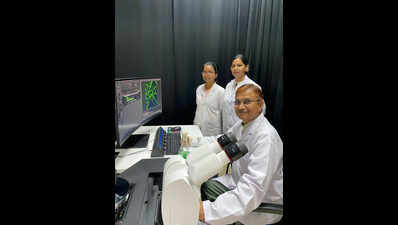
Jaipur: In a discovery that could have real-world impact beyond the lab, researchers from the Central University of Rajasthan have identified a new species of cyanobacteria from Pushkar Lake in Ajmer.The organism, named Pushkarnema CURAJAE, was found in samples collected from Pushkar Sarovar during field visits in 2016 and 2021. The study, led by dept microbiologist, CURAJ Prof Pawan K. Dadheech, was published in the international journal Fottea, Czech Republic. The genus name is Pushkar and species name CURAJAE are dedicated to Pushkar Lake and Central University of Rajasthan.While it may sound highly technical, scientists say the finding matters in simple terms. Every time a new microbe is discovered, it offers a fresh “biological blueprint”.“This isn’t just another species, it could be the starting point for future breakthroughs, whether in new medicines, biofuels or even solutions to climate change,” Dadheech explained.The newly discovered cyanobacterium could potentially be used to develop drugs, biofertilisers and even nutrient-rich supplements that improve immunity and overall health. Cyanobacteria are already known for their role in improving soil fertility and maintaining ecological balance.Pushkar turned out to be a unique place for such a discovery. The lake, a well-known religious site, lies in a semi-arid region with harsh conditions — hot summers and limited water. “These conditions act like a natural filter, allowing only specialised microorganisms to survive. At the same time, the lake hasn’t been studied much for microbes, which makes it ideal for finding new species,” said Dr Anuj Tomar from the dept of Biotechnology, AIIMS Delhi, one of the researchers.Scientists say discovering a completely new genus is rare, especially in a place as well-known as Pushkar. “It shows that even familiar locations can still hold surprises,” they added. The research was carried out in collaboration with Prof Dale A. Casamatta of the University of North Florida.Globally too, the discovery is being seen as important, as it adds to the ongoing effort to understand Earth’s hidden microbial diversity.“The next step is to decode the organism’s full genetic makeup to understand what it can do. Researchers believe this could open doors to its use in clean energy, environmental solutions and biotechnology, aligning with India’s BioE3 policy,” said Soman, another researcher.For now, the finding is a reminder that even in places we think we know well, there is still a lot waiting to be discovered.