
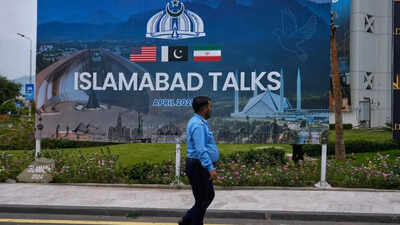
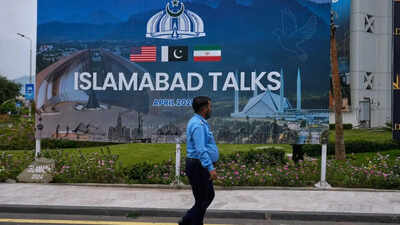
Second round of talks between the United States and Iran to ease tensions in the Middle East is expected to take place on Monday, news outlet CNN reported, citing Iranian officials.According to the officials, the delegations of both countries are likely to be in Islamabad on Sunday.This comes as Islamabad has offered to “go to all lengths” to help secure a deal between the United States and Iran.Earlier, Pakistan Prime Minister Shehbaz Sharif met Qatar’s Emir Sheikh Tamim bin Hamad Al Thani and Turkish President Recep Tayyip Erdogan and discussed “international efforts aimed at de-escalation and advancing diplomatic solutions”, Al Jazeera reported.The meetings took place on the sidelines of the Antalya Diplomacy Forum, as per Al Jazeera.Meanwhile, Pakistan’s Army Chief Asim Munir met Iranian Parliament Speaker Mohammad Bagher Ghalibaf in Tehran on Thursday as diplomatic efforts intensified to revive stalled US-Iran negotiations. The visit comes amid heightened back-channel engagement between the United States and Iran, with Pakistani officials expressing hope for a breakthrough, particularly on Tehran’s nuclear programme, Al Jazeera reported.Munir, who arrived in Tehran on Wednesday, was received by Iranian foreign minister Abbas Araghchi. The visit aims to prepare the ground for a possible second round of talks after earlier discussions ended without progress.Trump to visit Pakistan?Meanwhile, US President Trump has said that he would go to Pakistan if the peace agreement is finalised with Iran.“I would go to Pakistan, yeah,” Trump told reporters at the White House before departing for Las Vegas. “If the deal is signed in Islamabad, I might go. They want me to go,” he added.The US President also expressed confidence that talks with Iran were progressing well and suggested a breakthrough could come soon. “I think we have a very successful negotiation going on right now,” he said.“If it happens, it’ll be announced fairly soon, and that’ll give us free oil, free Hormuz Strait, everything will be nice. And I think your oil price will go down to lower than what it was before,” he added.Key sticking points remainThe main disputes are over Iran’s nuclear programme and broader regional security issues.The United States continues to insist that Iran must end uranium enrichment, dismantle key facilities and relinquish its stockpile of highly enriched material.Tehran, however, has refused to abandon enrichment entirely, framing it as a sovereign right. Iranian negotiators instead proposed a temporary suspension, reportedly suggesting a shorter timeframe than Washington is willing to accept. This gap remains one of the most difficult to bridge.Sanctions relief is another major obstacle. Iran is seeking the lifting of both primary and secondary sanctions, as well as access to frozen assets. The US position has been more conditional, tying economic relief to verifiable nuclear concessions.Beyond the nuclear file, disagreements also extend to the Strait of Hormuz and regional security guarantees. Iran wants assurances against future military action, while the US is pushing for broader commitments, including limits on Tehran’s regional influence.The Islamabad Peace Talks, held on April 11–12, marked a historic but inconclusive diplomatic attempt to end the 39-day Gulf War between the United States and Iran. Mediated by Pakistan, the talks were the first high-level, face-to-face negotiations between the two nations since the 1979 Islamic Revolution.Meanwhile, US President Donald Trump announced a 10-day ceasefire between Israel and Iran-backed group Hezbollah, which is seen as a potential step toward broader de-escalation.The ceasefire comes amid heightened tensions along the Israel-Lebanon border, with exchanges involving Israeli armed forces and Hezbollah, which saw a major escalation following the US-Iran war in the region.Earlier on Thursday, Trump announced that Israel and Lebanon had reached an agreement to initiate a 10-day ceasefire, following intensified diplomatic efforts to reduce hostilities in the region.The US President shared that he held “excellent conversations” with Lebanese President Joseph Aoun and Israeli Prime Minister Benjamin Netanyahu, confirming that both leaders have committed to the temporary truce as a step towards a broader resolution.The ceasefire comes at a critical juncture for West Asia, following a period of significant volatility along the Israel-Lebanon border.