
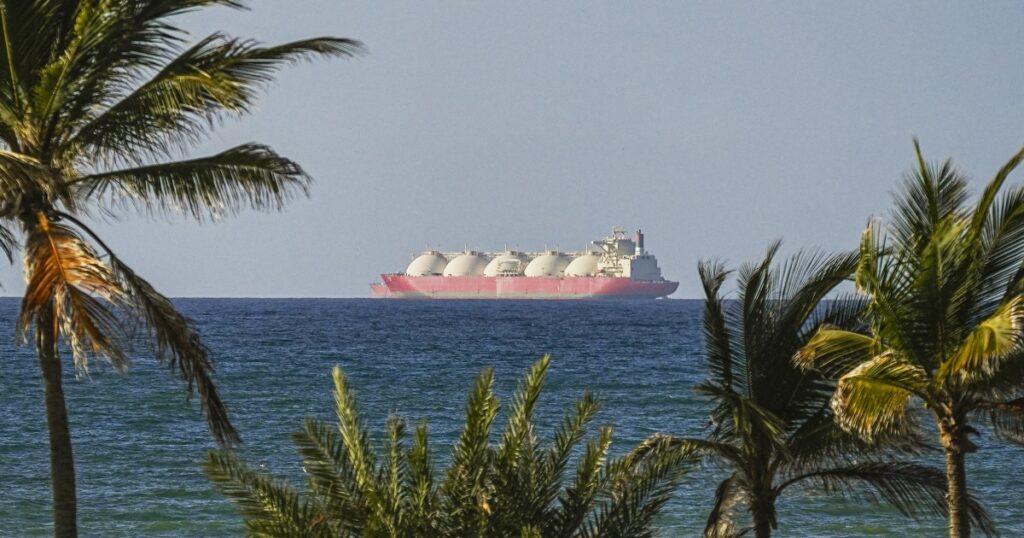
The price of oil surged Sunday night after President Donald Trump said the U.S. would blockade the Strait of Hormuz after peace talks with Iran failed.
Subscribe to read this story ad-free
Get unlimited access to ad-free articles and exclusive content.


U.S. crude oil soared 8%, to more than $104 per barrel. International Brent oil jumped more than 7%, to $103 per barrel. Wholesale gas prices also spiked 6%, while heating oil, a proxy for jet fuel prices, jumped 10% in early trading.
Stock futures declined sharply. Futures that indicate where the S&P 500 will trade fell 1%, Nasdaq 100 futures slid 1.3%, and Dow futures tumbled more than 500 points.
“Effective immediately, the United States Navy, the Finest in the World, will begin the process of BLOCKADING any and all Ships trying to enter, or leave, the Strait of Hormuz,” Trump said on Truth Social.
“I have also instructed our Navy to seek and interdict every vessel in International Waters that has paid a toll to Iran,” Trump added in the post.
The Strait of Hormuz is one of most important waterways for oil and other energy products, such as liquefied natural gas. Before the war, hundreds of ships per day passed through it, carrying that energy to the global marketplace. But on most days since the war began Feb. 28, fewer than 10 ships a day have been able pass through.
“Reopening the Strait has become the market’s most time-sensitive priority,” JPMorgan Chase commodities analysts said Sunday. “The last tanker to clear Hormuz on February 28 is expected to reach its destination around April 20, marking the point at which pre-closure barrels are fully exhausted from the global supply chain.”
Last week, only 24 ships passed through the strait out to the ocean. On Friday, only two ships passed, according to data from S&P Global Market Intelligence that was shared with NBC News. Neither were oil or gas tankers.
Trump made the announcement early Sunday after Vice President JD Vance, along with Trump’s special envoy for peace, Steve Witkoff, and Trump’s son-in-law Jared Kushner, flew to Islamabad to hold talks with Iranian regime leaders amid a two-week ceasefire.


FORSUBSCRIBERS


Strait of Hormuz sailor makes long journey home
02:08
The lack of an agreement to end the war or defuse tensions, coupled with the threatened blockade, scuttled short-lived optimism in markets that the conflict could end soon.
“These developments underscore that the U.S. and Iran are headed for a prolonged period of elevated tensions,” said Sarah Bianchi, chief strategist of international political affairs and public policy at the investment advisory firm Evercore ISI.
Last week, oil prices dropped more than 12% on hopes that the Islamabad talks would lead to an off-ramp for the administration to start winding down the war. The S&P 500 rose 3.5% week.
Oil’s renewed surge means prices for consumers are expected to resume their rise.
“Gas prices are likely to return to climbing,” GasBuddy analyst Patrick De Haan wrote on X. Price hikes could resume “as early as tomorrow,” he added. Already, gas prices have risen more than $1.20 per gallon since the war began, to a national average of $4.12, according to AAA.
The speaker of Iran’s parliament wrote Sunday on X: “Enjoy the current pump figures. With the so-called ‘blockade’, Soon you’ll be nostalgic for $4–$5 gas.”
Trump himself also said Sunday that prices could continue to rise. Asked Sunday morning by Fox News whether prices would be lower by the time of the midterm elections, he responded: “I think so. It could be, it could be or the same, or maybe a little bit higher, but it should be around the same.”
On Sunday night, U.S. Central Command appeared to clarify Trump’s comments, saying in a statement that the blockade would affect only “maritime traffic entering and exiting Iranian ports.” The statement added that U.S. “forces will not impede freedom of navigation for vessels transiting the Strait of Hormuz to and from non-Iranian ports.”
Central Command said that the blockade had not begun immediately, as Trump said, but that it would start at 10 a.m. ET Monday.
“Trump’s move to announce a naval blockade of the Strait of Hormuz is set to reignite risk aversion this week,” said Elias Haddad, vice president of markets strategy at the investment bank Brown Brothers Harriman.
Haddad said the Hormuz blockade looked “more like a negotiating gambit to reset the bargaining terms of Strait of Hormuz access than a durable blockade.”