








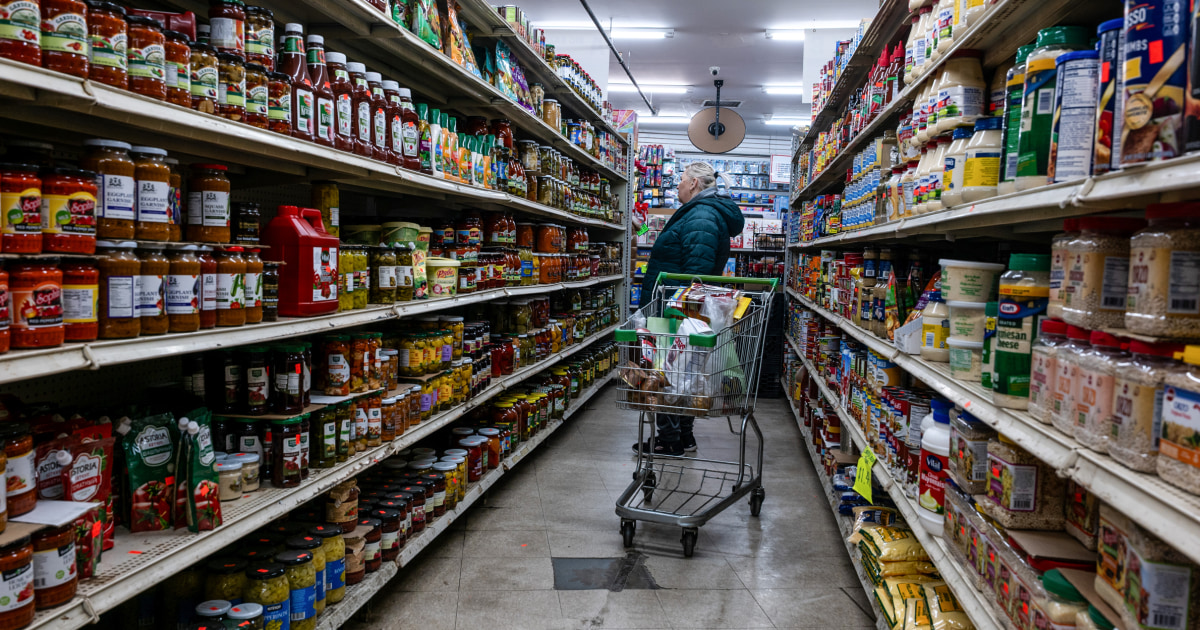
The price of household necessities rose in December over the previous month, even as inflation overall held steady. The result is that price pressures were unevenly distributed across income groups, with lower-income people particularly affected.
On Wall Street, economists cheered signs of progress in the government’s latest inflation report released Tuesday, pointing to a stabilizing trend in what’s known as “core” inflation, a measure that excludes food and energy, for which prices can be more volatile.
But those essentials were precisely where inflation showed few signs of letting up.
Grocery prices rose broadly in December, with five major food categories posting increases, while dining out also became more expensive.
Utility costs added to the pressure, with electricity prices up nearly 7% last year and natural gas posting double-digit gains.
After several years of relatively slow growth, health care costs are beginning to play a larger role in inflation, according to the data from the Bureau of Labor Statistics.
Tariff-related price pressures also have yet to fully appear in the retail prices of some imports, such as apparel and footwear.
In some categories, lower prices last month helped offset price increases elsewhere, according to the BLS data.
The cost of gas fell in December, one of the few price declines most consumers notice day to day. Used cars, communication services and household services also decreased in price over the previous month.
Still, Tuesday’s report “reinforces [that] price pressure is edging higher across key consumer product categories that matter most to consumers,” wrote Rob Holston, who leads the consumer products practice at the consulting firm EY Global.
Persistent inflation in basic necessities also threatens to deepen the financial divide that has created what’s being called a “K-shaped” U.S. economy.
That is a situation in which higher-income consumers — insulated by home values and stock market gains — continue to spend freely, while lower-income households increasingly struggle to pay for everyday expenses and sharply cut back.
The K-shaped divide is also evident in how — and where — people on either side of it spend their money.
The top 5% of consumers drove the bulk of overall spending gains through late 2025, according to Bank of America data. Within that group, households continued to spend money on travel, dining and online retail.
Meanwhile, lower-income consumers reined in spending on nonessentials like airline tickets, vacation rentals and hotels, entertainment and furniture.
“The ‘K’ is here to stay,” Bank of America economists wrote in a client note published Monday.
When growth relies so heavily on a narrow group of high earners, economists warn of broader economic risks, particularly when hiring has softened and wage gains have slowed.
Both of those further limit economic mobility among low, middle and high earners.
“The reality of it is that we have had 5 years of middle-income families being underwater,” Glenn Williams, CEO of the financial services company Primerica, said in an email Tuesday.
“These families are frustrated at their ability to get ahead because of the rise in the cost of living, the lag in wage growth, their inability to save and the increase in their credit card balances.”
The frustration is raising alarm bells at the White House in an election year when affordability remains a top concern among voters.
Consumer sentiment is sharply lower than it was a year ago, reflecting ongoing concern about job prospects and the cost of living.
Other surveys point to similar unease: Data from the New York Fed shows that people increasingly expect it will be harder to find jobs in the year ahead and that they remain worried about rising prices.
Those dynamics have pushed President Donald Trump to sharpen his focus on affordability.
“One of our top priorities of this mission is promoting greater affordability,” Trump said Tuesday afternoon in a speech at the Detroit Economic Club. “Now that’s a word used by the Democrats. They’re the ones that caused the problem.”
The midterm election season is already well underway, with some congressional districts preparing to hold primary contests as soon as March.
In just the past few days, Trump has rolled out a series of proposals aimed at easing household costs. He has urged oil companies to invest in and export Venezuelan crude as part of a broader effort to lower gasoline prices. He has also ordered roughly $200 billion in mortgage bond purchases to help bring down home borrowing costs and called on credit card companies to cap interest rates at 10% for one year.
Lower interest rates remain central to Trump’s economic message — a lever that can support growth by lowering borrowing costs for consumers and businesses, from financing cars and homes to funding investment and hiring.
But economists say that kind of relief may not come quickly. Most analysts expect the Federal Reserve to keep interest rates on hold in the near term, with policymakers set to make their next decision this month.
Trump has long pressed the Fed to move more aggressively to lower rates, arguing it would boost economic growth. But economists warn that cutting rates too quickly would risk reigniting inflation.