
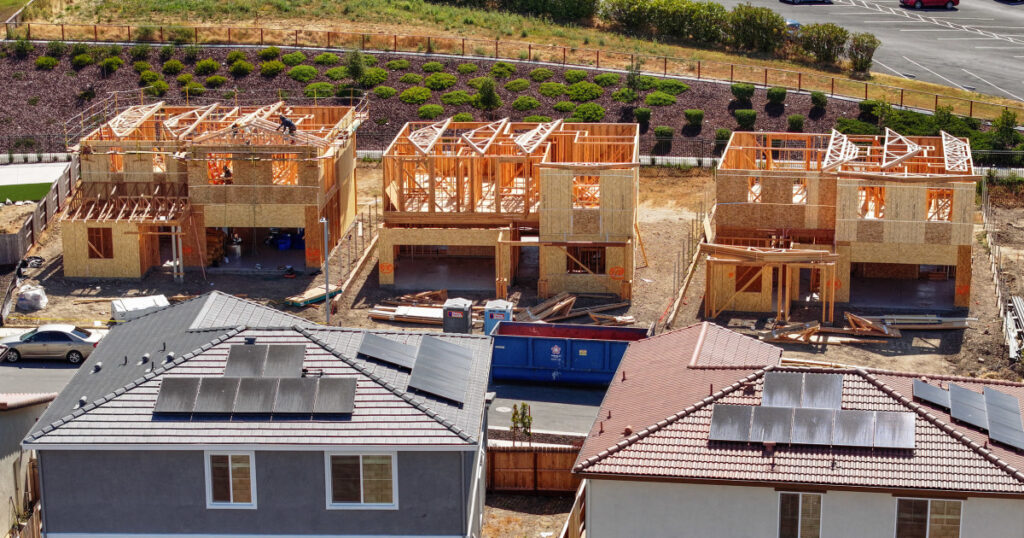
WASHINGTON — The Senate passed a bill Thursday aimed at boosting the supply of housing and bringing down prices, marking a rare bipartisan breakthrough on a major issue.
The 21st Century ROAD to Housing Act, written by Sens. Tim Scott, R-S.C., and Elizabeth Warren, D-Mass., won 89 votes. Ten senators voted against it. Scott is the chairman of the Banking, Housing, and Urban Affairs Committee, and Warren is the ranking member.
The 303-page legislation creates a series of grants and pilot programs for housing construction, while revising federal definitions to encourage more housing units and prevent Wall Street from buying up tons of single-family homes.
Such a big, bipartisan vote is increasingly unusual in Congress and the bill aims to tackle a major affordability issue for voters ahead of the midterm elections. But it is uncertain if it can pass the House as is, and President Donald Trump has signaled he’s not as interested in the package as he is in passing separate voting legislation.


The housing bill seeks to cut inspection delays for the Department of Housing and Urban Development by creating other avenues to satisfy requirements, while directing HUD and the Department of Agriculture to jointly coordinate environmental reviews for certain housing projects to boost construction in rural areas.
One key section, titled Homes Are For People, Not Corporations, “prohibits large institutional investors from purchasing certain single-family homes” as a way “to promote homeownership opportunities for American families, not corporations,” according to an official summary. Trump called on Congress to pass legislation banning large Wall Street firms from buying up thousands of single-family homes in his State of the Union address this year.
The legislation gives both parties an opening to claim victory.
Scott said it’s about fulfilling Trump’s affordability agenda by “cutting regulatory red tape, lowering costs and expanding housing supply while generating no new spending” and expanding homeownership.
Warren cast the bill as an attempt at “increasing housing supply and bringing down costs” by taking on investors who are buying up homes and increasing prices for individuals and families.
“It will mean, for the first time, that we’re moving housing prices in a better direction and beating private equity out of the system — making a very public statement that homes are for the families who live there, not for Wall Street investors who figured out another way to make a buck,” Warren told NBC News.
The only Democrat who voted against the bill was Sen. Brian Schatz, D-Hawaii, who argued the language in a key provision was too broad.
Also voting no were Sens. Ted Budd, R-N.C., Ted Cruz, R-Texas, Ron Johnson, R-Wis., Mike Lee, R-Utah, Rand Paul, R-Ky., Rick Scott, R-Fla., Thom Tillis, R-N.C., Tommy Tuberville, R-Ala., and Todd Young, R-Ind.
One senator missed the vote: Marsha Blackburn, R-Tenn.
The bill still needs approval from the Republican-controlled House, and it remains unclear whether the Senate-approved version will pass and go to Trump’s desk to become law.
House Speaker Mike Johnson, R-La., told Republican leaders and committee chairs at their annual retreat earlier this week that Trump wants the SAVE America Act to be a top priority, brushing aside a GOP fight over the housing bill.
Johnson told members that Trump privately stressed to him the importance of the SAVE America Act and that the president said “no one gives a (bleep) about housing,” according to a lawmaker who was there.
A White House spokesman, Davis Ingle, denied that the exchange took place, saying that it’s “not accurate whatsoever” and that Trump “has been laser-focused on making housing more affordable.”
He said Trump “will sign bold new executive orders on housing in the coming days.”
The conversation between Johnson and Trump, which was first reported by Punchbowl News, comes as Republicans have splintered over how to pass the SAVE America Act, a voter ID and proof-of-citizenship-to-vote bill, which Trump has labeled his “No. 1 priority.”
Trump has even threatened not to sign any other legislation until Congress passes the SAVE America Act, although the White House partially walked that back as it relates to a potential bill to fund the Department of Homeland Security.
Asked about Trump’s alleged private comments on the Senate package, Sen. Raphael Warnock, D-Ga., called it a “once-in-a-generation piece of housing legislation.”
“If I told you that Tim Scott and Elizabeth Warren walked into a bar, it sounds like the beginning of a bad joke,” he said. “But we got that through our committee. There’s overwhelming support in the Senate. We’re going to get this over the finish line.”
The measure faces some industry pushback, in part due to a provision that requires major investors who build or own at least 350 single-family homes to sell after seven years.
Schatz said the package contains many good policies but slammed the seven-year provision as “a very bizarre thing” to apply more broadly than just to hedge funds.
“There’s literally no reason for this,” Schatz said on the floor. “Anyone who wants to build housing and then provide it for rent is going to be forced to sell after seven years. … A lot of these folks are not actually in a position to sell after seven years. They will not have made their money back.”
“This is positively Soviet,” he said.
A Democratic aide on the Banking Committee disputed his argument, pointing to a Stanford University analysis that said the economic effects of the provision “are likely to be limited” and that overall, “[r]educed investor activity may modestly lower prices and increase homeownership in some markets.”
Scott said the goal of the bill is to right a wrong.
“Today, the average age of a first-time homebuyer is 40. Forty years old before you ever experience the American dream,” he said. “That age is too old.”