
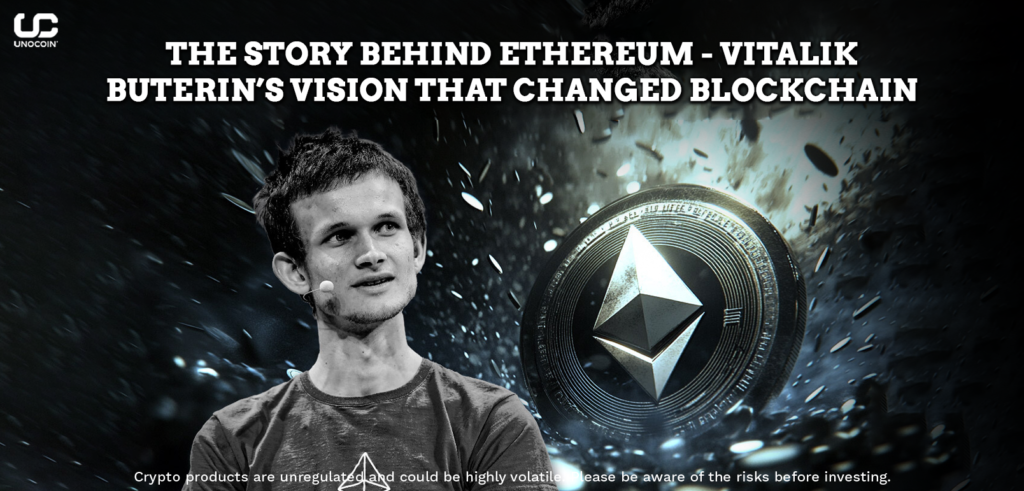
The world of cryptocurrency has witnessed many innovations over the past decade, but few have had the transformative impact of Ethereum. Today, Ethereum stands as the second-largest cryptocurrency in the world and the backbone of thousands of decentralised applications. But the journey of Ethereum began with a bold idea from a young programmer who believed blockchain could do far more than power digital money.
That visionary was Vitalik Buterin, a programmer and crypto enthusiast who helped redefine what blockchain technology could achieve.
The Early Vision of Vitalik Buterin
Before Ethereum existed, the cryptocurrency landscape was largely dominated by Bitcoin, which introduced the concept of decentralized digital money. While Bitcoin proved that blockchain technology could securely move value without intermediaries, Vitalik believed the technology had far greater potential.
In 2013, at just 19 years old, Vitalik published the Ethereum whitepaper, outlining a new type of blockchain platform that could run programmable applications. Instead of simply sending digital currency from one person to another, this platform would allow developers to create smart contracts—self-executing programs that run automatically when certain conditions are met.
This idea would later become the foundation for what we now know as decentralized applications, or dApps.
The Team Behind Ethereum
Although Vitalik Buterin is widely recognized as the founder of Ethereum, the project was built with the help of several other influential figures in the early blockchain community.
Some of the key contributors included:
- Gavin Wood, a computer scientist who later created the Solidity programming language used to write Ethereum smart contracts.
- Joseph Lubin, who played a major role in supporting the ecosystem and later founded the blockchain company ConsenSys.
- Anthony Di Iorio, an early supporter who helped fund the project during its formative stage.
- Charles Hoskinson, who contributed during Ethereum’s early organisational development.
Together, this group helped transform Vitalik’s concept into a fully functional blockchain platform capable of running decentralised software.
Ethereum’s Early Days
Ethereum officially launched in July 2015, introducing a completely new framework for blockchain innovation. Unlike traditional blockchains that were primarily used for financial transactions, Ethereum allowed developers to build applications directly on its network.
This breakthrough quickly attracted developers and entrepreneurs who saw the potential to create decentralized services across industries such as finance, gaming, digital art, and identity verification.
Soon after its launch, Ethereum began gaining traction as developers built innovative applications on top of the network. This led to the emergence of new sectors within the crypto ecosystem, including decentralised finance (DeFi) and non-fungible tokens (NFTs).
Ethereum effectively became the foundation of Web3, a decentralised vision of the internet where users have greater control over their digital assets and data.
The Rise of Ethereum’s Global Ecosystem
Over the years, Ethereum has evolved into one of the most active blockchain networks in the world. Thousands of projects now rely on its infrastructure to power their platforms.
From decentralised lending platforms and blockchain-based games to digital art marketplaces and tokenised assets, Ethereum has played a central role in expanding the possibilities of blockchain technology.
The platform has also undergone significant upgrades aimed at improving efficiency and scalability. One of the most notable changes was Ethereum’s transition to a proof-of-stake consensus model, which dramatically reduced the network’s energy consumption while strengthening security.
These developments continue to attract developers and investors who see Ethereum as a long-term cornerstone of the digital economy.
Ethereum for Traders and Investors
As Ethereum’s ecosystem expanded, its native cryptocurrency, ETH, became one of the most widely traded digital assets in the world.
For many investors, Ethereum represents more than just a cryptocurrency—it is a gateway to the broader blockchain economy. Because ETH is required to power transactions and smart contracts on the network, demand for the asset often grows alongside the ecosystem itself.
Today, Ethereum remains one of the most important assets in the crypto market and continues to play a crucial role in shaping the future of decentralised technology.
Trading Ethereum on Unocoin
For users looking to participate in the Ethereum ecosystem, **Unocoin provides a simple and secure platform to buy, sell, and trade ETH.
Ethereum has been available for trading on Unocoin for a long time, allowing users to easily access one of the most influential cryptocurrencies in the market. Through the platform, investors can manage their digital assets conveniently while exploring opportunities in the rapidly growing crypto space.
With Ethereum continuing to drive innovation across the blockchain industry, access to ETH trading provides users with an opportunity to be part of a technology that is shaping the future of finance and the internet.
A Legacy of Innovation
From a whitepaper written by a young programmer to a global ecosystem supporting thousands of decentralised applications, Ethereum’s journey reflects the power of innovation within the crypto industry.
Thanks to the vision of Vitalik Buterin and the early contributors who helped bring the project to life, Ethereum has grown into a foundational pillar of blockchain technology—one that continues to influence the evolution of the digital world.
Please find the list of authentic Unocoin accounts for all your queries below:
Disclaimer: Crypto products are unregulated as of this date in India. They could be highly volatile. At Unocoin, we understand that there is a need to protect consumer interests, as this form of trading and investment has risks that consumers may not be aware of. To ensure that consumers who deal in crypto products are not misled, they are advised to DYOR (Do Your Own Research).