
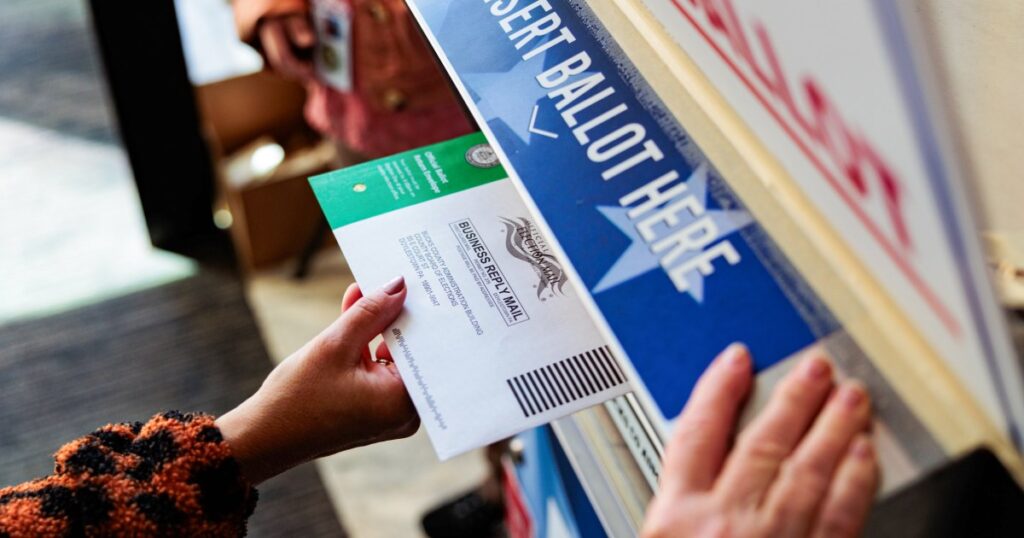
WASHINGTON — The Supreme Court on Monday delves into the issue of mail-in voting, weighing whether states can count ballots that are mailed on time but arrive after Election Day.
The justices will hear arguments as President Donald Trump has ramped up his opposition to mail-in voting and urged Congress to ban it in most cases.
The court is considering a Mississippi law, similar to measures in 13 other states, that allow for mail-in ballots to be counted as long as they are postmarked by Election Day. The case could have implications for the midterm elections this November, when voters will decide which party controls the House and Senate.


FORSUBSCRIBERS
02:01
NBC News poll shows Democrats with slight lead as midterms begin
00:0000:00
California, New York and Texas are among the states with comparable laws to Mississippi’s. Eligibility for mail-in ballots differs among those states, with Mississippi limiting it to a list that includes elderly and disabled people.
If the court were to strike down the Mississippi statute, it would upend election rules in the affected states, as well as potentially for people who live overseas, including members of the military. In total, 29 states allow extended deadlines for voters abroad and the military, according to a brief filed by former national security officials.
Four Republican states have recently changed their laws to bar the counting of late-arriving ballots. Trump has complained, without evidence, that the mailing of ballots allows for elections to be “rigged.” The Trump administration filed a brief backing the challenge to Mississippi’s law.
Mississippi’s Republican attorney general is defending its law to count ballots that arrive after Election Day, pitting the state against the Republican National Committee and Mississippi’s own Republican Party. The Libertarian Party of Mississippi has also challenged the measure.
While the Constitution gives states a major role in overseeing elections, the legal question revolves around the federal law that sets Election Day as the Tuesday after the first Monday in November.
The challengers argue that this means ballots must not only be cast but also received by the close of Election Day. With most of the mail-in ballot laws enacted recently, the RNC also argues that there is no history or tradition of states allowing late-arriving votes to be counted.
The Mississippi law allows mail-in ballots to be counted up to five days after Election Day as long as they were sent beforehand. The state argues that nothing in the federal law bars states from extending the deadline for ballots to be received as long as the votes were cast by Election Day.
Those defending the law point out that relaxed receipt deadlines for overseas voters in Florida helped Republican candidate George W. Bush win the closely contested 2000 presidential election.