
WASHINGTON — Tax cuts are becoming the hottest new idea in Democratic politics from coast to coast, as candidates across the party spectrum seek to capitalize on cost-of-living struggles and win back working-class voters.
Subscribe to read this story ad-free
Get unlimited access to ad-free articles and exclusive content.


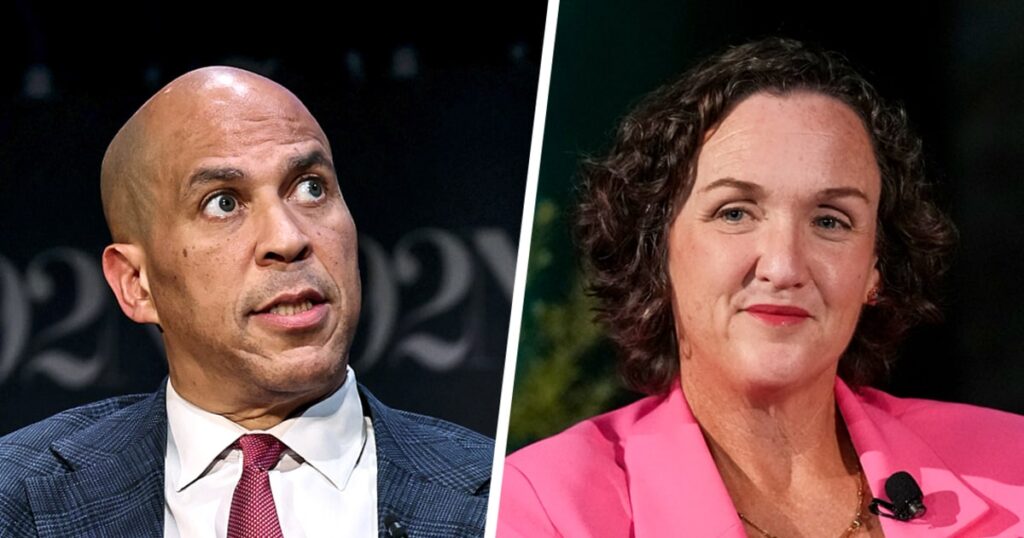
Sens. Cory Booker, D-N.J., and Chris Van Hollen, D-Md., recently rolled out sweeping tax cut plans. Booker seeks to create a federal tax exemption for up to $75,000 in income for married couples. Van Hollen wants to set that figure at $92,000. Both have been floated as potential 2028 presidential candidates.
In California, progressive candidate for governor Katie Porter, a former Democratic congresswoman, is proposing to wipe out state income taxes for California families making up to $100,000 per year.
In Georgia, gubernatorial candidate Keisha Lance Bottoms, a former mayor of Atlanta and Biden administration official, is campaigning on “eliminating state income taxes for teachers.”
The trend has sparked a “wonk revolt” uniting policy experts from the center to the left against the new trend, said Zach Moller, senior director of economic policy at the moderate Democratic group Third Way.
He said the divide is part of a “Democratic Cold War” between those who want to give tax breaks to certain groups and policy-minded figures who favor a broad revenue base.
The critics warn that Democrats cannot plausibly fund a European-style safety net if they continue to push for slashing revenues or shrinking the tax base.
“There’s only so much revenue you can get out of corporations and billionaires and the 1%,” Moller said. “It’s highly unlikely Democrats are going to get enough revenue from that group to do everything they want to do, whether it’s child care, paid leave, furthering the child tax credit, Medicare expansion.”

“Democrats are going to have a math problem at the end of the day if they go down this road,” he said, adding that it further jeopardizes any hope of lowering the national debt.
The pushback from the left is more intense. They warn that these Democrats are surrendering to a Reaganesque vision that treats taxes as a punishment and thereby endangers the liberal project, which relies on tax revenues to fund national priorities.
And some Democrats are rejecting the trend ahead of the next presidential primary, where it’s shaping up to become one of several major topics about the future of the party.
Rep. Ro Khanna, D-Calif., a progressive populist weighing a 2028 presidential run, is laying down a marker against the trend.
“Democrats need to offer a vision of the state that provides health care, education and child care and asks each of us to do our patriotic duty in rebuilding our communities and nation,” Khanna told NBC News. “We should argue from an FDR frame that believes in the role of the state to provide essential services to Americans, not the Reagan frame that believes government is the problem and taxes are evil.”
Tré Easton, a former Senate Democratic aide who now oversees policy for the Searchlight Institute, said the trend began when Democrats rushed to embrace President Donald Trump’s popular pitch for “no taxes on tips” in the 2024 election.
“That kind of took off. And I think this is Democrats trying to replicate that by offering stuff that’s meant to appeal to working-class voters, who we need to win back. And it just feels so gimmicky to me across the board,” Easton said.
He called the new trend “exceedingly problematic” and “myopic,” one that “undercuts what used to be Democrats’ main argument — that we’re all in this thing together, and so we should try and pay for this stuff together to make people’s lives better.”
“You’re never going to out-tax-cut the Republican Party. They will always win on that front. That is in their DNA,” Easton said. “And I think the broader point here is we shouldn’t be viewing taxes as punishment or a burden, right?”
Even in deep-blue Washington, D.C., mayoral candidate Kenyan McDuffie is seeking to tap into anti-tax sentiment, saying recently that the nation’s capital won’t become like New York City on his watch, accusing Mayor Zohran Mamdani of peddling “tax hikes dressed up as hope.”
Easton said, speaking broadly about the Democratic proposals: “When you start removing people from the tax base, what you’re doing is saying, actually, no, it’s not our collective responsibility to make society improve, to actually invest in our communities and each other. You’re saying that it’s just the responsibility of really, really superrich people and no one else.”
Asked about the criticisms, Van Hollen told NBC News his plan is “completely consistent with the liberal project.”
“People who are making a living wage, meaning they’re earning enough just to pay their bills and get by, should be able to keep more of their money. As I’ve said, this is an important pillar of a tax plan. It’s not the only part of a tax plan. We should also have a wealth tax,” he said, adding that he supports the plan by Sen. Bernie Sanders, I-Vt., to slap a 5% annual wealth tax on the estimated 938 billionaires in the U.S.
Booker defended his plan as a bid to make Democrats the party of “big ideas.”
“Donald Trump has put forward a lot of big ideas. He doesn’t follow through on them, but they resonated in his last election,” he said in a recent interview. “We need big economic ideas that people can immediately hear and put their mind around.”
A Gallup tracking poll found that the share of Americans who say the income taxes they pay are “unfair” rose to 50% in March, up from 35% in 2017.
Asked about the proposals by her Senate colleagues, Sen. Elizabeth Warren, D-Mass., said, “I’m focused right now on getting billionaires to pay their fair share. If billionaires were paying, we’d have plenty of money to invest in the things families need, to help bring down costs and make this whole economy work better for those in the middle.”
Vanessa Williamson, a senior fellow at the Urban-Brookings Tax Policy Center and the author of “Read My Lips: Why Americans Are Proud To Pay Taxes,” sighed deeply when asked about the tax cut trend.
“The decision of prominent Democrats to make tax cuts their focus is ill-conceived for a number of reasons,” she said. “I think some Democrats appear to be mistakenly under the impression that we live in a nation of Grover Norquists. We don’t. We never have.”
She said Democrats have historically succeeded politically when their leaders, like Franklin Delano Roosevelt and Lyndon Johnson, were candid about the importance of taxation in pursuit of popular projects like the New Deal and the Great Society.
“It is a remarkably condescending attitude to take with the American people,” Williamson said. “How are you going to go to the American people and say, ‘Government is worthwhile,’ but then say, ‘Don’t worry, you don’t have to pay for it?’ That the democratic system is a good one, but not so good that it’s worth investing your own money in?”