


Imagine having a switch and watching clean water drip from the sky, without any pipes or wells, just the air around you.Sounds like sci-fi?Right now, over 2.2 billion people lack steady access to safe drinking water, as per UN and WHO stats. People in remote deserts or crowded cities where taps run dry, families hauling buckets for miles, kids missing school, farms withering. But a woman has developed a technology that catches vapor from the air and turns it into drinkable H2O.

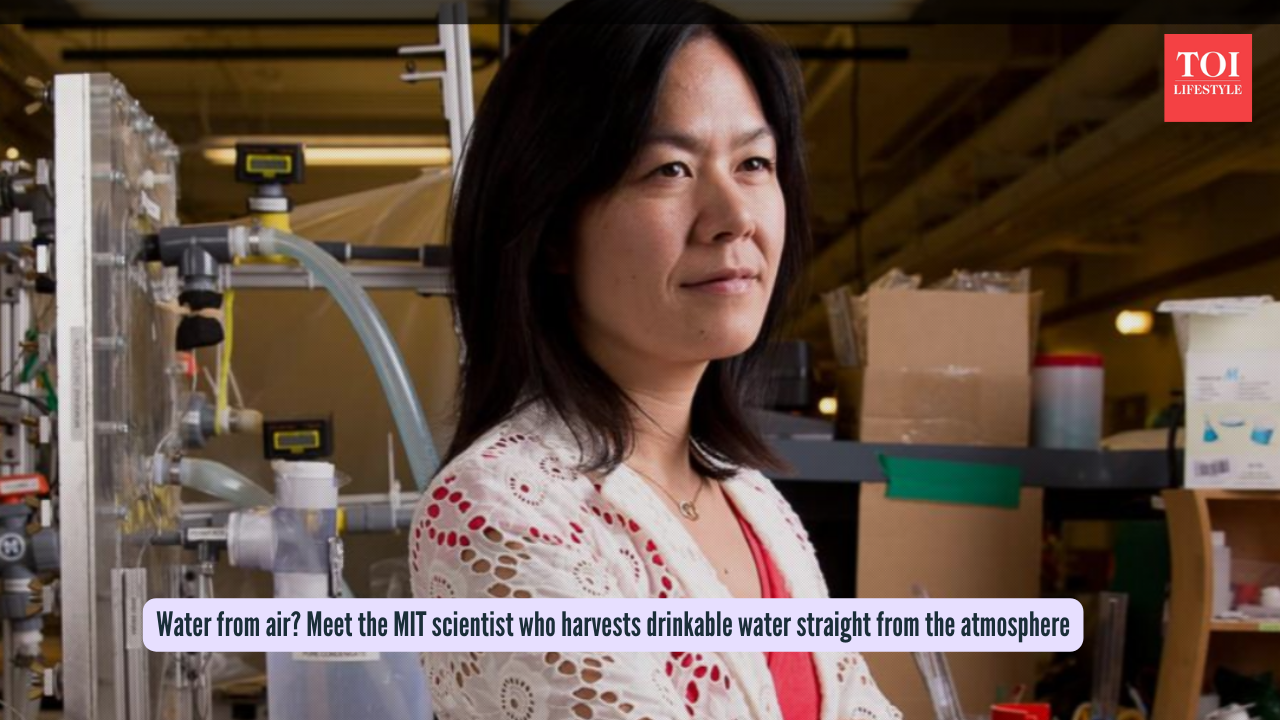
Water from air Meet the MIT scientist who harvests drinkable water straight from the atmosphere (Photo via meche.mit.edu)
Meet Evelyn N. Wang
Evelyn N. Wang is a mechanical engineer at MIT, pioneering ways to pull drinking water straight from the air. As the Ford Professor of Mechanical Engineering at MIT, Wang drives research into atmospheric water harvesting, a technology that captures air moisture using special materials, then releases it as liquid via heat.Her team’s solar-powered devices work brilliantly, as special porous materials absorb water vapor from the air at night, sunlight releases it during the day, and it condenses into usable water, and no electricity is needed. This makes them ideal for dry regions with unreliable power.
Wang’s educational qualifications
She completed her BS in Mechanical Engineering from MIT (1996–2000), then her MS in 2001 and PhD in 2006 from Stanford, focusing on heat transfer, which is core to her water tech. Post-PhD, she researched at Bell Laboratories before joining MIT as Assistant Professor in 2007.She then became an Associate Professor in 2011, a Full Professor in 2017, and served as Mechanical Engineering Department Head from 2018–2022. In 2023, she led the Advanced Research Projects Agency-Energy until early 2025, then took MIT’s Vice President for Energy and Climate role in April 2025, according to an India Today report.
Her innovations have earned big accolades to her name
Scientific American and the World Economic Forum called her arid-climate water tech a “Top 10 Emerging Technology of 2017”.MIT’s Device Research Lab under Wang keeps pushing prototypes, like solar systems yielding drinkable water from “dry” air, as detailed in a 2020 MIT News article.