
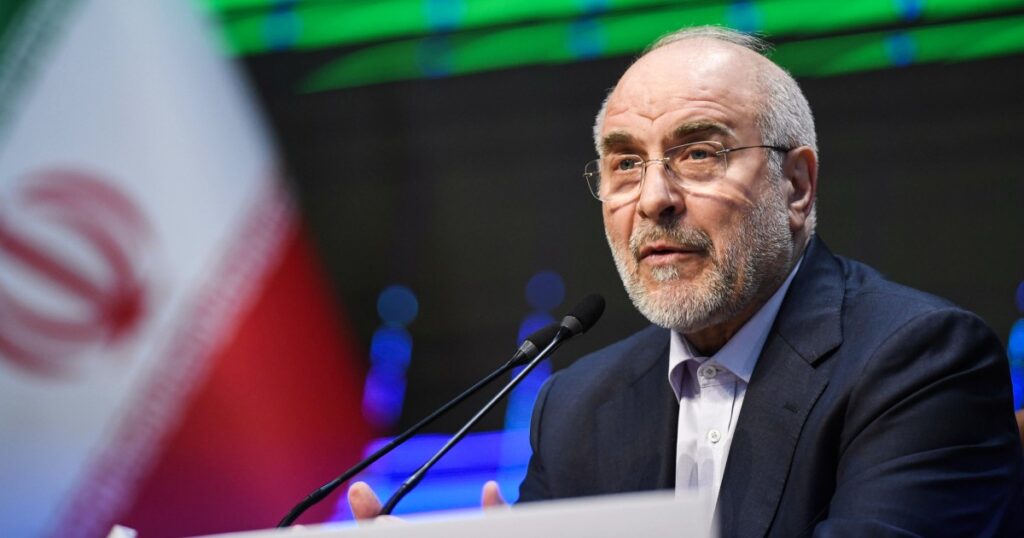
Rather than pursue university studies or work in his father’s shop, he decided to join the Revolutionary Guard at age 18 and fought in the Iran-Iraq war. In his autobiography, he wrote that he essentially grew up during the brutal eight-year conflict that left hundreds of thousands dead, and he quickly rose through the ranks to become a commander. His brother, Hassan, was killed in the war.
After the war, Iran’s supreme leader at the time, Ayatollah Ali Khamenei, appointed Ghalibaf, who is a brigadier general, to be the head of the Revolutionary Guard’s air force. In 1997, Ghalibaf traveled to France to get a pilot’s certification to fly Airbus planes, and he has flown planes for Iran’s national carrier, Iran Air, according to his autobiography.
Ghalibaf also was the country’s chief of police and has overseen crackdowns on protests and internal dissent. During his 12-year tenure as mayor of Tehran, Ghalibaf was accused of corruption, which he denied.
He also ran for president four times. In 2005, Ghalibaf wore a white suit at some campaign events, apparently to present a more moderate image, in stark contrast to the generally dour fashion sense of most politicians. The move got him noticed, but it was also ridiculed by some.
“He has always had the ambition to be the head of the executive branch and has lobbied for years for Mr. Mojtaba Khamenei to be the supreme leader,” said Ali Akbar Mousavi Khoeini, a former Iranian parliamentarian who worked with Ghalibaf when he was a politician in Iran and is now a fellow at George Mason University in Fairfax, Virginia.
That ambition is expected to come to the fore after Khamenei was appointed supreme leader this month after his father, Ali Khamenei, was assassinated on Feb. 28. He has not issued a video or audio statement since he took the highest position in the country.
“Mojtaba reportedly has long maintained a very close relationship with Tehran Mayor and presidential hopeful Mohammad Baqr Qalibaf; Mojtaba was reportedly the ‘backbone’ of Qalibaf’s past and continuing election campaigns,” a 2008 American diplomatic cable published by WikiLeaks, which uses a different transliteration for the parliament speaker’s last name, read. “Mojtaba is said to help Qalibaf as an advisor, financier, and provider of senior-level political support. His support for and closeness to Qalibaf reportedly remains undiminished.”
Other men have also emerged as key figures in the country’s power structure.
Until he died in a military strike last week, Ali Larijani, the head of the Supreme National Security Council, was the figure whom many observers pointed to as the de facto leader of the country. He was replaced Tuesday by Mohammad Bagher Zolghadr, a hard-line former Revolutionary Guard commander who has also held top security posts.
Another prominent figure is Ahmad Vahidi, who was appointed head of the Revolutionary Guard this month after his predecessor was killed during the opening salvo of the war on Feb. 28. Vahidi, a hard-liner who previously was both defense and interior minister and is now leading the war effort, was sanctioned by the U.S. Treasury in 2022 for his role in a bloody crackdown on protests at the time.

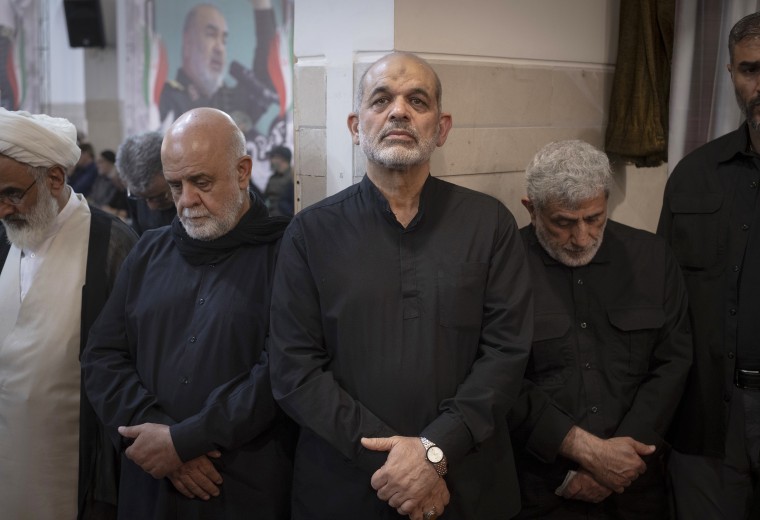
The Treasury also said Vahidi oversaw the bombing of a Jewish community center in Buenos Aires, Argentina, in 1994 that killed 85 people and wounded hundreds more. Interpol issued a red notice for Vahidi because of his alleged role in the bombing.
The rise of Ghalibaf, Zolghadr and Vahidi in top leadership roles in the Islamic Republic — along with the absence of Mojtaba Khamenei — signals a shift toward hard-line elements of the Revolutionary Guards effectively running the country, said Mousavi Khoeini, who is still in touch with officials in Iran.
“The power is in the hands of the Revolutionary Guard and the most radical faction of the Revolutionary Guard,” he said.
He added: “Vahidi is in charge of the country. Ghalibaf doesn’t have the strength to confront him.”
It is Vahidi, Mousavi Khoeini said, who pushed to continue attacks against regional countries, despite opposition from other top officials, like President Masoud Pezeshkian.
The current and former Guard commanders are likely to maintain their hard-line posture in any dealings with the U.S. to end the war and, if they survive the conflict, will be ruthless in dealing with any internal dissent, some observers say.
The developments are an indication of “the gradual transformation of the Islamic Republic into a military dictatorship, albeit one retaining a clerical figure, Mr. Mojtaba Khamenei, as a ceremonial head of state and leader of the revolution,” said Alfoneh, of the Arab Gulf States Institute.