
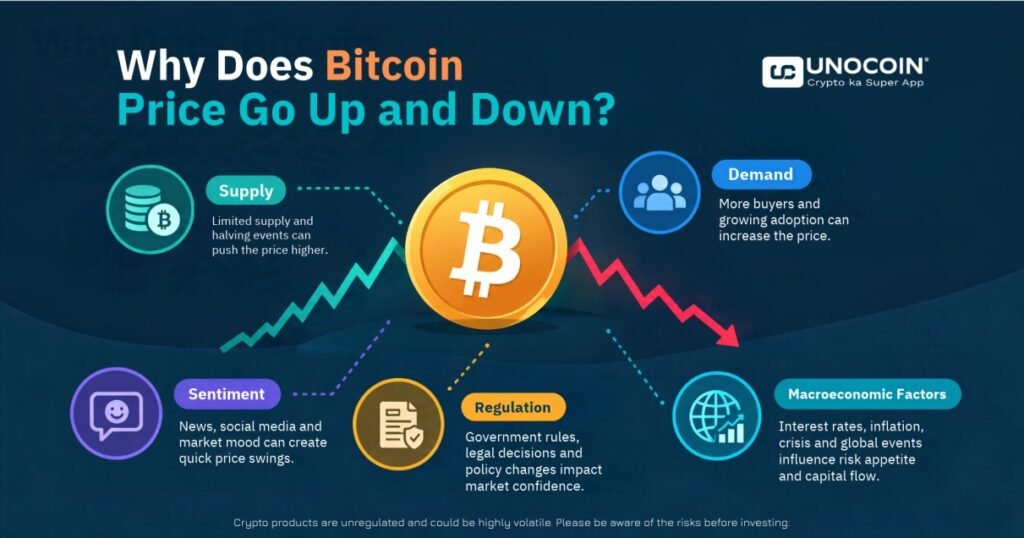
Why does Bitcoin price go up and down? Bitcoin’s price changes because buyers and sellers continuously interact in the market, while factors such as supply, demand, investor sentiment, liquidity, regulation, economic conditions and market expectations influence how much people are willing to buy or sell. More buying demand than available selling supply can push the price up — more selling pressure than buying demand can push it down.
If you have ever checked the Bitcoin price and wondered why it was higher or lower than it was a few hours earlier, you are not alone. Bitcoin can experience large price movements over relatively short periods — and the reason is never one single event or formula.
Bitcoin’s price changes because buyers and sellers continuously interact in the market, while a combination of factors shapes how aggressively each side wants to trade. This guide covers all of them.
Why Does Bitcoin Price Go Up and Down?
Bitcoin price goes up and down because the balance between buyers and sellers changes. When many people want to buy Bitcoin and fewer sellers are willing to sell at the current price, buyers may offer higher prices to find sellers — and the market price moves upward. When many holders want to sell while fewer buyers are willing to pay the current price, sellers may accept lower prices to complete their trades — and the price moves downward.
Key Takeaways
✔Bitcoin’s price is determined by market supply and demand
✔Limited supply alone does not guarantee a higher price
✔Changes in buying and selling activity can move Bitcoin’s price
✔Investor sentiment can increase or reduce demand quickly
✔Market liquidity affects how strongly buying or selling can move the price
✔Bitcoin’s price can react to regulation, economic conditions, interest rates and major news
✔Bitcoin’s halving reduces new supply — but does not guarantee a price increase
✔Bitcoin remains a volatile asset — large price movements can happen in both directions
How Bitcoin Price Moves in the Market
A simple way to understand Bitcoin price movement is as a chain reaction. Events do not directly set the Bitcoin price — they influence the decisions of market participants, who then buy or sell, which shifts the balance of supply and demand.
Bitcoin Price Movement Chain
| 1News, event or data release |
| 2Market participants change their expectations |
| 3Buying or selling activity changes |
| 4Demand and available supply become unbalanced |
| 5Bitcoin price moves up or down |
Important: The event itself does not directly set the Bitcoin price. It influences the decisions of market participants — who then collectively create buying or selling pressure through their actions.
17 Key Factors That Drive Bitcoin Price
| 1 |
Supply and Demand The foundation of Bitcoin price discovery |
Bitcoin has a predetermined monetary supply schedule and a total supply limited by the protocol. New Bitcoin enters circulation through mining rewards, and the issuance rate decreases over time. However, Bitcoin’s limited supply does not automatically mean its price must increase. Demand still matters.
Think of Bitcoin price as:
Available supply + Demand + Market conditions
Not simply: Limited supply = higher price
| 2 |
Buying and Selling Pressure How aggressively each side wants to trade |
Every Bitcoin trade involves a buyer and a seller — but the important question is how aggressively each side is willing to trade. If buyers are willing to accept increasingly higher prices, upward pressure develops. If sellers accept increasingly lower bids, downward pressure develops.
|
Buying Pressure Buyers bid higher → price moves upward |
Selling Pressure Sellers accept lower bids → price moves downward |
| 3 |
Investor Sentiment Optimism and fear can shift demand rapidly |
Investor sentiment can have a major effect on Bitcoin’s price. When market participants feel optimistic, they may become more willing to buy or hold. Negative sentiment can develop from regulatory concerns, security incidents or market losses. Sentiment can change very quickly — which is one reason Bitcoin can move sharply even when the underlying network has not changed.
|
Positive sentiment from: →Increased adoption →New financial products →Institutional activity →Strong market momentum |
Negative sentiment from: →Regulatory concerns →Security incidents →Market losses →Broader economic uncertainty |
| 4 |
Market Liquidity How easily Bitcoin can be bought or sold without moving the price |
Liquidity refers to how easily an asset can be bought or sold without causing a large change in its price. When liquidity is lower, a relatively large order can have a greater effect on the market price. For Bitcoin, liquidity can vary across exchanges, trading pairs and market conditions — meaning a large buying or selling order can sometimes have a noticeable short-term impact.
| 5 |
Bitcoin’s Limited Supply ~21 million BTC maximum — but scarcity alone ≠ higher price |
The Bitcoin protocol limits the total number of bitcoins that can be created to approximately 21 million. New bitcoins are issued through mining rewards, and the issuance rate decreases over time, creating a predictable supply schedule. But limited supply is only one part of the equation.
| ↑Demand increases + limited supply → upward price pressure may develop |
| ↓Demand decreases + limited supply → price can still fall |
| 6 |
Bitcoin Halving and New Supply Reduces new supply rate — does not guarantee a price rise |
Bitcoin’s mining reward is periodically reduced through an event known as the halving. When a halving occurs, the amount of new Bitcoin created through the block subsidy is halved — reducing the rate at which new Bitcoin enters circulation. The latest halving occurred in April 2024, reducing the block subsidy to 3.125 BTC per block.
Important: A halving does not mechanically set the price of Bitcoin. The market still depends on demand, liquidity, expectations and broader conditions. A reduction in new supply can matter, but it does not guarantee that Bitcoin’s price will rise after a halving.
| 7 |
News and Market Expectations Price reflects expectations as well as current information |
Bitcoin trades continuously, so new information can affect market expectations at any time — including regulatory announcements, institutional developments, security incidents and economic data. The market does not necessarily wait for an event to happen. If traders expect an event to have a particular effect, they may buy or sell Bitcoin before the event occurs.
This is why Bitcoin sometimes moves before an announcement that later becomes widely discussed. The price reflects expectations as well as current information.
| 8 |
Regulation and Government Policy Can affect demand, confidence and market accessibility |
Regulatory developments can influence Bitcoin demand and market sentiment. A new rule may affect how businesses operate, how exchanges provide services, or how investors access Bitcoin. A regulatory development perceived as supportive may increase confidence among some market participants. A restrictive or uncertain development may reduce demand or increase caution. The effect depends on the specific regulation, jurisdiction and prior market expectations.
| 9 |
Institutional Participation Large players move larger amounts — but can be buyers or sellers |
Large financial institutions and professional investors can influence Bitcoin markets because they may transact in significantly larger amounts than individual investors. Their activity can include buying, selling, holding, offering Bitcoin-related financial products or trading derivatives. However, institutional participation does not always mean prices will rise — institutions can be buyers or sellers, depending on their objectives and market conditions.
| 10 |
Bitcoin ETFs and Other Financial Products Additional channels for investor participation |
Financial products that provide exposure to Bitcoin — such as spot Bitcoin exchange-traded products (ETPs) — can affect how investors access the asset and introduce additional channels through which market participants interact with Bitcoin. However, a spot Bitcoin ETF has its own fees, trading activity, structure and risks. Its effect on Bitcoin’s price depends on broader market conditions and flows.
| 11 |
Macroeconomic Conditions Bitcoin does not trade in isolation from global economics |
Changes in the global economy can affect how investors view risk and where they want to allocate capital. Factors that can influence market behaviour include interest rates, inflation expectations, economic growth, employment conditions, currency movements and global liquidity.
Caution: There is no simple rule such as “interest rates fall → Bitcoin always rises” or “inflation rises → Bitcoin always rises.” Markets are more complicated. Bitcoin can respond differently depending on what investors expected before the data was released and how other markets react.
| 12 |
Interest Rates and Liquidity Affect cost of money and appetite for risk assets |
Interest rates can influence investor behaviour because they affect the cost of money and the attractiveness of different assets. When expectations around interest rates change, investors may reconsider how much risk they want to take. When financial conditions are loose and investors have more capital available for riskier assets, demand for Bitcoin can change. When conditions tighten, investors may become more cautious. The relationship is not always direct, but monetary conditions can influence the broader environment in which Bitcoin trades.
| 13 |
Bitcoin Whales and Large Transactions Large holders can influence price — but blockchain movement ≠ selling |
The term “Bitcoin whale” refers to an individual or organisation that holds a large amount of Bitcoin. Large holders can influence market conditions if they move or sell significant amounts into a market with limited buying liquidity, contributing to downward pressure. Similarly, large purchases can contribute to upward pressure.
Note: Not every large blockchain transaction means Bitcoin is being bought or sold. Bitcoin can be moved between wallets, exchanges and custodians for many reasons. Blockchain movement should not automatically be interpreted as buying or selling.
| 14 |
Trading Activity and Market Volume High volume shows activity — not direction |
Trading volume shows how much Bitcoin is being traded during a particular period. Higher trading activity can occur when market participants have strong opinions about the direction of the market. High volume can accompany both rising and falling prices. High volume does not automatically mean Bitcoin will go up — it simply tells us that trading activity is elevated.
| 15 |
Derivatives Can Affect Market Activity Futures and options interact with spot markets |
Bitcoin is traded not only in spot markets but also through derivatives such as futures and options. Derivatives allow traders and institutions to take positions based on expected future price movements or manage existing exposure. Activity in these markets can influence overall market positioning and sentiment. However, derivatives do not independently determine the Bitcoin price — they interact with spot markets, liquidity, expectations and the broader supply-and-demand environment.
| 16 |
Fear and Greed Can Amplify Price Movements Emotional feedback loops accelerate rallies and drawdowns |
Markets are driven by people making decisions under uncertainty. When prices rise quickly, some market participants may become more confident and buy because they expect further increases. When prices fall quickly, fear can lead some holders to sell. This creates a feedback loop:
|
Greed Loop Price rises → optimism increases → more buying → price rises further |
Fear Loop Price falls → fear increases → more selling → price falls further |
| 17 |
Bitcoin Market Cycles Historical patterns provide context — not predictions |
Bitcoin has historically experienced periods of rising prices followed by significant corrections. These cycles can be influenced by supply issuance, investor sentiment, liquidity, adoption, market speculation, macroeconomic conditions, institutional activity and regulatory developments — all simultaneously.
It is tempting to assume that previous Bitcoin cycles can predict the next one exactly. They cannot. Historical patterns can provide context, but they do not guarantee what Bitcoin’s price will do next.
Why Is Bitcoin So Volatile?
Bitcoin is considered a volatile asset because its price can experience significant changes over relatively short periods. Several factors contribute to this:
|
→Rapidly changing investor sentiment →Market speculation and leverage →Variable market liquidity |
→Large buying or selling activity →Regulatory developments →Bitcoin’s evolving adoption globally |
Bitcoin trades around the clock across global markets with no single daily closing period. A major event can trigger buying or selling activity while traditional financial markets in some countries are closed. Combined with changing liquidity and market sentiment, this can produce rapid price movements at any hour.
Does Bitcoin Price Always Follow Supply and Demand?
Supply and demand are fundamental — but the process is more complicated than simply counting the number of buyers and sellers. What actually matters is:
What Drives Bitcoin Price in Practice
| →How much buyers want to purchase (size of orders, not just count) |
| →How much sellers want to sell and the prices they accept |
| →Available market liquidity at the time |
| →Expectations about future demand |
| →Overall market conditions at the moment of trading |
For example, 1,000 buyers do not necessarily create more upward pressure than 100 buyers — the size and urgency of their orders also matter. This is why Bitcoin price movement can change rapidly when market participants suddenly become more aggressive.
Why Can Bitcoin Fall Even When Its Supply Is Limited?
This is one of the most important questions for Bitcoin investors to understand. Bitcoin’s supply can remain limited while its price falls — because price depends on both supply and demand.
Suppose demand falls significantly:
1Even though Bitcoin’s total supply remains limited, buyers may no longer be willing to pay the previous market price
2Sellers may then have to accept lower prices to find willing buyers
3The market price falls — despite the supply limit being unchanged
Scarcity does not guarantee price appreciation.
The same principle applies to many scarce assets across all markets.
A Simple Example of Bitcoin Price Movement
Imagine Bitcoin is trading at ₹80 lakh
|
Scenario A — Price Rises →Many buyers enter the market expecting demand to increase →Not enough BTC being offered at ₹80 lakh →Some buyers accept ₹80.5L, others ₹81L Market price moves upward ↑ |
Scenario B — Price Falls →Many holders want to sell at the same time →Fewer buyers willing to pay ₹80 lakh →Sellers accept ₹79.5L, ₹79L or lower Market price moves downward ↓ |
Nothing about Bitcoin’s underlying protocol changed in either scenario. The change happened because the balance between buying and selling activity changed.
What Makes Bitcoin Price Go Up or Down?
|
What Can Make Bitcoin Price Go Up →Increased demand and buying pressure →Positive market sentiment →Greater adoption and use cases →Increased market liquidity →Institutional buying activity →Positive regulatory developments →Expectations of future demand →Favourable macroeconomic conditions |
What Can Make Bitcoin Price Go Down →Reduced demand and selling pressure →Negative market sentiment →Large selling activity from whales →Regulatory uncertainty or restrictions →Security incidents or exchange failures →Lower liquidity in the market →Weak broader market conditions →Changes in investor expectations |
Bitcoin Price: The Simple Explanation
Bitcoin price is the result of buyers and sellers meeting in the market.
| SupplyHow much Bitcoin is available and how much new Bitcoin is being created |
| DemandHow much people and institutions want to buy or hold |
| SentimentHow optimistic or cautious market participants are |
| LiquidityHow much buying and selling the market can absorb without large price changes |
| InformationNews, regulation, economic data and other events that change expectations |
| ExpectationsWhat market participants believe could happen in the future |
Frequently Asked Questions
QWhy does Bitcoin price go up and down?
Bitcoin price changes because buying and selling demand changes. Supply, investor sentiment, liquidity, regulation, macroeconomic conditions, institutional activity, news and expectations can all influence that demand.
QWhat determines the price of Bitcoin?
Bitcoin’s price is determined by market supply and demand. Buyers and sellers interact across markets, and their willingness to buy or sell at different prices determines the market price at any given moment.
QWhy is Bitcoin so volatile?
Bitcoin can be volatile because market sentiment, liquidity, speculation, news, regulation and other factors can change quickly. Large changes in buying or selling activity can therefore produce significant price movements, especially as Bitcoin trades around the clock across global markets.
QWhat makes Bitcoin price go up?
Bitcoin price can rise when buying demand increases relative to available selling supply. Increased adoption, positive sentiment, institutional activity and changes in market expectations can all contribute to higher demand.
QWhat makes Bitcoin price go down?
Bitcoin price can fall when selling pressure increases or demand decreases. Negative sentiment, regulatory uncertainty, market stress and changes in investor expectations can all contribute to a decline.
QDoes Bitcoin’s 21 million supply guarantee a higher price?
No. Bitcoin’s limited supply creates scarcity, but scarcity alone does not guarantee price appreciation. Demand is also required. If demand falls significantly, Bitcoin’s price can decline even though the supply limit has not changed.
QDoes Bitcoin halving always make the price go up?
No. A halving reduces the rate at which new Bitcoin is created, but it does not guarantee a price increase. Bitcoin’s market price continues to depend on demand, liquidity, expectations and broader market conditions.
QDo Bitcoin whales control the price?
Large Bitcoin holders can influence market conditions if they buy or sell substantial amounts, particularly when liquidity is limited. However, the overall Bitcoin market involves many participants, so a single holder does not simply set the global price.
QDo Bitcoin ETFs affect Bitcoin’s price?
Bitcoin-related exchange-traded products can provide another way for investors to gain exposure to Bitcoin and influence market participation and demand. However, their effect on Bitcoin’s price depends on broader market conditions, flows and investor behaviour.
Final Thoughts
Bitcoin price does not move because of one single factor. Its price changes because buyers and sellers continuously reassess what Bitcoin is worth and how much they are willing to buy or sell. Supply and demand provide the foundation, while sentiment, liquidity, regulation, institutional participation, macroeconomic conditions, news and expectations can change that balance.
Understanding these factors is more useful than trying to explain every price move with a single headline.
Ready to invest in Bitcoin in India?
Start from as little as ₹100 on Unocoin — India’s oldest Bitcoin exchange since 2013. FIU-IND registered. Full KYC and INR support.
Disclaimer
This article is for informational and educational purposes only and does not constitute financial or investment advice. Bitcoin’s price is highly volatile and can change significantly in a short period. Past price movements are not indicative of future results. Always conduct your own research before making investment decisions. Crypto products are unregulated as of this date in India. Please DYOR (Do Your Own Research).