
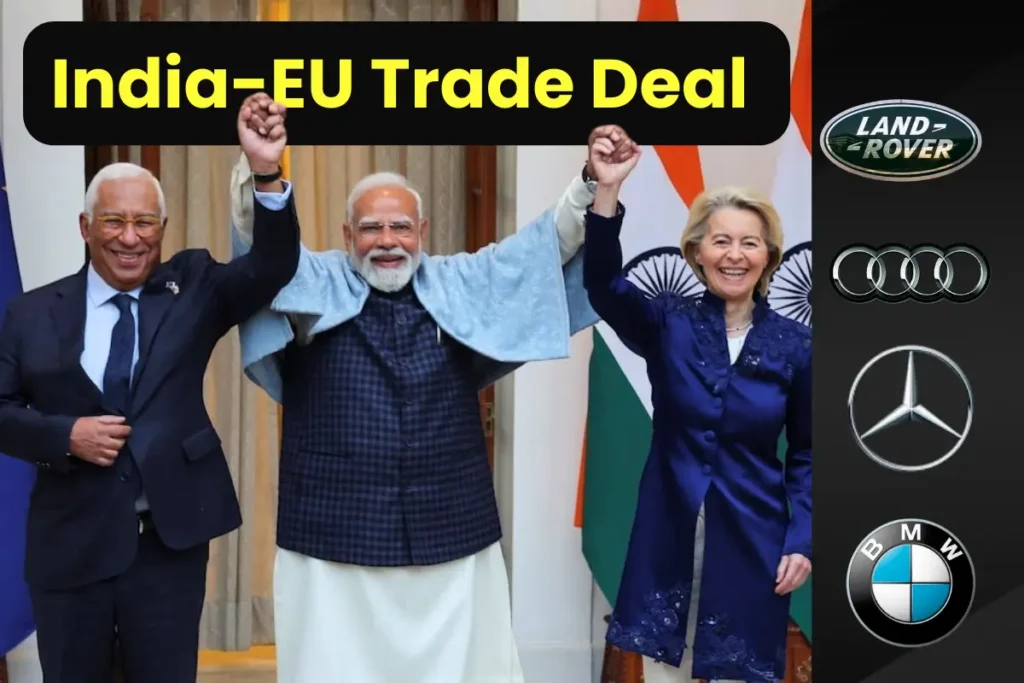
The global geopolitics has been undergoing a major transformation. India and the 27-nation European Union (EU) have recently signed a Free Trade Agreement (FTA), under which 93 percent of Indian exports will receive duty-free or tax-free access to the European Union. Simultaneously, the import of luxury cars and wines from European nations will become more affordable in India.
Touted as ‘Mother of all Deals’, the pact is expected to be enforced within the 2026 calender year.
India-EU Deal To Create 2 Billion Market
Commercee Minister Piyush Goyal, said that the India-EU trade deal will bring India and the European Union together and create a massive market of around 2 billion people. India is currently the world’s fourth-biggest economy, while the EU is the second largest economic group. Both account for nearly 25 percent of the global GDP and around one-third of global trade, worth close to USD 11 trillion.
Import Duty On CBU Cars to Fall
The fully imported cars currently attract high taxes of around 110%, which are expected to be reduced to nearly 40% in the first stage of the India and European Union trade deal. The lower import duties will majorly benefit luxury car brands such as Lamborghini, Porsche, BMW and Audi. However, due to their limited sales volumes, the overall Indian car market is unlikely to witness any major change.
Most European carmakers including Renault, Skoda and Volkswagen bring their vehicles to India via CKD (Completely Knocked Down) route and then assemble them locally. These CKD models currently attract a duty of around 17%, which is expected to remain unchanged under the new trade deal.
Mass-Market Cars to Remain Unaffected
According to an analysis by global brokerage firm Goldman Sachs, the India and EU free trade deal is unlikely to have significant impact on the Indian OEMs including Mahindra & Mahindra which has nearly 13% of its vehicles sales from models priced over Rs 23 lakh.
In comparison, Maruti Suzuki, Tata Motors and Hyundai have just 0.2% 2.8% and 8.7% sales of their sales, respectively, coming from models priced over Rs 23 lakh. As a result, the overall risk for the Indian car manufacturers is likely to remain limited.