







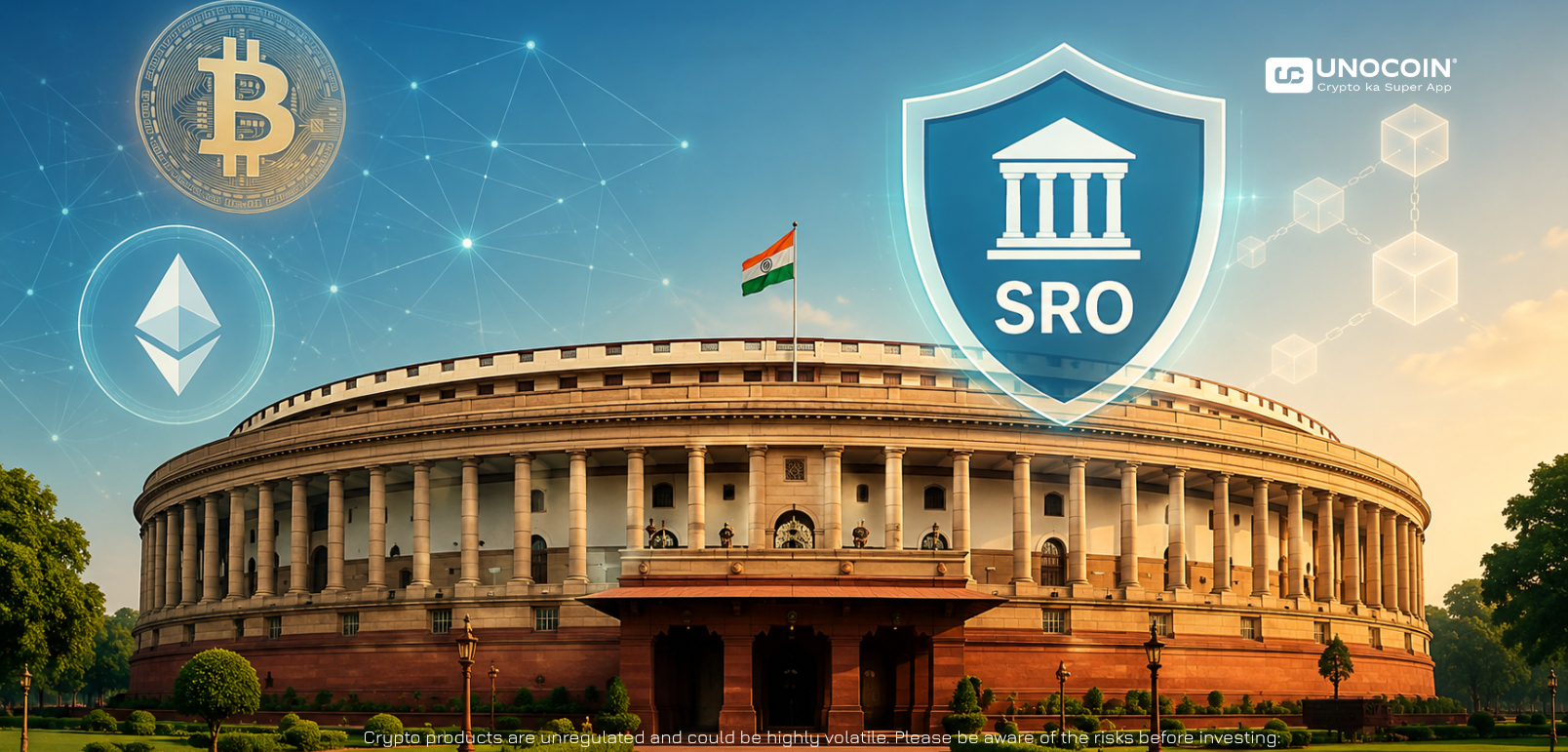
India’s Parliamentary Standing Committee on Finance has recommended that the government consider establishing a Self-Regulatory Organisation (SRO) for the crypto industry — to be overseen by either the RBI or SEBI — until a dedicated law for Virtual Digital Assets is enacted. This is a significant development in India’s evolving approach to crypto regulation.
India could be one step closer to a clearer regulatory framework for cryptocurrencies. A Parliamentary Standing Committee on Finance has recommended that the government consider introducing a Self-Regulatory Organisation (SRO) to oversee India’s crypto industry — until a dedicated law for Virtual Digital Assets (VDAs) is enacted.
The proposal comes at a time when cryptocurrencies are already taxed in India, exchanges comply with anti-money laundering (AML) requirements, and millions of Indians continue to invest in digital assets. Furthermore, India still does not have a comprehensive law governing cryptocurrencies — making this recommendation an important step toward that goal.
Here is everything Indian investors need to know about this development and what it may mean for the future of crypto regulation in India.
Important: These are recommendations from a Parliamentary committee — not new laws. Existing rules for buying, selling, and holding crypto in India remain unchanged unless formally enacted by the government.
What Has the Parliament Committee Recommended?
The Parliamentary Standing Committee has suggested that India explore allowing a recognised Self-Regulatory Organisation (SRO) for the crypto industry. Specifically, the recommendation outlines the following structure:
Key Recommendations at a Glance
01
The SRO would operate under the supervision of a designated regulator — either the Reserve Bank of India (RBI) or the Securities and Exchange Board of India (SEBI)
02
Its primary objectives would be investor protection, industry standards, and responsible market practices
03
The arrangement would remain in place until India introduces a dedicated legal framework for digital assets
04
The committee also urged the government to evaluate legislation covering Cryptocurrencies, Stablecoins, NFTs, and DeFi
Notably, the committee’s recommendation goes beyond Bitcoin and traditional cryptocurrencies. By explicitly including stablecoins, NFTs, and DeFi, policymakers are signalling that they are considering the broader digital asset ecosystem — not just crypto trading platforms.
What Is a Self-Regulatory Organisation (SRO)?
An SRO is an industry body that helps establish rules, standards, and best practices for its members — while operating under the oversight of a government regulator. It acts as a bridge between the industry and the government, helping implement compliance standards without requiring direct government intervention in every business decision.
Simple Definition: Think of an SRO as an industry “watchdog” that is run by the industry itself, but answerable to the government regulator. Members of the SRO agree to follow its rules in exchange for the ability to operate in the market.
Many industries around the world use SROs effectively. Well-known examples include stock exchange associations, banking industry bodies, and securities market regulators. If implemented in India’s crypto sector, an SRO could help:
Responsible Practices
Promote responsible business practices across all crypto exchanges and platforms
Transparency
Improve transparency across the crypto industry — pricing, fees, disclosures
Better Compliance
Encourage consistent compliance with AML, KYC, and consumer protection norms
Investor Confidence
Strengthen investor confidence through clear standards and accountability
Regulator Coordination
Support better coordination between crypto exchanges, platforms, and government regulators — creating a more structured industry dialogue
Why Is This Recommendation Important for Indian Crypto Investors?
To understand why this recommendation matters, it helps to look at the current regulatory landscape. India already has several crypto-related rules in place — however, a crucial piece is still missing.
What India Already Has
✔30% flat tax on VDA profits (Section 115BBH)
✔1% TDS on qualifying transactions (Section 194S)
✔Mandatory KYC for all exchange users
✔Anti-money laundering (AML) reporting obligations
✔FIU-IND registration for exchanges
What India Still Lacks
✖A dedicated, comprehensive crypto law
✖A designated single regulator for crypto
✖Formal legal recognition of digital assets
✖Regulatory clarity for stablecoins, NFTs, DeFi
✖Clear investor protection framework
The committee believes an interim SRO mechanism could help bridge this gap — providing structured oversight while policymakers work on a comprehensive legal framework. Consequently, this recommendation is seen as a meaningful step toward regulatory clarity, even if it does not immediately create new rules.
Technology-Neutral Regulation — What Does It Mean?
One of the most significant — and often overlooked — recommendations from the committee is that future securities laws should remain technology-neutral. This is an important concept for anyone following India’s crypto regulatory landscape.
Technology-Neutral Regulation — Explained Simply
The principle is straightforward: the law should regulate the financial product — not the technology used to create it.
Example:
If traditional securities (such as shares or bonds) are represented on a blockchain through tokenisation, they should continue to fall under existing securities regulations — rather than escaping oversight simply because they use distributed ledger technology.
This approach has two important objectives. First, it aims to encourage innovation by ensuring that new technologies are not unnecessarily disadvantaged by unclear rules. Second, it seeks to maintain regulatory safeguards by ensuring that existing protections cannot be circumvented simply by putting a product on a blockchain.
For India’s growing blockchain and tokenisation industry, this recommendation could be particularly significant — as it potentially provides a clearer path for regulated financial products that use blockchain infrastructure.
RBI’s Concerns Continue — What Is the Central Bank’s Position?
RBI’s Position: The Reserve Bank of India has not changed its long-standing cautious stance on private cryptocurrencies. The committee’s recommendations do not reflect an RBI endorsement of crypto — the central bank’s concerns remain on record.
The recommendations come just weeks after the Reserve Bank of India reiterated its long-standing concerns regarding cryptocurrencies. The RBI has consistently highlighted a range of potential risks. These concerns include:
⚠Financial stability — concerns about crypto’s impact on the broader financial system
⚠Monetary sovereignty — risks to the Indian Rupee and RBI’s control over monetary policy
⚠Money laundering and terror financing — potential for misuse in illicit financial flows
⚠Tax evasion — concerns about undisclosed crypto holdings and cross-border transfers
Additionally, the central bank has maintained that banning private cryptocurrencies remains one of the options under consideration. While the parliamentary committee acknowledged these concerns, it also recognised that Virtual Digital Assets currently exist in a regulatory grey area — and that investor protection requires clearer oversight rather than an absence of rules.
The tension between the RBI’s cautious stance and the committee’s more structured regulatory approach reflects the broader ongoing policy debate around crypto in India.
How Has the Crypto Industry Responded?
Several industry leaders and crypto exchanges have welcomed the committee’s recommendations. The general sentiment across India’s crypto sector is cautiously optimistic — acknowledging that regulatory clarity, even in interim form, is better than the current uncertainty.
Regulatory clarity could encourage responsible innovation — giving businesses the confidence to build and invest in India’s crypto ecosystem
A supervised SRO may improve investor protection — ensuring minimum standards for customer funds, disclosures, and dispute resolution
Clear rules could strengthen institutional confidence — making India a more attractive destination for global crypto businesses and institutional investors
India can continue developing blockchain-based financial technologies without the uncertainty caused by regulatory ambiguity
Industry experts have also pointed out that countries such as the United States, Singapore, Japan, the United Kingdom, and the European Union have already introduced regulatory frameworks for digital assets. India, as one of the world’s largest crypto user bases, is increasingly seen as needing a comparable framework to protect investors and support responsible growth.
| Country / Region | Regulatory Status | Framework in Place? |
|---|---|---|
| United States | SEC, CFTC, FinCEN oversight — evolving framework | Partial |
| Singapore | MAS licensing for Digital Payment Tokens | Yes |
| Japan | FSA-regulated crypto exchanges since 2017 | Yes |
| European Union | MiCA (Markets in Crypto-Assets) regulation enacted | Yes |
| United Kingdom | FCA-regulated — crypto promoted as financial product | Partial |
| India | Taxation + KYC + AML in place — no dedicated crypto law yet | Pending |
What Does This Mean for Crypto Investors in India Right Now?
Short Answer: At present, nothing changes immediately. Indian investors can continue buying, selling, and holding cryptocurrencies according to existing regulations. The committee’s recommendations do not create new rules.
However, if the government accepts these recommendations and moves forward with implementation, the crypto industry could eventually see meaningful improvements for investors:
Better Consumer Protection
Minimum standards for exchange operations, customer funds, and dispute resolution — giving investors greater security and recourse.
More Transparent Operating Standards
Clearer disclosure requirements, fee transparency, and operational standards across all crypto platforms in India.
Stronger Compliance Across Exchanges
Uniform compliance standards may level the playing field — potentially weeding out non-compliant platforms and strengthening user trust in regulated exchanges like Unocoin.
Greater Regulatory Certainty
A clearer regulatory path may encourage more long-term participation from both retail and institutional investors in India’s crypto market.
Improved Institutional Confidence
Regulatory clarity often precedes increased institutional participation — which could improve market depth, liquidity, and overall market maturity.
Remember: These are recommendations — not new laws. Any regulatory changes would require further government consideration and, where applicable, formal legislative action by Parliament. The timeline for implementation remains uncertain.
What This Could Mean for India’s Broader Crypto Ecosystem
If India moves toward a structured regulatory framework — whether through an SRO or a dedicated law — it could help the country achieve a meaningful balance between two important but sometimes competing goals.
Investor Protection
Appropriate oversight protects millions of Indian retail investors from fraud, mismanagement, and unregulated platforms
Innovation Support
A clear framework supports responsible growth in blockchain and digital asset technology — keeping Indian companies competitive globally
Furthermore, a transparent regulatory environment may encourage responsible growth, attract foreign and domestic investment into blockchain infrastructure, and provide greater confidence to businesses looking to build in India’s digital asset sector.
India currently has one of the largest pools of crypto users globally. Additionally, Indian developers and blockchain companies are active contributors to global Web3 ecosystems. A stable regulatory framework could help channel this activity more productively — rather than pushing innovation offshore due to regulatory uncertainty.
Conclusion — What Should Indian Crypto Investors Do?
The Parliamentary Standing Committee’s recommendation to establish a supervised crypto Self-Regulatory Organisation represents an important development in India’s evolving approach to digital assets. While it does not immediately change the legal status of cryptocurrencies, it signals continued and serious policy discussions around creating a structured regulatory framework for the sector.
As India evaluates the future of crypto regulation, the most important thing investors can do right now is:
1Stay informed — follow official announcements from the government, RBI, and SEBI regarding any regulatory changes
2Use compliant platforms — trade only on FIU-IND registered exchanges that follow KYC, AML, and TDS obligations
3Maintain transaction records — keep detailed records of all crypto purchases, sales, and transfers for tax compliance
4File taxes correctly — declare all VDA income in your ITR under Schedule VDA — the 30% tax and 1% TDS rules continue to apply
5Do not panic — regulatory discussions are normal in a maturing market. The current buying, selling, and holding framework remains unchanged
Trade crypto safely on India’s oldest, FIU-registered exchange.
Unocoin has been compliant since 2013 — KYC verified, TDS compliant, and fully transparent.
Disclaimer
This article is for informational purposes only and does not constitute legal, financial, or investment advice. The recommendations described are from a Parliamentary Standing Committee and have not been enacted into law. Crypto regulations in India are subject to change. Always consult a qualified legal or financial professional before making investment decisions. Crypto products are unregulated as of this date in India and could be highly volatile. Please DYOR (Do Your Own Research).
Frequently Asked Questions
Related Guides on the Unocoin Blog