








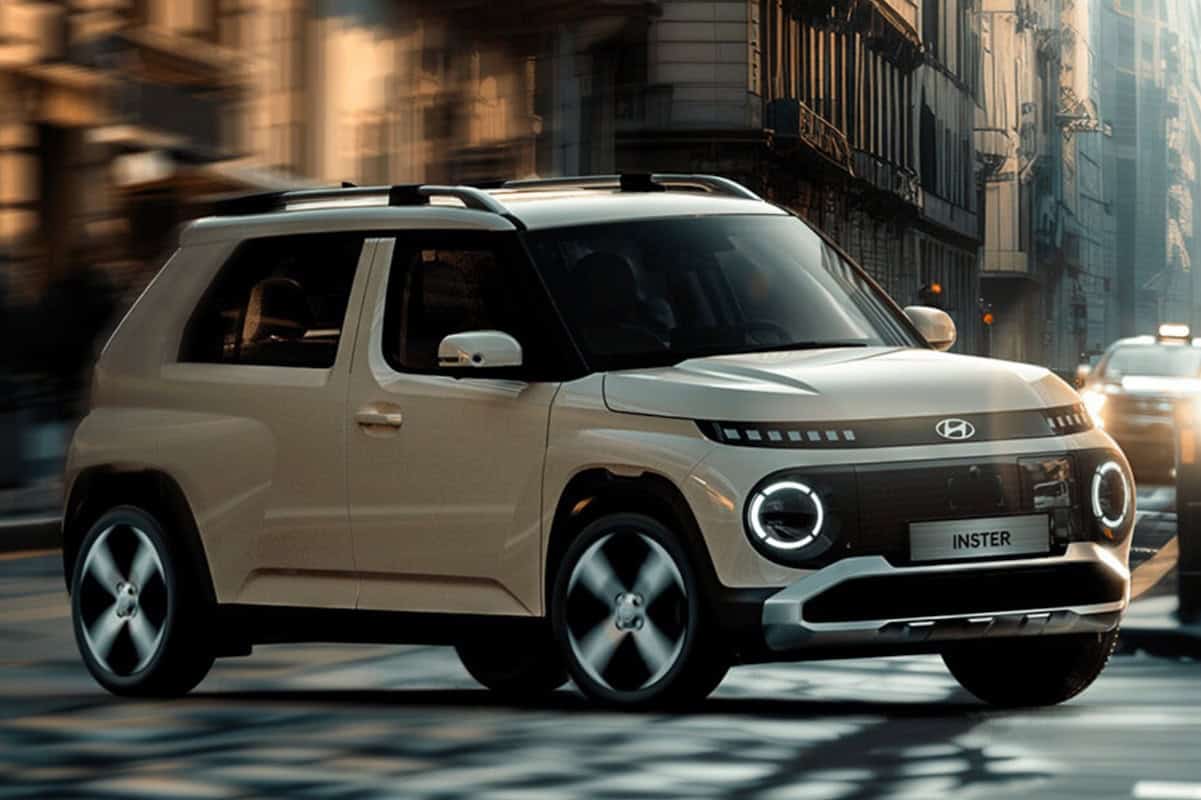
In 2025, Hyundai had announced an all-new electric compact SUV for the Indian market. While the carmaker remained tight-lipped about the upcoming model, it confirmed that the EV will be “designed, engineered and built” locally. The new Hyundai compact SUV is likely to measure under 4 metres in length, and will directly challenge the Tata Punch EV.
Also Read: New-Gen Hyundai Creta & i20 India Launch Details & More
Hyundai’s Sriperumbudur manufacturing facility in Tamil Nadu will serve as production hub for the EV. The carmaker will use localized batteries, sourced from Exide. Industries.
Upcoming Hyundai Compact EV – What to Expect?

Codenamed HE1i, the new Hyundai compact EV will hit Indian roads in 2027. It could be based on the Hyundai Inster EV, and based on the scalable E-GMP (Electric Global Modular Platform). This architecture supports 800V high speed charging, and offers a driving range of over 500km. Hyundai has also confirmed that its upcoming compact EV will be available with two battery options.
Globally, the Hyundai Inster EV is offered with 42kWh Standard Range and 49kWh Long Range battery options, delivering a claimed WLTP range of 300km and 355km. While the former uses a 97bhp/147Nm electric motor, the latter comes with a 115bhp/147Nm motor.
The South Korean automaker has confirmed that the new Hyundai compact EV will feature a Level 2 ADAS (autonomous driver assistance system) suite and an infotainment system supporting OTA (over-the-air) updates. Similar to the global-spec Hyundai Inster, the Made-in-India EV might offer a dual screen setup, automatic climate control, in-car connectivity tech, a 360-degree camera with blind-spot monitoring system and more.
Localization & Future Plan
Hyundai aims to a build a high-level localized EV supply chain including locally sourced battery cells, high-tech e-powertrain components and several sub-parts developed in collaboration with local suppliers.
The South Korean automaker has also announced plans to launch 26 new models in India by 2030. The plan outlines four products by 2026, eight models during FY2027-2028, and fourteen between FY 2029-2030.