







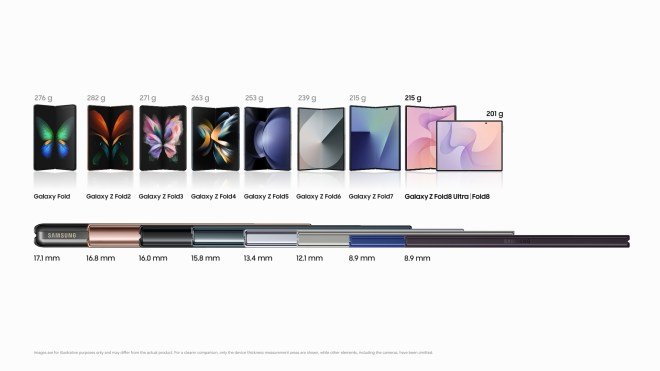
The original Galaxy Fold weighed a hefty 276g – and that isn’t even the heaviest Fold. That honor goes to the Z Fold2, which tipped the scales at 282g. And yet Samsung’s latest book-style foldable is only 201g.
Okay, to be fair, this refers to the Galaxy Z Fold8, which has a smaller form factor than previous Folds. This is the story of how Samsung engineers made their Z foldables both lighter and thinner.
The Galaxy Z Fold7 achieved an ambitious goal. Samsung asked “Could a foldable be lighter than a bar-type flagship smartphone?” and then found a way to do it – the Z Fold7 weighs 215g, which is 3g less than the Galaxy S25 Ultra.
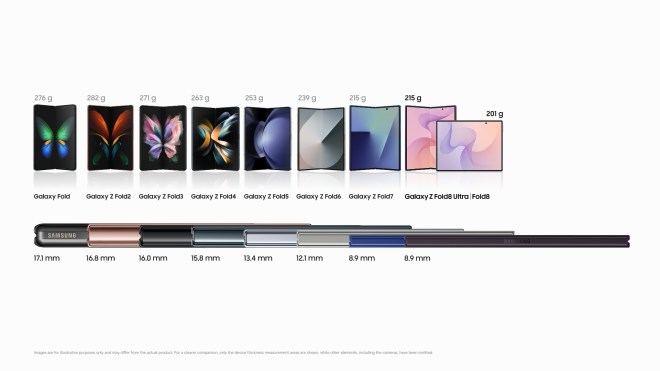
The history of the Galaxy Z Foldables as told by their weight
The new Galaxy Z Fold8 Ultra weighs the same, 215g, but that conceals a ton of work done to lighten the phone – it’s a give and take process.
The Z Fold8 Ultra has a bigger battery than the Z Fold7 – 5,000mAh vs. 4,400mAh. However, this new battery is 6g heavier than the old one. Six grams isn’t much, right? Well, to keep the weight the same, Samsung had to examine 270 components and 180 types of auxiliary parts. It managed to remove 15 part types, while also slimming down the others.
Some gains were as small as 0.0001g, but those add up across the whole device. But it wasn’t just the battery. The new Ultra also has a larger graphite sheet (+7%) for better thermal performance compared to the Z Fold7. And it has the first 50MP ultra-wide camera in the Fold family. Offsetting these also required weight savings.
It’s not just the weight – the Folds have gotten significantly thinner since the original model hit store shelves. Samsung has had to rework the internal structure, including the motherboard, to make more efficient use of the available space. That alone wasn’t enough, so it had to design new materials as well.
This generation, Samsung introduced the Flex Titanium design, which includes a titanium sheet that supports the folding display. This sheet is only a few tens of micrometers thick, roughly one third the width of a human hair.
There’s also a titanium plate that is only 0.2mm thick. When working with such thin materials, there is a risk that the machining process will bend and warp them. So, Samsung engineers had to rethink the machining sequence to get good, reliable results.
You can read our Galaxy Z Fold8 review and our Galaxy Z Fold8 Ultra review for a closer look at Samsung’s latest book-style foldables. We also have a detailed comparison between the two.