








| Key Takeaways
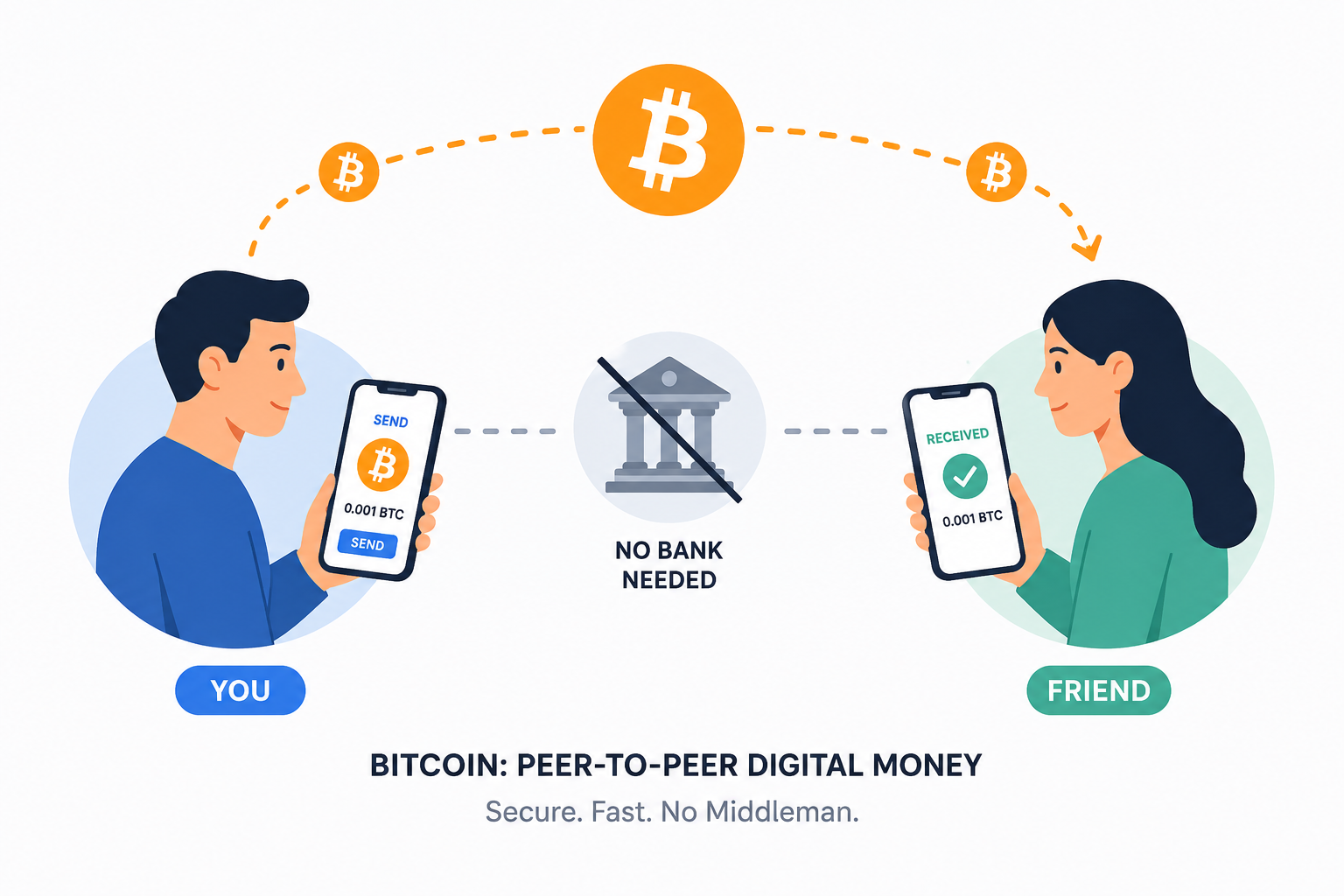
✔ Bitcoin is a decentralised digital currency — no bank or government controls it. |
Bitcoin is a decentralised digital currency that allows anyone to send or receive money — anywhere in the world — without the need for a bank or government. It was created in 2009 by an anonymous person or group known as Satoshi Nakamoto, and it continues to be the world’s most widely recognised and most valuable cryptocurrency.
Over the past decade, Bitcoin has transformed from a niche internet experiment into a globally recognised asset class. Today, millions of Indians hold Bitcoin through regulated exchanges like Unocoin — and the number grows every month. Yet for many first-time investors, one question still comes up again and again: what exactly is Bitcoin, and how does it work?
In this comprehensive guide, we cover everything you need to know — from what Bitcoin is in simple terms, to how the technology works, why it has value, and how you can safely buy your first Bitcoin in India today.
What is Bitcoin, Explained in Simple Terms?
Think of Bitcoin as digital cash — but smarter and more secure than physical notes. Just as a ₹500 note can be handed from one person to another without a bank being involved, Bitcoin can be sent from your digital wallet to someone else’s wallet — directly, instantly, and without any middleman.
However, unlike physical cash, Bitcoin is entirely digital. It exists only as entries on a shared public database called the blockchain — which we will explain in detail shortly. Furthermore, unlike the Indian Rupee, Bitcoin is not issued or controlled by any central authority. No RBI, no government, no corporation controls it.
Definition: Bitcoin (BTC) — A peer-to-peer electronic cash system that operates on a decentralised public ledger called the blockchain. It was the world’s first cryptocurrency and remains the largest by market capitalisation.
In short, Bitcoin is money for the internet age — portable, borderless, and resistant to censorship or inflation. Moreover, it is increasingly being treated by Indian investors not just as a currency, but as a store of value — similar in spirit to digital gold.
How Was Bitcoin Created? — The Origin Story
Bitcoin’s story begins in the aftermath of the 2008 global financial crisis — a period when trust in banks and financial institutions had collapsed worldwide. In October 2008, a whitepaper titled ‘Bitcoin: A Peer-to-Peer Electronic Cash System’ was published by someone (or a group) using the pseudonym Satoshi Nakamoto.
The first Bitcoin block — known as the Genesis Block — was mined on 3 January 2009. Embedded in that very first block was a message referencing a newspaper headline about a UK bank bailout — widely seen as a direct commentary on the failures of centralised banking.
Since then, Satoshi Nakamoto has remained anonymous and gradually faded from public view after 2010. Nevertheless, the open-source network that was built continues to run — maintained by thousands of developers and miners around the world, without any central owner or controller.
Transition: Knowing the origin helps — but understanding how Bitcoin actually works is what makes it truly fascinating.
How Does Bitcoin Work? — The Technology Behind It
Bitcoin is powered by three core technologies that work together: blockchain, public-key cryptography, and proof-of-work mining. Each plays a vital role in making the system secure, transparent, and trustworthy.
1. What is Blockchain? — Bitcoin’s Foundation
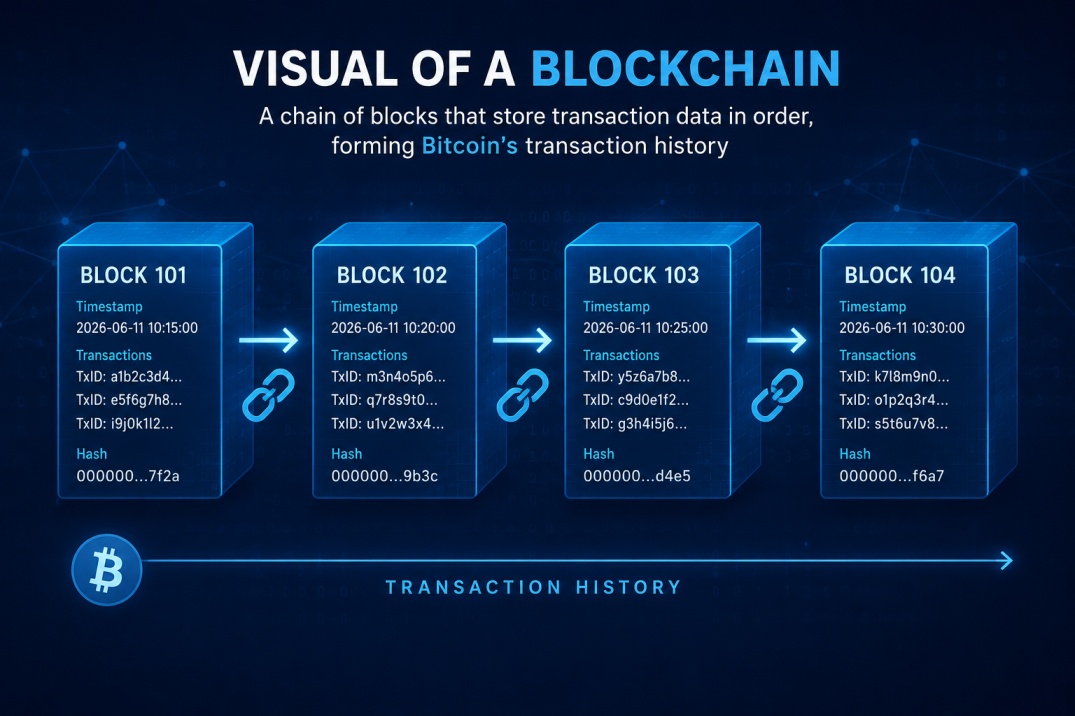
The blockchain is a public ledger — a permanent, ordered record of every Bitcoin transaction that has ever occurred. Imagine a Google Sheet that is shared with millions of people simultaneously, where every new row is permanently locked after it is added, and no one can delete or change a previous row. That is essentially what a blockchain is.
This ledger is not stored in one place. Instead, it is distributed across tens of thousands of computers (called ‘nodes’) around the world. Consequently, there is no single point of failure or attack. Even if thousands of computers are shut down, the network continues to run.
- Block: A group of verified transactions (typically 1–3 MB of data)
- Chain: Each block is cryptographically linked to the block before it
- Node: Any computer that stores and validates the full blockchain
- Distributed: No single server — copies exist worldwide
2. Public-Key Cryptography — How Wallets & Addresses Work
Every Bitcoin user is assigned a wallet — a piece of software that stores two mathematically linked keys:
- Public Key (your Bitcoin address): Like your bank account number — you share this openly to receive Bitcoin
- Private Key (your digital signature): Like your ATM PIN — never share this. It is used to authorise transactions
When you send Bitcoin, your private key is used to cryptographically sign the transaction. The network then verifies this signature using your public key — confirming the transaction is genuine. Notably, this process takes milliseconds and cannot be forged.
Important: If you lose your private key or seed phrase, your Bitcoin is permanently inaccessible. This is why using a regulated exchange like Unocoin — which manages custody securely — is strongly recommended for beginners.
3. Mining — How New Bitcoin is Created & Transactions are Confirmed
Bitcoin mining is the process through which new transactions are added to the blockchain and new Bitcoins are brought into circulation. Miners are computers that compete to solve a complex mathematical puzzle. The first miner to solve it gets to add the next block of transactions to the chain — and as a reward, they receive a fixed amount of newly minted Bitcoin.
This process is called Proof of Work — and it is what makes the Bitcoin network secure. Because solving the puzzle requires enormous computational power, it would be prohibitively expensive for any attacker to rewrite transaction history.
How a Bitcoin Transaction is Processed:
| ①
User Sends BTC Initiates transaction from wallet |
②BroadcastTransaction sent to peer-to-peer network |
③
Verification Thousands of nodes verify validity |
④
Mining Miners add it to a new block |
⑤
Confirmed Block added to blockchain — final |
Currently (post the April 2024 halving), miners receive 3.125 BTC per block. This reward is halved approximately every four years — a process called Bitcoin Halving, which reduces the rate at which new Bitcoin enters circulation and is widely considered a key driver of long-term price appreciation.
Why Does Bitcoin Have Value?
This is one of the most commonly asked questions — and rightfully so. After all, Bitcoin is not backed by any physical commodity or government guarantee. So why is it worth anything at all?
The answer lies in several overlapping factors that collectively give Bitcoin its value:
- Scarcity (Hard Cap of 21 Million): Only 21 million Bitcoin will ever exist. Unlike fiat currencies that can be printed indefinitely, Bitcoin’s supply is mathematically fixed. As of 2026, Over 20 million BTC (approximately \(19.98) to (20.04) million BTC) have already been mined.
- Network Effect: Bitcoin is the most widely adopted cryptocurrency. The more people and institutions that use and accept it, the more valuable the network becomes — similar to how WhatsApp grew more useful as more people joined.
- Decentralisation & Censorship Resistance: No government can freeze your Bitcoin wallet or inflate away its value. This is particularly meaningful for people in countries with unstable currencies — and increasingly for Indian investors hedging against rupee depreciation.
- Institutional Adoption: MicroStrategy, Tesla, BlackRock, and major Indian and global funds now hold Bitcoin on their balance sheets — validating it as a legitimate asset class.
- First-Mover Advantage: Bitcoin has a 15-year track record, the deepest liquidity, and the most developer activity of any cryptocurrency. Its brand recognition is unmatched.
- Store of Value Narrative: Many economists and investors compare Bitcoin to digital gold — a hedge against inflation and currency debasement over long time horizons.
Transition: Now that you understand what gives Bitcoin its value, let us compare it directly to the traditional financial instruments you may already be familiar with.
Bitcoin vs Traditional Money vs Gold — Side-by-Side Comparison
To understand Bitcoin’s unique position, it is helpful to compare it directly against the alternatives most Indian investors already know:
| Feature | Bitcoin (BTC) | Traditional Bank | Gold |
| Issuing Authority | None (decentralised) | Central Bank / RBI | Mining companies |
| Supply Limit | 21 million coins | Unlimited (printed) | Limited (mined) |
| Transfer Speed | 10 minutes avg. | 1–3 business days | Physical delivery only |
| Transaction Fees | ₹50–₹500 approx. | ₹25–₹1,000+ | Not applicable |
| Accessibility (India) | 24/7, anyone with phone | KYC + bank branch | Physical storage |
| Inflation Risk | Minimal (fixed supply) | High (govt. control) | Low (limited supply) |
| Transparency | Fully public ledger | Private (bank records) | Not applicable |
Note: The comparison above is based on general characteristics and may vary based on network congestion, exchange fees, and market conditions. Always refer to current data before making investment decisions.
Is Bitcoin Legal in India? — The Regulatory Picture
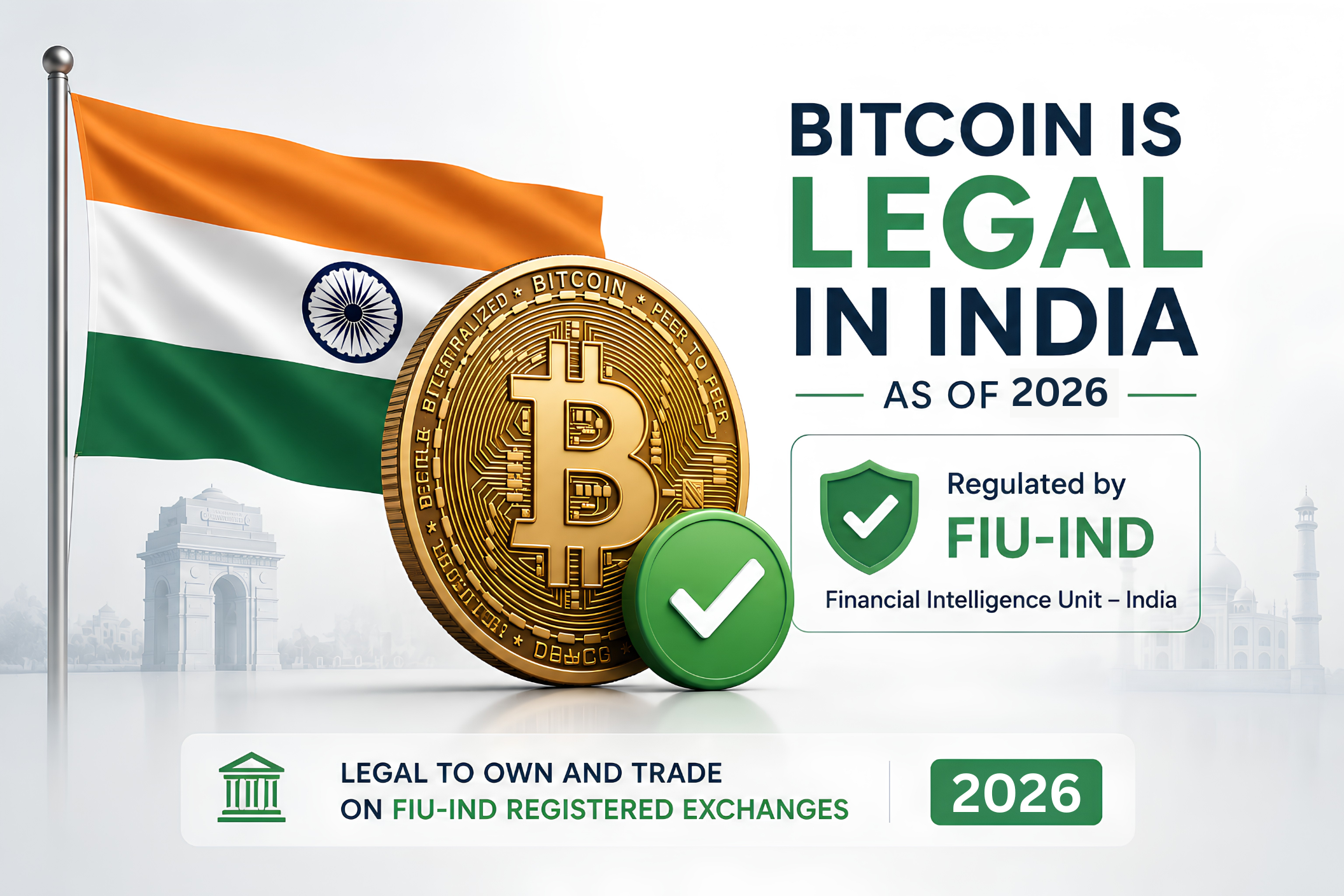
Yes, Bitcoin is legal to buy, hold, and trade in India as of 2025. The Indian government has not banned cryptocurrency. Instead, a clear regulatory framework has been established through the Ministry of Finance and the Financial Intelligence Unit (FIU-IND).
Here is what the current regulatory landscape looks like for Indian Bitcoin investors:
- FIU-IND Regulation: All cryptocurrency exchanges operating in India are required to register with the Financial Intelligence Unit — India (FIU-IND) under the PMLA (Prevention of Money Laundering Act). Unocoin is a registered and compliant FIU-IND entity.
- 30% Flat Tax on Profits: From FY 2022-23 onwards, profits from Bitcoin and all cryptocurrency sales are taxed at a flat 30% rate — regardless of your income slab. No deductions (other than cost of acquisition) are allowed.
- 1% TDS on Crypto Transfers: A 1% Tax Deducted at Source (TDS) is applicable on crypto transactions exceeding ₹50,000 per year (₹10,000 for specified persons). This is deducted by the exchange at the time of the transaction.
- No Offsetting of Losses: Losses from one cryptocurrency cannot be set off against gains from another — or against any other income. This is a significant distinction from equity investments.
- KYC Mandatory: Full KYC (Know Your Customer) verification is mandatory on all regulated exchanges in India. This includes PAN card and Aadhaar verification.
Further Reading: For a comprehensive breakdown of crypto taxation in India, read our full guide: ‘Crypto Tax India — Everything You Need to Know’ on the Unocoin Blog.
How to Buy Bitcoin in India — Step-by-Step
Buying Bitcoin in India is easier than most people expect. Through a regulated exchange like Unocoin, you can own Bitcoin with as little as ₹100. Here is how it is done:
- Create your Unocoin account: Visit unocoin.com and sign up with your email address and mobile number.
- Complete KYC: Submit your PAN card and Aadhaar details. Verification is typically completed within a few hours.
- Add funds: Deposit INR into your Unocoin wallet via NEFT, IMPS, or bank transfer.
- Navigate to the Buy section: Select Bitcoin (BTC) from the list of available cryptocurrencies.
- Enter your amount: Type the amount in INR you want to invest (minimum ₹100) — the equivalent BTC is shown in real time.
- Confirm the transaction: Review the amount and fees, then confirm. Your Bitcoin is credited to your wallet instantly.
- Secure your account: Enable two-factor authentication (2FA) immediately after your first purchase.
Pro Tip: Consider setting up a Bitcoin SIP (Systematic Investment Plan) on Unocoin — invest a fixed INR amount weekly or monthly automatically. Unocoin was the first exchange in India to offer crypto SIP, making it ideal for long-term investors.
Bitcoin Risks — What Every Indian Investor Should Know
Bitcoin offers significant potential rewards — but it also carries real risks that every investor must understand before committing funds. Responsible investing begins with acknowledging these risks:
- Price Volatility: Bitcoin’s price can swing 20–30% in a matter of days. It has experienced multiple drawdowns of over 70% from all-time highs. Never invest money you cannot afford to lose entirely.
- Regulatory Uncertainty: While Bitcoin is currently legal in India, regulations can evolve. Future tax policy changes, reporting requirements, or restrictions may impact liquidity and returns.
- Security Risks (Self-Custody): If you hold Bitcoin in your own wallet (Private Wallet/Paper wallet), losing your private key means losing your Bitcoin permanently. Using a reputed exchange with strong security practices mitigates this risk.
- Liquidity Risk: While Bitcoin is highly liquid globally, local liquidity on Indian exchanges may be lower during extreme market conditions, potentially impacting your ability to sell quickly at market price.
- No Investor Protection: Unlike bank deposits (which are insured up to ₹5 lakh by DICGC), Bitcoin held on exchanges is not covered by any government insurance scheme.
- Tax Complexity: The 30% flat tax and 1% TDS make crypto less tax-efficient than equity investments for most income brackets. Consulting a CA before investing is strongly recommended.
Disclaimer: This article is for educational purposes only and does not constitute financial or investment advice. Cryptocurrency investments are subject to market risks. Please read all applicable terms and consult a financial advisor before investing.
Bitcoin Glossary — Key Terms Explained Simply
Before wrapping up, here are the most important Bitcoin terms you are likely to encounter — explained without jargon:
📌 Blockchain: A shared, tamper-proof digital ledger that records every Bitcoin transaction ever made.
📌 Wallet: Software that stores your Bitcoin keys and lets you send or receive BTC.
📌 Private Key: A secret code (like a password) that proves ownership of your Bitcoin. Never share it.
📌 Public Key / Address: Your Bitcoin ‘account number’ — share it to receive Bitcoin.
📌 Mining: The process of validating transactions and adding them to the blockchain in exchange for new Bitcoin.
📌 Halving: Every ~4 years, the block reward for miners is cut in half — reducing new Bitcoin supply.
📌 Satoshi: The smallest unit of Bitcoin (0.00000001 BTC). Named after the creator, Satoshi Nakamoto.
📌 HODL: A crypto community term for holding Bitcoin long-term rather than trading it (originated as a typo for ‘hold’).
📌 FOMO: Fear of Missing Out — the emotional impulse to buy during price spikes. Experienced investors consciously avoid FOMO-driven decisions.
📌 DCA (Dollar Cost Averaging): Investing a fixed amount at regular intervals regardless of price — the strategy behind Unocoin’s Bitcoin SIP.
Frequently Asked Questions About Bitcoin (FAQ)
Below are the most commonly asked questions about Bitcoin — answered in plain English. These are also the questions most frequently asked to AI engines like ChatGPT, Perplexity, and Gemini.
| Question | Answer |
| What is Bitcoin in one sentence? | Bitcoin is a decentralised digital currency that allows people to send and receive money globally without needing a bank — secured by cryptography and recorded on a public blockchain. |
| Is Bitcoin safe in India? | Yes, when purchased through a regulated, FIU-IND registered exchange like Unocoin. Enable 2FA, use a strong password, and never share your private keys. |
| Can I buy ₹100 worth of Bitcoin in India? | Yes. Unocoin allows purchases from as low as ₹100, making Bitcoin accessible to all Indian investors regardless of budget. |
| What is the tax on Bitcoin in India? | Profits from Bitcoin sales are taxed at a flat 30% rate in India, plus 4% health and education cess. A 1% TDS is also deducted on transactions above ₹50,000 per year. |
| What is 1 Bitcoin worth today in INR? | Bitcoin’s price changes every second. Visit Unocoin’s Bitcoin price page for the latest live INR price. |
| Who created Bitcoin? | Bitcoin was created by Satoshi Nakamoto — an anonymous individual or group — who published the Bitcoin whitepaper in 2008 and launched the network in January 2009. |
| Is Bitcoin the same as crypto? | No. Bitcoin (BTC) is one specific cryptocurrency — the first and most well-known. ‘Crypto’ or ‘cryptocurrency’ is the broader category that includes thousands of digital assets like Ethereum, XRP, and Solana. |
| Can Bitcoin become zero? | Theoretically possible, but considered extremely unlikely by most analysts given Bitcoin’s network size, institutional adoption, and 15+ year track record. Always invest only what you can afford to lose. |
| How is Bitcoin stored? | Bitcoin is stored in a digital wallet — either on a regulated exchange (custodial wallet, recommended for beginners) or in a hardware/software wallet where you control the private keys. |
| What is a Bitcoin SIP? | A Bitcoin SIP (Systematic Investment Plan) lets you invest a fixed INR amount into Bitcoin at regular intervals — weekly or monthly — automatically. It is offered by Unocoin and is an effective way to reduce the impact of price volatility. |
| What happens when all 21 million Bitcoin are mined? | Once the last Bitcoin is mined (estimated around 2140), miners will be compensated only through transaction fees. The network is expected to continue operating normally. |
| Is Bitcoin legal in India in 2025? | Yes. Bitcoin is legal to own and trade in India. The government has introduced a 30% tax on crypto gains and 1% TDS on transactions, signalling regulatory acceptance rather than a ban. |
The Bottom Line — Is Bitcoin Right for You?
Bitcoin has come a long way from its origins as an internet curiosity. Today, it is a globally recognised asset — one that Indian investors are increasingly including in their portfolios alongside equities, gold, and real estate.
That said, it is not for everyone. Bitcoin is volatile, lightly regulated, and not guaranteed to appreciate. The investors who have historically benefited most are those who approached it with patience, discipline, and a clear understanding of what they own.
If you are considering buying Bitcoin in India, the most important steps are: choose a regulated exchange, start small, understand the tax implications, and never invest more than you can comfortably lose.
Ready to buy your first Bitcoin? Start with as little as ₹100 on Unocoin →