








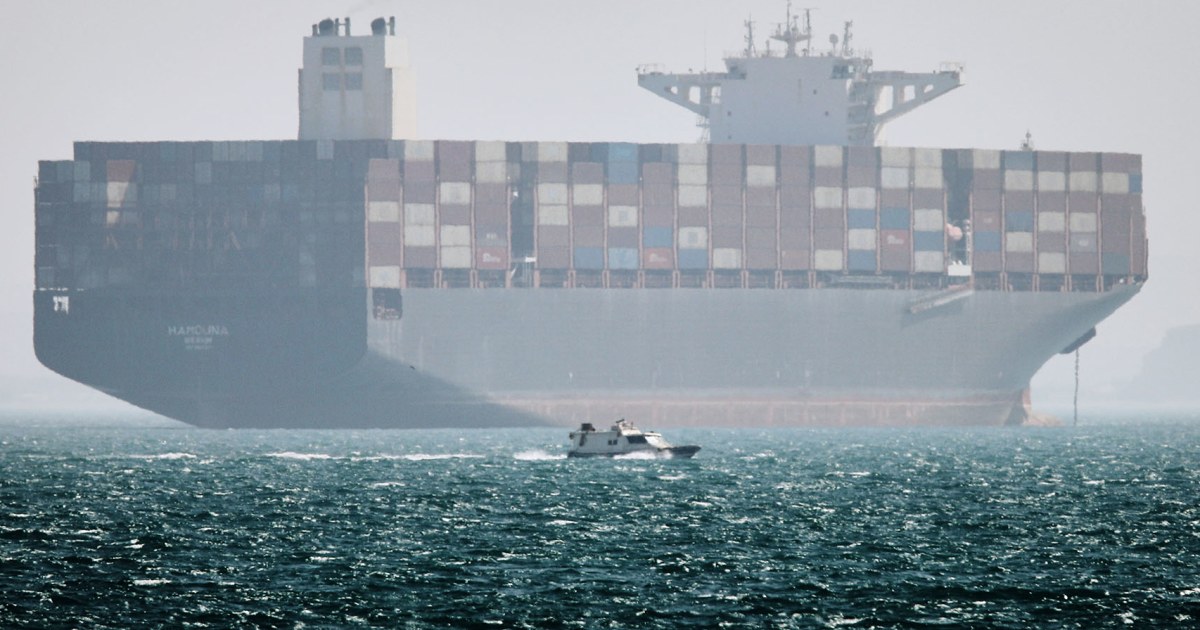
Ships in the Strait of Hormuz might be the only things that aren’t moving.
Subscribe to read this story ad-free
Get unlimited access to ad-free articles and exclusive content.

Even as markets surged on hopes of a deal between the U.S. and Iran after President Donald Trump’s latest dramatic reversal, shipping through the critical waterway remained effectively halted Wednesday and is unlikely to fully resume until there is long-term stability, industry figures told NBC News.
Hundreds of ships and their crews remain stranded, with operators unwilling to risk crossings amid the tense marine standoff between Tehran and Washington.
Trump had planned to use the U.S. military to guide ships that have been stuck in the strait for weeks under his “Project Freedom” initiative to break Tehran’s stranglehold on the key oil choke point, which has throttled international shipping and sent energy prices soaring.
The plug was pulled on the operation late Tuesday after less than 48 hours, however, with Trump citing progress in peace talks. Early Wednesday, markets were surging on an Axios report that the two sides were close to a one-page agreement to end the war and eventually reopen the strait.
Iran’s Parliament Speaker Mohammad Bagher Ghalibaf, who was the lead negotiator in talks with the U.S. last month, ridiculed the short-lived “Project Freedom” in a post on X on Wednesday.
“Operation Trust Me Bro failed,” he wrote in the post in English.
Trump told a gathering of reporters at the White House that “they want to make a deal badly. And we’ll see if we get there.”
Leading figures in the shipping industry told NBC News that until there is a long-term deal to end the uncertainty backed by specific guarantees, the traffic jam rattling the global economy will not be resolved.
“Changes announced at short notice or changes that are surprising, such as the sudden suspension of ‘Project Freedom,’ are a challenge for shipowners attempting to assess the risks and planning for leaving the Persian Gulf,” Jakob Larsen, chief safety and security officer with the Baltic and International Maritime Council (BIMCO), which counts more than 2,000 shipping companies among its members, said Wednesday.
Ship operators have been reluctant to allow their crews to transit given the risk of Iranian attack, and industry figures said for now at least they would err on the side of caution and not rush to change their risk assessments.
“Shipping decisions are ultimately driven by practical conditions on the water rather than political messaging alone,” Bjorn Hojgaard, the CEO of ship management company Anglo-Eastern Univan Group, told NBC News in an email Wednesday. “As a result, most prudent owners and operators are still likely to remain cautious until they see a more stable, predictable and sustained situation develop in practice.”

Tankers came under attack last month after a rapid shift in conditions that saw Iran initially declare the strait open under the ceasefire deal, only to close it again one day later, citing the U.S.-imposed blockade of its ports.
Hundreds of vessels and thousands of mariners are still stranded in and around the strait, where traffic had flowed freely for decades before the Iran war broke out. The chairman of the Joint Chiefs of Staff, Gen. Dan Caine, said Tuesday that 22,500 mariners were trapped in the strait on more than 1,550 commercial vessels.
Analysis by Lloyd’s List Intelligence, a maritime intelligence agency, showed Wednesday that transit volumes had dropped from 44 to 36 passages over the past week.
Crew morale, it said, has been badly hit by the crisis.
Secretary of State Marco Rubio called the trapped sailors “sitting ducks” who were starving and vulnerable. At least 10 sailors have died since the war began, he told reporters in Washington on Tuesday.
Global shipping giant Hapag-Lloyd told NBC News on Wednesday the strait remained closed for transit of its vessels. “The only certainty is the uncertainty,” company representative Hanja Maria Richter said in an email.
Larsen, with BIMCO, said the suspension of “Project Freedom” shortly after its launch came as a surprise, and while a few ships made it out safely, it was clear that transits without coordination with Iran entailed significant risk.
BIMCO’s members report that crews are coping mentally and practically with the situation, he added, and shipowners are still able to buy provisions and fuel locally, although at elevated prices.
“If there is demonstrable security in the transit route, if we get guarantees that it has been mine-cleared, then that should increase the confidence of ships, companies and particularly seafarers to take that route to get out of the Gulf,” said John Stawpert, marine principal director at the International Chamber of Shipping, the global trade association for shipowners and operators. “But we just don’t have that certainty at the moment. There are far too many unknowns.”
Any deal would have to include a commitment by Tehran not to attack civilian ships and a military protection mechanism that would reassure the shipping industry that the strait’s waters are free of mines, with a rapid reaction force in place, said maritime security expert and author Christian Bueger.
“What we need is a long-term agreement of how maritime security in the strait will be governed, because otherwise we might be back to the same situation in three years or five years,” he added.
Some ship companies willing to take risks will start moving their vessels through the strait quickly once a deal is announced, but it may take months, if not years, to return to the prewar flow of traffic through the strait, Bueger said.
“That will happen gradually, and it highly depends on the risk assessments of the shipping companies, because they make the decisions and have to consult with their crews about whether they are willing to take the risk,” he added. “So we are looking at a gradual and staged reopening.”
The instability around the strait was highlighted Wednesday after U.S. Central Command announced on X that it had disabled an “Iranian-flagged unladen oil tanker.”
“U.S. Central Command (CENTCOM) forces observed M/T Hasna as it transited international waters enroute to an Iranian port on the Gulf of Oman. American forces issued multiple warnings and informed the Iranian-flagged vessel it was in violation of the U.S. blockade,” CENTCOM said.
“After Hasna’s crew failed to comply with repeated warnings, U.S. forces disabled the tanker’s rudder by firing several rounds from the 20mm cannon gun of a U.S. Navy F/A-18 Super Hornet launched from USS Abraham Lincoln (CVN 72). Hasna is no longer transiting to Iran.”