








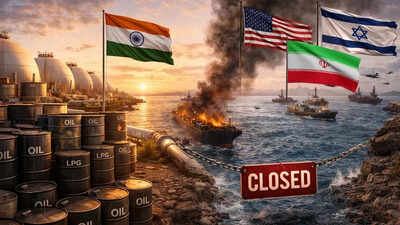
India is among the top five world economies and its energy security is of paramount importance. The ongoing US-Israel-Iran war has caused disruptions in global oil, gas and trading shipments, especially with the closure of the Strait of Hormuz. The government has indicated that India is in a comfortable position. Oil minister Hardeep Singh Puri has said that India has sufficient energy reserves to deal with the ongoing situation. Also, a close watch is being kept on the global energy market to make sure that India gets uninterrupted supplies.But, India’s position carries inherent pressure points given that the country imports roughly 90% of its crude requirement, with around 45–50% sourced from the Middle East. While near-term buffers exist through strategic petroleum reserves and commercial inventories, this high external dependence makes India structurally sensitive to disruptions in Gulf flows, says Sumit Ritolia, Lead Research Analyst, Refining and Modelling at Kpler.
India’s Oil Dependency on Middle East & Strait of Hormuz
Estimates from experts on India’s dependency on Middle East and the Strait of Hormuz peg it at 50% of India’s oil imports.Sourav Mitra, Partner, Oil and Gas, Grant Thornton Bharat notes that in the last five years, India’s oil import strategy has taken a pragmatic stance via diversifying its supplier base. Post Russia’s invasion of Ukraine, India’s crude oil basket shifted from Middle East dominance to Russia. “In the last few months, oil supplies from the Middle East have increased and vary between 45-50% of total imports as Indian refiners look to trim Russian oil purchases following US sanction,” he tells TOI.
How much oil reserves does India have? What’s the buffer?
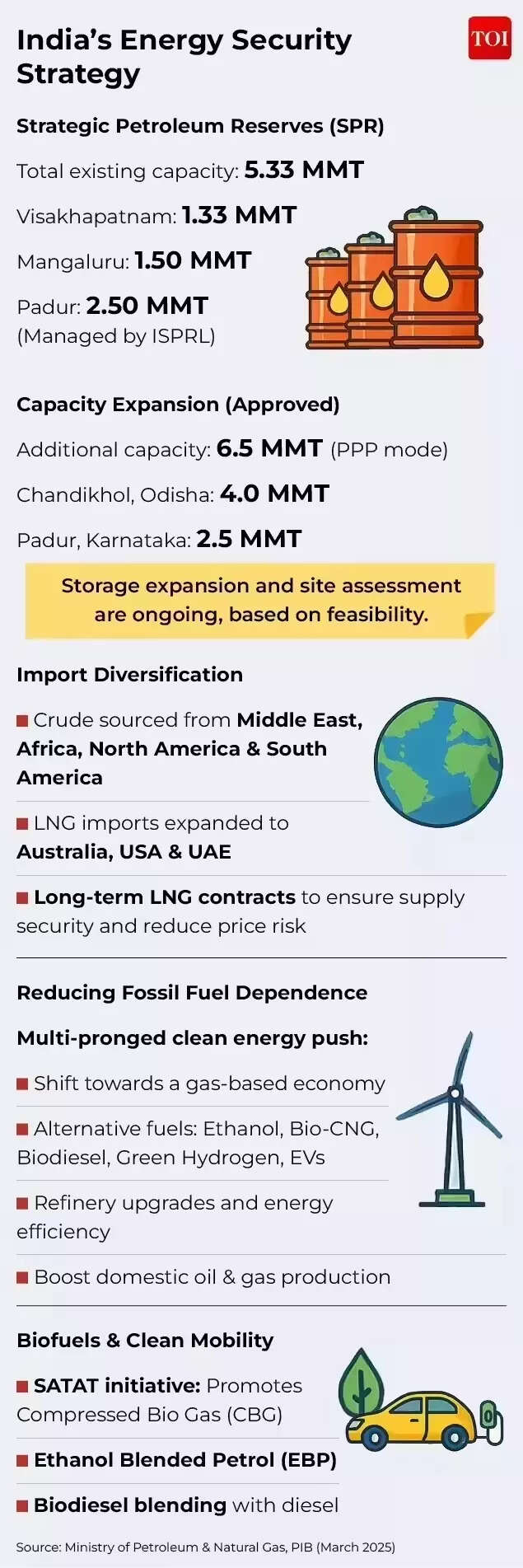
According to an ANI report quoting government sources, at present India has around 8 weeks of crude oil and petroleum products inventory. This includes India’s strategic reserves. Sources quoted in the reports said that India has 25 days of crude oil inventory and 25 days of petrol and diesel inventory.
Experts says India’s near-term supply looks secure, but there are inherent risks in the system due to the large dependence on imports. India’s strategy to diversify its crude oil supplier base, along with its crude oil import cover, has allowed itself to mitigate geopolitical disruptions, they say.India maintains strategic petroleum reserves alongside commercial inventories held by refiners and oil marketing companies. These buffers are intended to manage temporary supply shocks rather than sustained outages. Based on Kpler inventory data, commercial crude stocks are around 100 million barrels, including volumes in the SPR facilities at Mangalore, Padur and Visakhapatnam.
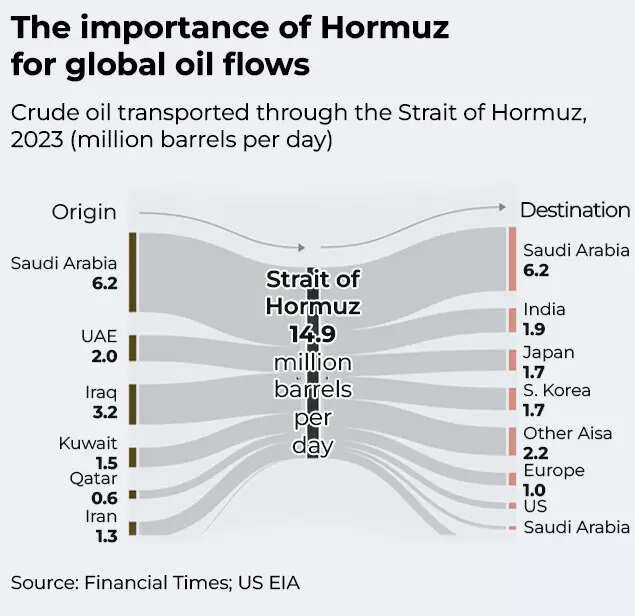
“With imports via the Strait of Hormuz averaging roughly 2.5 mbd – about half of India’s approximately 5 mbd total crude imports – these combined reserves could theoretically cover around 40–45 days of imports in a crude disruption scenario. Additional refined product inventories would extend effective coverage further,” says Sumit Ritolia.However, compared with China, India’s strategic reserves are smaller both in absolute terms and relative to consumption, as China has built significantly larger emergency stockpiles over the past decade. Some reports peg China’s strategic reserves at around 3 months. “Though China doesn’t disclose data around strategic reserves, they are estimated to be about three months of the country’s demand,” says Sourav Mitra.
What are the alternatives to Middle East Crude?
Let’s look at a worst case scenario now: What happens if the oil supplies via the Strait of Hormuz completely stop for some time? Where will India get its oil from?Considering that India’s nearly 50% of oil import (2.6 million barrels per day) passes through the Strait of Hormuz; its closure will have a significant impact on India’s oil supply.India had already ramped up crude oil purchase from non-Russian sources including the US, Canada, West Africa, and Latin America due to mounting US pressure against India’s Russian oil purchase. But it’s important to understand that India’s crude oil procurement basket is diversified with over 40 countries acting as suppliers. According to Sourav Mitra of Grant Thornton Bharat, India can look to augment supplies from these sources and even increase purchase of Russian Urals if the tension on West Asia prolongates.Additionally, India also plans to secure crude through the Saudi East-West (to the Red Sea) and Abu Dhabi Crude Oil Pipeline (to Fujairah) to bypass the Strait of Hormuz.Kpler’s Sumit Ritolia says that if Middle East crude supply were to stop completely for a temporary period, the immediate impact would be logistical and price-driven, creating crude supply risks if movement through Hormuz is disrupted for a longer period. India sources a significant share of its crude from the Gulf, so prompt cargo liftings would be affected first. However, refiners typically hold commercial inventories, and cargoes already on water would continue to arrive. The system would have some short-term cushioning, he says.As an alternative, India can increase procurement from the Atlantic Basin – including the US, Brazil, Canada, Mexico and West Africa – though these barrels involve longer voyage times and higher freight exposure. According to Ritolia, Russian crude also remains commercially viable depending on policy and payment channels. “Russian cargoes currently floating in the Arabian Sea and wider Asian region without firm buyers could be absorbed relatively quickly if required,” he says.At present, India continues to get Russian oil as per previous contracts.“The key constraint is not global supply availability, but voyage duration, tanker availability, risk premiums, and insurance issues. Replacing Gulf barrels is possible, but it comes at a higher landed cost and with logistical delays,” says Ritolia.
Crude Oil Bill To Balloon?
So, if India were to increase crude procurement from alternative sources, how much would its crude bill rise?If the Strait of Hormuz were disrupted or shipping were forced onto longer routes for a a prolonged period, India’s crude import bill would rise meaningfully. Even without a full blockade, higher freight, war-risk insurance and geopolitical premiums would lift landed costs. Sehul Bhatt, Director at Crisil Intelligence tells TOI, “Around 45-50% of India’s annual crude oil procurement is from the Middle East because of proximity, established trade partnerships and relatively competitive shipping costs. However, the past three fiscals had seen the share of oil imports from the region declining as Russia opportunistically offered highly discounted crude. While worries about blockade of the crucial Strait of Hormuz abound because of ongoing uncertainties, an extended closure appears unlikely at this juncture.”
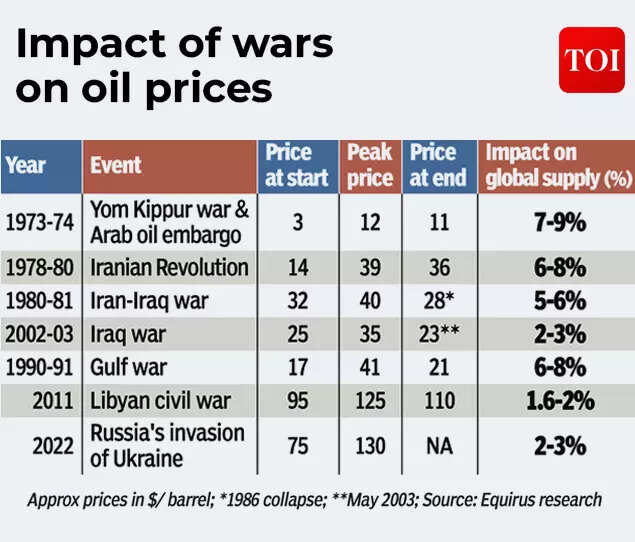
“If indeed there is a prolonged disruption, oil tankers will have to be rerouted via the Cape of Good Hope on the horn of Africa. That will lengthen transit times, and increase shipping costs and insurance premiums that, in turn, will cull the margins of importers and bloat India’s oil import bill,” he says.Sourav Mitra of Grant Thornton Bharat explains that the alternative routes to the Strait of Hormuz involve voyages of more than 25 days as compared to about seven days for Middle East supplies. Hence, supplies from alternative sources will add on to the landing cost for importers due to freight and insurance costs.A $1 increase in crude oil prices can add close to $2 Billion in India’s crude oil import bill on an annualized basis, assuming India’s current run rate of about 5-5.5 million bpd, he says.However, as Ritolia points out: refinery margins may remain relatively supported, particularly for complex refiners, as middle distillate cracks tend to strengthen during supply uncertainty. In such an environment, gross refining margins could find support from strong diesel and jet demand, partially offsetting higher crude input costs.Ritolia says that the worst-case scenario would involve a prolonged and severe disruption to Hormuz flows combined with sustained geopolitical escalation. In that case, crude prices would spike sharply, freight markets would tighten, and refiners could eventually be forced to trim runs if replacement barrels are delayed. “However, such a scenario would have major global economic consequences, making it a low-probability but high-impact risk,” he says.To sum it up: the near-term risk is primarily price volatility and higher import costs rather than immediate physical shortage. India has diversification options and inventory buffers, but sustained disruption would materially increase the import bill and create macroeconomic pressures.
LPG and LNG Disruption Threat
Energy security is not just about crude oil, petrol and diesel inventory. India is also a major exporter of LPG and LNG. According to Global Trade Research Initiative, in 2025, nearly 50% of India’s LNG imports, and over 85% of LPG imports, transited through the Strait of Hormuz.“India imports ~80–85% of its LPG needs, with the majority sourced from Gulf suppliers – almost entirely transiting Hormuz. Unlike crude, India does not maintain strategic LPG reserves of comparable scale, making LPG flows more logistically sensitive in a disruption scenario,” says Sumit Ritolia.“Crude flows can be buffered through strategic petroleum reserves, commercial stocks and Russian optionality. LPG, however, has thinner structural buffers,” he adds.Sources quoted in an ANI report have said that India is in a comfortable position with respect to LPG and LNG supplies as well. Reports have suggested that India is looking at some alternative sources for importing crude oil, LPG and LNG.