








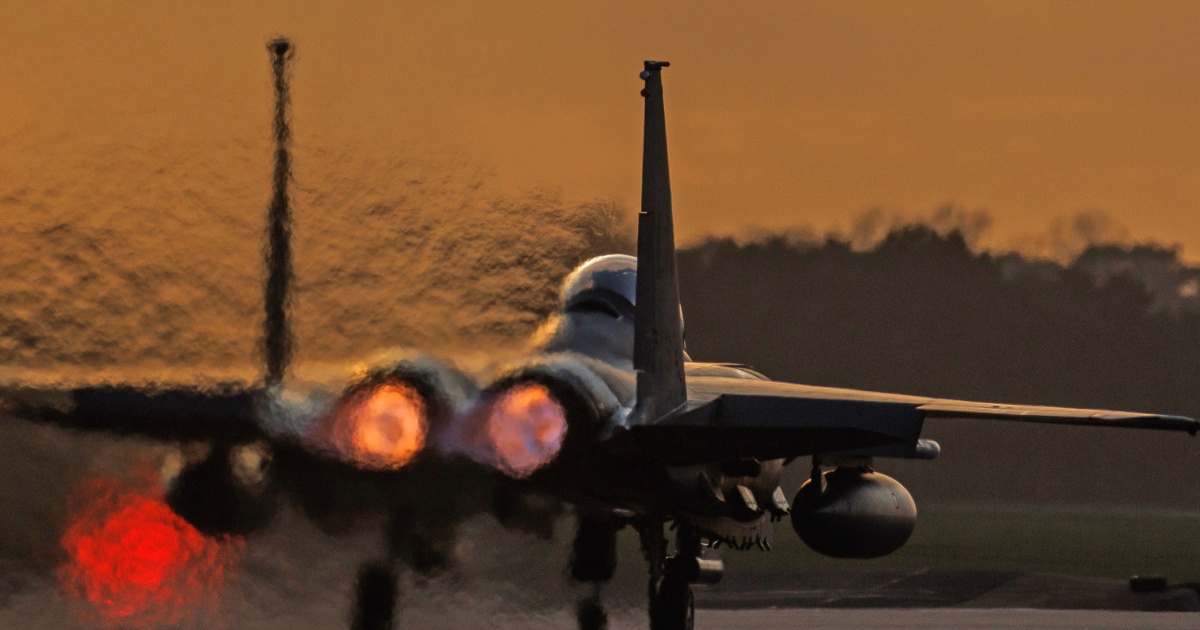
WASHINGTON — Less than 48 hours after President Donald Trump told Americans the U.S. military had “beaten and completely decimated Iran,” Tehran shot down an F-15E fighter jet, setting off a high-risk scramble by U.S. forces to rescue two service members from deep inside Iranian territory. Iran also struck two Blackhawk helicopters and an attack jet that were assisting in the search and rescue effort.
Subscribe to read this story ad-free
Get unlimited access to ad-free articles and exclusive content.

The harrowing incidents have put in stark relief a growing challenge facing the president as the war enters its second month: Despite a daily bombing campaign and his triumphant wartime narrative, Iran retains enough military capabilities to inflict considerable damage to U.S. service members and America’s allies and assets in the Middle East.
“They have no anti-aircraft equipment,” Trump said of Iran in his address this week. “Their radar is 100% annihilated. We are unstoppable as a military force.”
Roughly half of Iran’s ballistic missile launchers are still intact and thousands of one-way attack drones remain in its arsenal, according to a U.S. official and a person briefed on the matter. Multiple missile stockpiles buried underground in Iran also remain undamaged, the sources said. And, they said, Iran still can launch missiles at ships transiting waterways across the region.
“Even at the rates at which they’re firing things now, they’re going to be able to sustain it for awhile,” Kelly Grieco, a senior fellow at the foreign affairs think tank Stimson Center, said of the Iranians. She said Iran also is getting better at hiding the weaponry it has.
Iran’s attack on the F-15E on Friday was the first time in decades that a U.S. fighter jet had been downed by enemy fire. One of the service members was rescued, while the U.S. military searched for the other. There were minor injuries to U.S. forces on the Blackhawk helicopter, and the pilot of the attack aircraft, an A-10 Thunderbolt, safely ejected over Kuwaiti airspace, according to a U.S. official.
But the developments marked a potential turning point in the war for Americans, as the White House’s account of how the war is going — emphasizing the U.S. military successes and downplaying the threat Iran still poses — is in conflict with its grim realities. A senior White House official said Trump gathered his national security team at the White House on Friday evening to monitor the ongoing events.
A spokesperson for the White House did not immediately respond to a request for comment.
Earlier this week, the White House had assured Americans that Iran no longer controlled the airspace over its country. “U.S. and Israeli joint forces control the skies and have asserted air dominance over Iran,” White House press secretary Karoline Leavitt said on Monday.
Yet since Trump’s prime-time address to the nation on Wednesday — where he extolled the “swift, decisive, overwhelming victories on the battlefield” — Iran has launched at least 50 ballistic missiles and more than 150 drones targeting the U.S. and its allies across the Middle East, according to a tally compiled by NBC News.
At least 16 U.S. Reaper drones have been downed since the start of the war, including two this week, the U.S. official said.
Trump has also argued the Iranian regime has been killed off and a more sympathetic one that’s holding diplomatic talks with his administration to end the war is in power. The president has sent mixed signals about how and when the conflict may end, while gas prices continue to rise because of Tehran’s ability to choke off the flow of oil through the Strait of Hormuz with its drone and other low-cost weapons. Trump told NBC News on Friday that talks with Iran would not be affected by the downing of the F-15E.
Iran, though, says there are no direct talks. And the U.S. has no indication that Iran’s authoritarian government has lost its grip on power or that successors to assassinated leaders have made a break with the Islamic Republic’s hard-line anti-Israel, anti-U.S. stance, according to multiple Western officials, U.S. intelligence assessments and regional analysts. The Iranians who have replaced senior leaders are known as equally hard-line or arguably even more militant than their predecessors, the sources say.
It has been difficult to independently quantify the status of the war, including the level of U.S. military success, in part because there is little public information made available by the Trump administration. The U.S. has released generalized data and videos about targets or missiles launched, and no independent news media is embedded with American forces as has been the case in past conflicts.
Gen. Dan Caine, the chairman of the Joint Chiefs of Staff, has said the U.S. has superiority of the airspace over parts of western and southern Iran, but not yet to the east. Grieco, the fellow at the Stimson Center, said the U.S. does not have superiority in the east, and Iran has seized on its ability to inflict harm on the U.S. and prolong the conflict through asymmetric warfare, including with drones, hidden missile launchers, sea mines and small attack boats used in the Strait of Hormuz.
The Iranians “still have capability and capacity, and the real question for me is, what’s the potential for what they can do with that capability and capacity that they do have?” she said. “What we’re seeing is asymmetric warfare playing out in the air and maritime space.”
Iranian media on Friday published photos alongside claims from the Islamic Revolutionary Guard Corps that it had shot down the F-15E. Iran’s parliament Speaker Mohammad-Bagher Ghalibaf later trolled Trump in a post on X.
“After defeating Iran 37 times in a row, this brilliant no-strategy war they started has now been downgraded from ‘regime change’ to ‘Hey! Can anyone find our pilots? Please?’ Wow. What incredible progress. Absolute geniuses.” One service member remains missing.
Trump is finding the U.S. is increasingly isolated, as allies stand by and refuse to engage in a war they were not consulted about joining before it was underway.
Trump ramped up his attacks on European allies this week, deriding NATO members’ refusal to show “courage” and lead in clearing the Straight of Hormuz. He’s also angry that the United Kingdom, France and Spain have not allowed the U.S. unfettered access to their airspace and military bases for attacks on Iran. NATO’s secretary-general was heading to the White House next week.